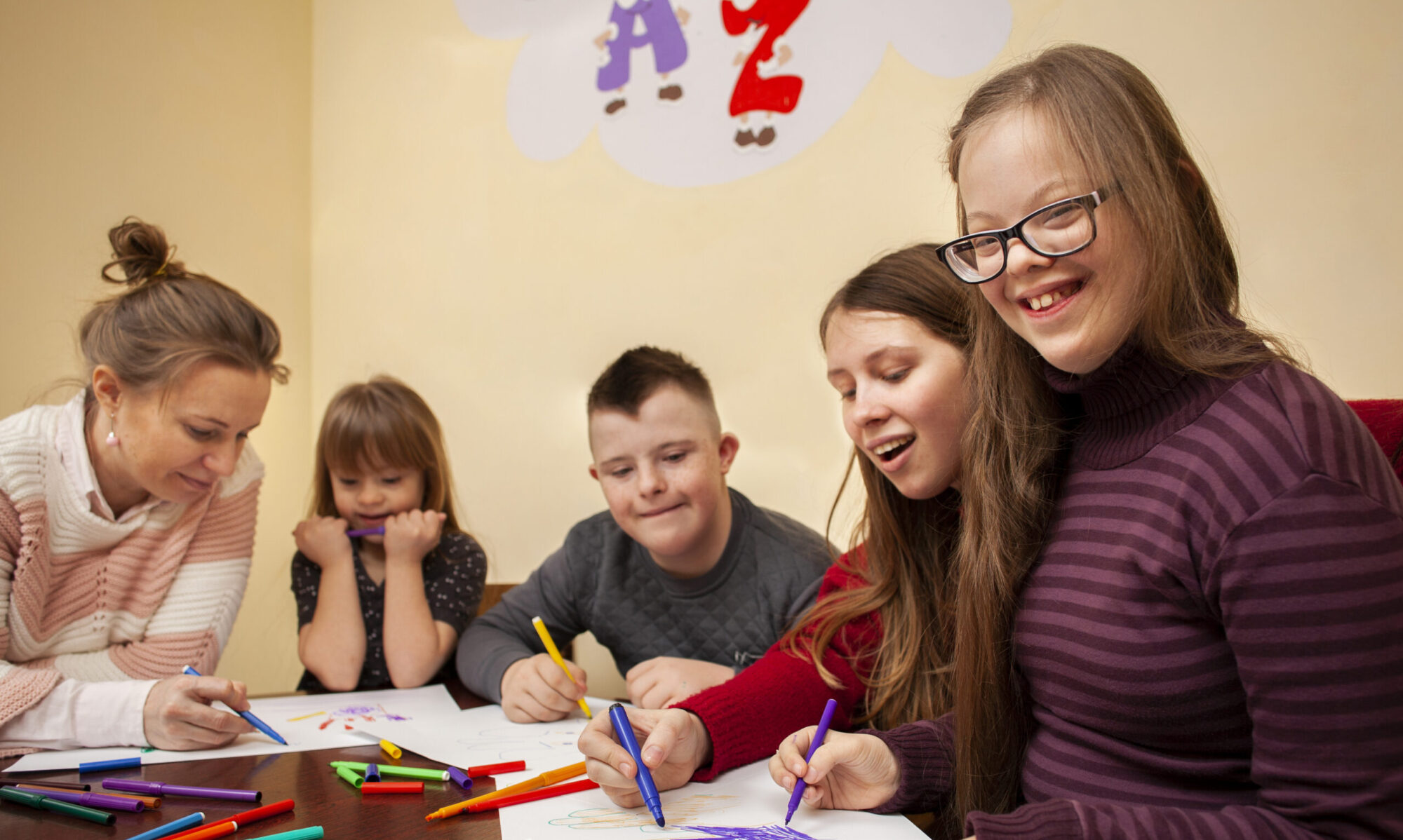
5 Reasons We Love Inclusive Teachers

When we think back to our favorite teacher it’s often not what the person said or did that we remember, but how that person made us feel. The best teachers lift us up, show us our worth, and make space for us to truly belong. For Teacher Appreciation Week, we want to lift up and show our gratitude to inclusive teachers. Those that go out of their way to do the hard work of including all learners together.

What Makes a Teacher Inclusive?

  1. Inclusive Teachers are explicit about belonging. So, you successfully advocated for your child to be in the regular classroom for most of the day, but when you visit your child at school it seems he/she is like an island in the classroom. Your child doesn’t have their name on a desk, their classmates don’t know them, and the general education teacher ignores them. Parents realize that getting into a regular classroom doesn’t always equate to meaningful inclusion. That’s why parents are always so grateful when an inclusive teacher clearly defines meaningful inclusion in their classroom. Little things like explicitly modeling how to include a student with a disability, creating a physical space that shouts “You belong here” assigning peer models, not grouping by ability, using a paraeducator to support all students and the teacher, and social-emotional curriculum can go a long way to create a space of belonging and inclusion.

2. Inclusive Teachers have a Growth Mindset. Let’s be honest. Colleges of Education do not teach special education law and research to special education teachers, let alone general education teachers. I have a Master’s in Secondary Education and only took one class on teaching students with disabilities. So it’s always incredible when I meet a regular or special education teacher or paraeducator who has an open mind and is willing to relearn teaching strategies that will be effective for all learners. Teachers with a growth mindset take responsibility for improving their teaching practices and see setbacks and feedback as an opportunity to grow their skills. These types of teachers also have high expectations for all learners, and actively seek out new challenges.

Related Blog Post: Back To School Guide for Inclusive Education

3. Inclusive Teachers make time for UDL. Universal Design for Learning (UDL) is supported by research and the law. It’s a teaching approach that works to accommodate the needs and abilities of all learners and eliminates unnecessary hurdles in the learning process. It’s also the most effective way to include even students with the most significant disability in the regular classroom. Inclusive teachers know worksheets and direct teaching are the least impactful way to reach any student. They get that teachers should never teach just one way, and learners don’t need to show what they learned just one way. Inclusive teachers always make the least dangerous assumption and believe that all learners deserve the chance to show what they know and can do.

4. Inclusive Teachers build relationships. The best teachers care deeply about all their students, even and especially the “hard” students. Inclusive teachers know that all students do well when they can, and building a bond with their students is the best way to motivate all learners. When was the last time you wanted to work for a rude or disrespectful boss? Never! We’d leave, but we expect kids to just suck it up when it comes to dealing with rude or disrespectful teachers. Inclusive teachers understand the power of relationships and create a safe space for learners to belong.

Related Blog Post: 7 New Research Studies to Win the Fight for Inclusion

5. Inclusive Teachers expose students to culturally relevant material. We currently live in a world where many teachers are afraid to teach culturally relevant material that speaks to a student’s lived experience as a disabled person, a person of color, or non-gender confirming, etc. It takes courage and moxy to go against the current political trend and explicitly honor a child’s true self. Inclusive teachers know that a child with a disability is going to perform higher and be more engaged if they see someone like themselves in a lesson plan. Nondisabled peers are going to broaden their perspective of the human condition and will be more likely to treat their disabled peers as equals when they understand the history of the disability community and our fight for inclusion. Inclusive teachers create advocates for change and inclusion. And those students will one day be doctors, lawyers, and teachers themselves who will remember what they learned and will hopefully include a person with a disability in their work, home, and community.

Thank you to the inclusive teachers of the world that have opened their hearts and shaped the future into a more inclusive place for us all. We appreciate and celebrate you!

Back To School Parent-To Parent-Guide To Inclusion

It’s that time of year. Back to school shopping, first day of school social media posts, and well planned out lunches. But if you’re a parent to a child with a disability, you have the added anxiety of IEP meetings, checking in to see if your child and his teacher have all the needed supports, and wondering if your child will be meaningfully included.

Start the school year right by sharing information about your child, as well as what inclusion means to you. Being intentional about disability acceptance could be the key to friendships with typical peers in the general education classroom. Parents of typically developing classmates may not know what to say to their child about your child’s differences. They may even be apprehensive about having a child with a significant disability in their child’s class.

Dispelling any myths and educating parents about the benefits of inclusion is a great way to start out the school year.

I got you covered. Below is a parent-to-parent guide that you can print and share. Also included are tips to create your own customized “all about me” page highlighting your child.

Read Related Post: 3 Words That Will Transform Your Child’s IEP Meeting

I suggest you wait until the second or third week of school to share these resources with classmates’ parents. You want parents to spend time with these documents, and too much information is sent home at the start of the school year. This is a conglomerate of information I’ve seen and learned over the years as a non-attorney special education advocate. Feel free to print and share the PDF version below:

Read Related Post: Promoting Inclusion through Universal Design for Learning

If you’re looking for an easy way to create a customizable “All About Me” page look no further than www.canva.com. Canva’s image-driven bold templates are sure to catch anyone’s attention. Check out the one I made for my son a few years ago:

Added Bonus: I have my son hand-deliver this to teachers during the first IEP meeting or Back to School Night before school begins. He also shares his most current work. This gives teachers a glimpse of a highly-capable student, instead of the weakness-based legal documents they’re used to reading about students.

How do you introduce your child and the idea of inclusion to teacher and classmates? Share any resources in the comments section below.

5 Tips for Including Students with Down Syndrome in a General Education Classroom

Having your student with Down syndrome included in the general education classroom with proper supports can often seem like a pipe dream. Just look at the statistics: only 16% of our loved ones with intellectual disabilities (ID) are included in general education classrooms most of their school day.

But the research and federal law back up full inclusion with support, so how do we get there? Well, I was lucky enough to find inclusion expert, Nicole Eredics from The Inclusive Class. This amazing inclusion teacher has created a huge database of resources to support full inclusion for even students with Down syndrome. You can also buy her book (shown below) with over 40 modifications for students with the most significant needs.

Read Related Post Here: $10 MillIion Dollar Grant Awarded to Support Inclusion for Students with Significant Cognitive Disabilities 

Nicole Eredics moved to California from British Columbia, where she started her career in teaching. “In British Columbia the system is set up for mandatory inclusion. That’s the norm. All teachers were trained how to include every type of learner in their classroom. We all co-taught, and inclusion never happened in isolation. I was shocked by the lack of support for inclusion when I moved to the states,” Eredics says.

From this stark difference, The Inclusive Class blog was born. Eredics uses webinars, research-based evidence, podcasts and loads of resources to teach parents and teachers how to successfully include all learners. She says students with Down syndrome can in fact be included, but that child needs a lot of support. “You can’t place a child with an intellectual disability with same age peers if you’re not getting any support,” Eredics explains.

5 Tips From the Inclusive Class To Help Support Inclusion for Students with Down Syndrome: 

  1. Show your child’s school what successful inclusion looks like.

    “When inclusion isn’t the standard, the parent is going to have to be on the ground making it happen,” Eredics explains. Get to know the school climate, the principal, staff, and teachers. Share the video below with your child’s school, and watch more examples of what inclusion looks like here. Sometimes seeing is believing.

2. Teach the team about your child. 

“You know your child best, so show the school what he’s capable of doing,” explains Eredics. This should include describing in detail your child’s strengths, weaknesses, wants and needs. Check out the one-page bio of Troy. A fellow rockin’ mom was the original creator of this idea. Go here if you want to create one.

Eredics says videos are also helpful. Show your child interacting with peers, doing a favorite activity, mastering a skill. “Many teachers are fearful of how a student with an intellectual disability will impact their classroom. It’s important to  facilitate and encourage a strong relationship with the school, where they feel comfortable asking you about your child,” Eredics says.

Read Related Post Here: 3 Steps to Prepare for Your Child’s Next IEP Meeting

3. Demand that your students with Down syndrome gets the support he needs.

Eredics says students with intellectual disabilities obviously needs a well-planned IEP, but more important parents should ensure the IEP is being carried out with fidelity and that the student has  one-on-one support.

“The child is either going to need a paraprofessional to help facilitate the physical participation in the classroom or the class should be co-taught. I have never seen a student with ID successfully taught without the support of one of those teaching methods,” Eredics describes.

4. Ensure your child has appropriate accommodations and modifications.

Just as important as a paraprofessional or co-teaching method, is appropriate accommodations and modifications. There is a difference, and both are needed. “Accommodations are the pathways to learning like eyeglasses to see, a special pencil grip to write, or an audio book to read along,” Eredics explains.

Modifications may also be needed for students with Down syndrome, because it allows them to access grade-appropriate curriculum at their level. “They’re still learning the same content, but learning expectations are different. Content can be simplified, or the child can learn one aspect of the material. Alternative assessments and eventually alternate diplomas fall under modifications,” says Eredics. Click here to get more details about accommodations and modifications.

Eredics says it may also be helpful for parents to help create modifications. “There was never an expectation that the parent must do more at home, but we also were glad to work with parents that wanted to help. Request the textbook, curriculum, and lesson plans ahead of time,” says Eredics. Many states have actually modified the Common Core for students with the most significant cognitive disabilities, and many teachers don’t even know about this resource. Click here to get the Essential Elements.

Read Related Post Here: Promoting Inclusion through Universal Design for Learning 

5. Get teacher buy-in!

Eredics says the biggest barrier to inclusion for students with Down syndrome is the teacher. “If you have a teacher who’s not willing and resistant, inclusion will never work. The teacher is not only responsible for academics, but also the social aspect of the classroom. They create a community and set the tone. If the teacher is excluding the student, it doesn’t matter how much you advocate. Even though you have the law on your side, it really comes down to that teacher’s personality. Over the years, talking to people this is the #1 problem. Point blank,” she says.

Eredics encourages parents to volunteer in their child’s school and start learning who the teachers are in higher grades. Request teachers who seem to have heart and an open-mind. Start the inclusion conversation before they even begin school. And don’t be afraid to request a change of teacher if your child is being excluded.

Nicole Eredics’s book for parents and teachers called Inclusion in Action: Practical Strategies to Modify Your Curriculum will be available next month. “The book includes specific modifications for students who have intellectual disabilities,” says Eredics. Stay tuned for more information and a book review.

Check out her website here: www.theinclusiveclass.com 

Is your child with Down syndrome included in a general education classroom? What has been the biggest reward and challenge? I’d love to hear about your experiences. Comment below.

Accommodations vs. Modifications in Kindergarten

Everything is still possible in kindergarten, even for students with significant disabilities. Inclusion should come naturally, because all the students enter kindergarten at different levels. With the use of accommodations that changes “how” students with disabilities learn, many students with intellectual disabilities can meet the same kindergarten standards.

Still, expectations have changed a lot since I was in kindergarten 30 years ago. Writing journals, addition math problems, and mandatory reading levels are an actual thing now. I’m blown away by the standards kindergarteners must meet.

Read Related Post: Inclusion Must Start in Preschool

Thinking about how my son with Down syndrome would meet these new, rigorous standards made me nervous. I knew accommodations could help him access the kindergarten curriculum, but would he also need modifications to change what he’s taught and is expected to learn? Using modifications should never legally lead to a more segregated setting, but I knew from other family’s stories across the nation that often it does.

Ultimately, understanding my son’s potential, setting high expectations, and presuming competence helped guide his kindergarten year.

With three years of preschool under his belt, we decided to start the school year with only accommodations to allow our son to meet the same grade-level expectations as all the other kindergarteners. With so many students at different levels in his general education classroom, he often knew just as much as the majority of students in his class. Every family has to make their own choice about changing the grade-level content to meet their child’s needs. I’m an advocate of giving the student a chance to perform to grade-level standards with accommodations first, then moving on to modifications if needed.

My twin boys, who are in the same general education class do the same work, but their different ability levels are obvious. I admit that I compare the work that they bring home, and have been proud of how much individual progress both of them have made. Below you can compare a typical assignment they do each day.

Although my twin boys learn the same content, accommodations do change how my son with Down syndrome accesses that content. Here are his kindergarten accommodations:

  • paraprofessional
  • slant board
  • short writing utensils
  • foot rest
  • large font
  • less content on each page
  • more time to work on assignments and tests
  • Accept approximations for expressive assessments
  • Accept pointing to an answer rather than expressively saying an answer
  • visual cues and prompts
  • number line
  • sit near the instruction
  • visual timer
  • tablet with touch screen
  • small, one-click mouse

If the first semester of kindergarten was smooth sailing, the second half has tip the boat a bit. The few students who were behind my son have caught up in most areas. Some concepts, like “more or less” in math have been difficult for my son to pick up without a lot of concrete examples. Still, I’m glad I started with just accommodations. It gave me time to feel out the IEP team and kindergarten curriculum to see what was possible.

Read Related Post: 5 Tips for Including Students with Down Syndrome in General Education Classroom

I learned that my son’s IEP team members would not use modified IEP goals as an excuse to pull him out of general education. They’ve agreed to push all resources into general education so far. That gives me more confidence to define how the content may change to meet his level. For example, because my son had difficulty counting to 100 expressively, the team created an IEP goal to start by counting to 30 by ones and 100 by tens. He can also point to numbers that he has a hard time saying expressively.

As my son goes into first grade, I know modifications to the curriculum will be an important way for my son to continue accessing the grade-level content at his level. Modifications allow students who are far behind their classmates to access the grade-level curriculum at their own level, or can change the grade-level curriculum completely. 

Some great resources to help create appropriate modifications include’s Nicole Eredic’s new book “Inclusion In Action” with over 40 modifications for students with the most significant needs. Paula Kluth’s book “Universal Design Daily: 365 Ways to Teach, Support, and Challenge All Learners” is also a great gift to give your child’s general education teacher and will help all the students in the class.


On social media, join the “Educational Strategies for Students with Down Syndrome” page. Parents often share modified content that works. You can also follow Nicole Eredic’s Live Binder page that has specific modified assignments being added all the time. Click here to find it.

What accommodations or modifications does your student use that helps them access the grade-level content? Share any resources that you have in the comments section.

Misconceptions about the Least Restrictive Environment

Here’s a refrain we hear all too often in special education:

“Johnny’s LRE is the Autism Program. This program is 30 minutes away from his home school and is separate from the general education classroom, but Johnny has Autism so this really is the best program in the least restrictive environment for him.”

This statement can be heard in IEP meetings, found in blog posts, even written in scholarly articles. But the Individuals with Disabilities Education Act (IDEA) and case law dispels the myth that the Least Restrictive Environment (LRE) is individualized or unique for each child. It is not. I repeat, the LRE is not individualized. Yes, the Individualized Education Plan (IEP) is individualized. Yes, the decision of a Free and Appropriate Education (FAPE) is individualized, but the LRE is a place…and it’s only one place: A REGULAR CLASSROOM.

The misuse of the LRE has led to the systematic segregation of kids with disabilities. It has led to kids who never get a chance to even try the LRE with appropriate supports as the law intended them to. They essentially lose their civil right to the Least Restrictive Environment. It has caused schools to fail to follow more than 40 years of research on how to best educated children with disabilities.

Read Related Post: 7 New Research Studies to Win the Fight for Inclusion

Now some of you may be thinking “Wow, that word segregation seems kinda harsh,” but I would implore you to look at this from a civil rights lens. When we speak of students of color being separated from white students we call it what it is: segregation. Why wouldn’t we do the same for students with disabilities, especially when Congress makes clear that their intent of IDEA is to ensure students with disabilities are educated alongside non-disabled students and to have access to the general education curriculum in a regular classroom with supports. Here’s the actual language from IDEA:

§300.114 LRE Requirements. 

Each public agency must ensure that to the maximum extent appropriate, children with disabilities, including children in public or private institutions or other care facilities, are educated with children who are nondisabled; and special classes, separate schooling, or other removal of children with disabilities from the Regular educational environment occurs only if the nature or severity of the disability is such that education in regular classes with the use of  supplementary aids and services cannot be achieved satisfactorily. 

The fact is IDEA demands that any move to a more restrictive placement be an issue of FAPE. A discussion of whether or not the child can satisfactorily receive a FAPE in a regular classroom must be discussed and tried first before moving to a more restrictive environment. The problem is: this too often doesn’t happen. Instead, students with certain disabilities are automatically labeled as too disabled to even try the regular classroom. Or the district puts them in the regular classroom without maximizing appropriate supports, and moves them as soon as trouble arises.

Read Related Post: Endrew F. In Action

Case law reiterates Congress’ strong preference to have students with disabilities learning alongside their non-disabled peers in a regular classroom with supports.

  • Roncker Portability Test, 1983

Can services provided in segregated setting be transported to the general education classroom?

If so, then they must be provided in the regular classroom first. Special education is not a place. Services must be portable, and preferably brought into the regular classroom.

  • Daniel Two-Part Test, 1989

Can meaningful education be provided in general education classroom with supplementary services and aids?

If not the the student still must be integrated in regular education to the maximum extent possible.

The U.S. Supreme Court recently made it clear that children with  disability must make “meaningful progress” on general education curriculum in light of their disability. This means school districts must ensure IEPs are “appropriately ambitious,” and follow IDEA’s statutory intent to serve those students in the LRE. 

It is a red herring to say that a more restrictive placement is somehow a student’s Least Restrictive Environment. It distracts from the fact that placement is an issue of FAPE. If the school district determines a child must be placed in a more restrictive setting they must give a cogent, responsive reason why they have determined the child’s disability is so severe that the child cannot receive a Free and Appropriate Education in the regular classroom even with the use of supplementary aids and services. 

We need to start saying what we mean and meaning what we say. Or in this case, we need to start saying what Congress meant by the LRE. By using the LRE in the wrong context we’ve creating a system where too many children never have a chance to be education in the place that Congress wants the child to start and where all the research proves is most beneficial: the regular classroom. 

Learn More about the Misconceptions of LRE here:

Let’s start today by changing our language around the Least Restrictive Environment. Have you or your child with a disability faced systematic segregation because of the misuse of the LRE? Tell me your story in the comments below.

Back-to-School Checklist during a Pandemic

Whether your child with a disability is going back to in-person learning, a hybrid model, homeschooling with itinerant services at home, or completely virtual our back-to-school checklist will be the same. It won’t include the typical 3-ring binder and box of crayons. Instead, it will require vigilance and continued advocacy on the part of parents and students.

Below the checklist you will find a list of resources specific to learning during the pandemic from numerous disability rights organizations.

Back-to-School Checklist during the Pandemic:

  1. Take the First Step: Don’t wait for your child’s IEP team case manager or special education teacher to contact you. Call or email before school begins, request an IEP meeting, and ask how your child will receive all needed services and supports even during the pandemic. Many students with disabilities did not receive the services outlined in their IEP this past spring. Many parents became solely responsible for their child’s specialized instruction, therapies, related services, etc. This is not legal under the Individuals with Disabilities Education Act (IDEA) even during the pandemic, and cannot happen again this fall. Our children cannot afford to lose out on needed services again this new school year. Ask for a Prior Written Notice detailing, in writing, how the school intends on delivering these services virtually, in the home, or in-person during alternative school scheduling.
  2. It’s All About the Data: Your iPhone isn’t just for adorable pictures of your child. It can be a great tool for monitoring your child’s progress at home. With a majority of students around the country doing at least some learning virtually in the home or in day cares, parents and caregivers are now the experts in progress monitoring. You can use short video clips to prove that your child is not accessing the grade-level curriculum through synchronous (live) online instruction. You can use your iPhone notes to write real-time details about behaviors, task avoidance, successes in math, struggles in reading, etc. You can also request frequent data from private providers like tutors, therapists, etc. These experts can lend credibility to your own data. Write down what works and what doesn’t work. Track regression and progress. It’s important to videotape or write these incidents as they happen, because as the old adage says: “if it’s not in writing, it didn’t happen.” This parent-led progress monitoring can be used to make the argument for compensatory education.
  3. Know Your Child’s Rights: Do not sign any document that waives your child’s right to a Free and Appropriate Education (FAPE) now or ever! The Department of Education and U.S. Congress have not waived any rights under the Individuals with Disabilities Education Act (IDEA) during the COVID-19 school closures and alternative learning models. Many advocates and attorneys recommend the child’s IEP remain untouched during this time. Many states have created temporary COVID-19 learning plans to supplement, but not supplant a child’s IEP. I would argue that your child should receive all the services and supports outlined in their pre-COVID IEP even during this time. In practice this will likely take creativity on the part of school districts and courage on the part of parents to push school districts to uphold their legal responsibility.

Resources Related to Educating Children with Disabilities during the COVID-19 Pandemic:

I will add to this resource page as I learn of new resources for learning during the pandemic.

Remote Learning Strategies This google doc has a list of apps and website and platforms that teachers can use to make virtual learning more inclusive and interactive.

Educating all Learners Alliance a National Network of Educational Experts created this resource library to help teach all learners during the pandemic.

TIES Center The National Technical Assistance Center on Inclusive Practices for students with the most significant disabilities includes blog posts on the left hand side of the website. The latest blog posts include specific strategies for including students with disabilities in virtual learning during the pandemic. Here’s my favorite blog post to prepare for learning during the pandemic: The 5C Process

The 12th Annual Summer Leadership Institute has gone virtual, and this year’s speakers talk a lot about inclusion during the pandemic. The tickets are discounted at $150. I’ve enjoyed a lot of the webinars.

Council of Parent Attorneys and Advocates is making their annual conference virtual and has created weekly webinars related to learning for children with disabilities during the pandemic. The webinars are recorded and free to COPAA members.

The Department of Education has released a Q-and-A outlining the school districts’ responsibilities to children with disabilities during the pandemic.

Reopening Washington State Schools 2020: Special Education Guidance Check your state department of education website for more specific information for your state

A Day In Our Shoes has a great selection of COVID school closure related topics.

Parent IEP Mastermind

The Individualized Education Plan (IEP) can be an intimidating document. It can also make or break a student’s experience in special education. Parents often sit passively in IEP meetings where pre-written goals are recited to them. It can often feel like you have no input, but it doesn’t have to.

Parents are often their child’s best advocate. Use your expertise to become the mastermind of your child’s IEP. Don’t leave it to school staff to write the IEP from their perspective. Interject your wants and needs for your child. The Individuals with Disabilities Education Act (IDEA) gives parents the explicit right to be an equal member of the IEP team, and have their requests considered.

Read Related Post: What is Prior Written Notice and How Can It Help Me Get What My Child Needs?

You might be thinking: “I do this. I’m always making requests and the school staff always say no.” But are your requests in writing? Are your requests formally made before and during an IEP meeting, not just in an email? Are you asking for Prior Written Notice explaining the school’s decision to accept or deny your requests? You’ve heard the saying: If it’s not in writing, it doesn’t exist. You must formalize your requests, and require the school staff to formalize their denials. This last part is really important; most schools don’t want to formally deny parents’ requests because it creates a paper trail that parents can use in dispute resolutions.

Read on to learn how to formalize your requests:

You should be asking for a draft of your child’s IEP at least a few days before the meeting. A few days before the school sends you a draft IEP, send them a parent input form (see a sample parent input form below). Ask the IEP author to copy and paste your concerns into the IEP. It’s important to have your actual words inserted into the legal document. I do this for my own son and the families I advocate for, and I’m always amazed at how many of our requests are inserted into the draft.

Sending it ahead of time gives everyone a heads up of what to expect at the meeting. It cuts down on the time of the meeting, and allows the team to get to all of the parent’s concerns. For example, I notice in a lot of meetings the IEP team will spend so much time reading word for word about the present levels. Many parents have already read and accepted this information at the evaluation meeting. Present levels are often copied and pasted from the evaluation report. If you send in requests and get a draft IEP ahead of time, you might feel more comfortable skipping entire sections that you agree with or have already read.

Read Related Post: Using a Recent Federal Court Case at Your Child’s Next IEP

Often the IEP team never gets to topics like Extended School Year (ESY) and special transportation, because they used up all the meeting time on the first half of the IEP. But if you wrote in the parent input form that you have concerns about these topics they must address them, either at the meeting or in a Prior Written Notice (PWN). Always ask them to answer all your requests in the PWN, even if you didn’t get to those concerns in the meeting.

Check out an example of a Parent Input form that I use for my own son and the families I advocate for. I got this from fellow advocate, Helen Caldart, at the Special Education Advocates League of Pierce County, WA. It’s easy to use and follows most IEP formats. Feel free to share and use with credit to Helen Caldart. You can find more of her amazingly helpful documents at www.sealk12.org.

Many state Department of Education websites also have model parent input forms. You might check your state’s Parent Training and Information Center.

How do you prepare for your child’s IEP and make official requests? Do you put your requests in writing? Tell me about your experiences with this below.

How to Advocate Now for Extended School Year Services

Extended School Year (ESY) is an under-used and misunderstood part of special education. I’ve struggled to get my own son with Down syndrome meaningful ESY services. I was told that ESY was just for students who have fallen behind. At the time, my son was in his first year of preschool and the school district argued that he hadn’t yet fallen behind. After reading the law myself I realized my son was eligible for ESY services in order to received a Free and Appropriate Education (FAPE). I learned that I didn’t have to wait for my son to regress to get ESY services.

Extended School Year is any special education or related service provided to a student with a disability outside of the regular school year. The service must be tailored to the child’s Individual Education Plan (IEP) and at no cost to the parent. Summer school instantly comes to mind when we think of ESY, but don’t limit yourself to this idea alone. It can be ANY time school is not in session (before or after school, and winter or spring break included). ESY services can also be for a particular related service like speech, OT, or PT. It can go beyond academics and must be customized for your child. For instance, any social-emotional, functional, or behavior needs your child may have. Schools can conduct ESY services themselves or pay for your child to receive the services from a private provider.

Just remember this key question: Is ESY services needed to ensure your child receives a Free and Appropriate Education?

Read Related Post Here: Extended School Year: A Necessary Part of inclusion?

In my son’s case I argued that he was at a pivotal moment in emerging speech skills. The district had initially argued that ESY was only for regression and recoupment. I found that my state’s ESY eligibility policy also included maintaining skill level or work on emerging skills.

It’s important to start gathering data now to advocate for ESY. You don’t want to wait until the end of the school year to ask for ESY for your child. The school should be collecting data during and after winter break, spring break, after school, etc. The more specific the data you and the school gather the more likely you can successfully make your case for ESY for your child. You can use IEP progress reports, test scores, evaluations, behavior charts, pre and post tests, and school work before and after breaks.

Advocacy Tips to get ESY: 

  1. Make sure you look for your state requirements for ESY: The federal regulations give states discretion as to how to approach ESY. Services can vary from state to state, but must comply with the federal basic guidelines that you read above. For example, states cannot limit the type, amount or duration of ESY. ESY must also be customized for the student. A quick google search will help you find these regulations. I usually type in “Washington State Special Education Regulations” into google, and when I get into the document I scroll down to the table of contents and look for Extended School Year.
  2. Watch out for the “Regression and Recoupment” limit: Regression and Recoupment looks at how much information the student will lose over break and how long it will take them to relearn the information. Most states look at more than just regression and recoupment. Courts have said states CAN use only regression and recoupment to determine ESY, but they don’t have to limit their eligibility to just this determination. In my son’s case I argued that he was at a pivotal moment in emerging speech skills. The district had initially argued that ESY was only for regression and recoupment. I found that my state’s law included emerging skills, and was successful in getting his ESY by using this factor.
  3. Using other factors to advocate for ESY: Some states have expanded what factors can make a student eligible for ESY. Some of these factors can include working on emerging skills, the degree of impairment, the child’s rate of progress, critical point of instruction where the school must continue provide services so the student doesn’t fall behind. Interfering behaviors that may prevent a student from receiving FAPE during the school year can also be a factor. Also, special circumstances like Least Restrictive Environment (LRE) concerns. This is a big one in the Down syndrome community. For example, a state may decide that a student must be included in a summer school environment so the student can remain in the least restrictive environment during the break and work with typical peers.
  4. Use Case Law to make your case: Courts have interpreted ESY differently across the country. But some often cited cases include Cordrey v. Eukert (1990), which found that ESY is required to prevent serious skill loss. This case has also limited eligibility for ESY. This case reminds us that you really need to have specific data to get ESY for your child. Kenton County School Board v. Hunt (6th Circuit 2004) the regression must be more than normal regression that all students see over break, and will take longer to recoup than typical students. M.M. v. School District of Greenville County (4th Circuit 2002) asks if the child’s progress made during the school year will be significantly jeopardized if he doesn’t receive ESY.

Read Related Post Here: 3 Words That Will Transform Your Next IEP Meeting

We recently moved to a new state and my son is now in kindergarten. At our first IEP meeting I asked for the district’s ESY policy. His IEP automatically included a “no” check mark under the question “does this child require ESY services?” I specifically had to ask for a Prior Written Notice (PWN) stating that although he is not eligible for ESY yet, that the school would begin taking data to determine eligibility.

It may be up to you to initiate the ESY eligibility process. The federal law doesn’t give a timeline as to when ESY has to be considered; another reason to check your state regulations. Some districts are not going to broadcast that ESY is a viable option to ensure your child receives FAPE, and the quality of those ESY services will have to be reserved for a whole separate blog post.

Has your child received ESY services? What did you have to do to get him or her services? What type of services did he/she receive and was it worth it? Comment below.

Why I hate the “I” in IEP

I am white.

I have a master’s degree.

I am now firmly upper-middle class.

I’m lucky enough to be able to stay home and raise my kids.

I spend at least a small percentage of each day reading the latest research or news on disability rights, advocacy, and inclusion. I blog about it here.

I spend a lot of money on countless conferences and intensive advocacy trainings.

I’ve used all of this privilege to leverage a decent education for my son with Down syndrome. Unlike 83% of his peers with Intellectual Disabilities, he is fully included in general education with proper supports. I’m the self-proclaimed CEO of his Individualized Education Plan (IEP), and I would make CEO pay if someone paid out for solid IEPs.

Read Related Post: Clearing the Way for Systems Change in 2020

You’d think with all this privilege that my son would be set. That he would be guaranteed an appropriate education in the Least Restrictive Environment (LRE) with proper supports for the rest of his educational career.

But that’s the funny thing about the Individuals with Disabilities Education Act (IDEA); the federal law that opened the school house doors for people like my son who used to be institutionalized, pushed away, othered. This tremendously revolutionary law is not.

Read Related Post: 7 New Research Studies to Win the Fight for Inclusion

Yes, it gives parents the right to symbolically “bear arms:” we have supposed equity at the IEP table and due process protections. But then there’s that pesky “I” in IEP. If advocating for my son and other families has taught me anything it’s this: A lot of us are holding up our pitchforks and screaming, but we’re doing it ALL BY OURSELVES in a vacuum. Unlike the 2nd Amendment, IDEA doesn’t allow us to create the IEP version of a “well-formed militia.” It’s you against a cadre of school officials who’ve been entrenched in the institutionalized promotion of ability-based segregation that goes against all best practices and research.

Some parents buy into this system. Either because of innocent cultural deference or because of intentional ableism. I really like to believe most are in the former category. These parents believe they shouldn’t questioned professionals who are tasked with protecting and educating their child under the law. These types of parents may also have few of the privileges that help me understand and navigate the complicated special education system. Either way, both groups of parents don’t question IEP team staff . The ableist parents truly believe their child is better off segregated in a self-contained class or special school, even though all the research says they aren’t. The vast majority of parents are never really giving an option to start their child in the least restrictive environment with appropriate supports.

The segregated class becomes the best choice, because it’s the only choice.

Parents are given significant power under IDEA to be an equal decision maker for their child. The key phrase is “their child.” The emphasis on the individual at first glance seems powerful. Who doesn’t want a customized document for their child?

Just the other day a parent posted on my Facebook page: “It totally depends on the ‘individual’ needs of the student. As it should be.” There’s that word again: individual. Schools use the “I” in IEP to segregate: your child will receive a more “individualized” education in this “special” classroom is the common mantra. The problem is individualization undermines our community’s broader push for including ALL students with disabilities NO MATTER WHAT! The “I” in IEP is being used to divide and conquer our community, and segregate our children.

No student! I mean ABSOLUTELY NO STUDENT has individual needs that require a segregated setting! Separate is NEVER equal, and framing self-contained classes and special schools as “individualized” so somehow better does such a disservice to an entire class of humans.

Furthermore, it’s that pesky “I” again that prevents us from banning together. Enforcement of IDEA is handled on an “individualized” basis. If you have the privilege to take your school to court, you’re going alone. And too many due process decisions related to IDEA end right at that individual child, without a broader social change for ALL students with disabilities.

Our family makes up a tiny percentage of privileged, systems-changers. And still, I have no idea if my son will be appropriately educated next year in his least restrictive environment with supports. Think about that for a moment. Not even the most privileged amongst us are guaranteed what the law requires.

My district may get a new special education director, or he may get a general education teacher who doesn’t want him in class, or we may have to move. Countless factors outside my son’s solid IEP can drive us towards the brink of segregation. And the “I” in IEP will be there to push us over the edge.

What do you think is our biggest barrier to inclusion? I could write an entire article on the continuum of placement as a barrier…and I will. But tell me what you think below.

Inclusion Must Start in Preschool

My twin sons attended the same Ohio public preschool class. My son with Down syndrome went for free and received important supports and services like Speech, OT, and PT. The other twin served as a tuition-paying typical peer in a class that was 50% students with developmental disabilities and 50% typical learners. They both benefited greatly from this inclusive model in early childhood, and I believe it will set the trajectory for inclusion over my sons’ life.

Inclusion in early childhood education is supported by all the research, and has a strong legal foundation. The Individuals with Disabilities Education Act (IDEA) requires preschools to educated students with disabilities in general education alongside their typical peers to the maximum extent possible. However, “too many preschool children with disabilities are only offered the option of receiving special education services in settings separate from their peers without disabilities” (USDHHS & USDOE, 2015, p. 2).

Read Related Post: Everything I Need to Know About Inclusion I Learned in Preschool

I learned how lucky my twins were once we moved from Ohio to Washington state. As they entered kindergarten in one of the few area elementary schools that practiced inclusion, I realized almost every public preschool in our county was segregated. If I had wondered at why so few Washington schools really practiced inclusion in k-12, I now had my answer. Inclusion starts in preschool and Washington state, by and large, doesn’t practice inclusion in preschool.

School districts may argue that parents can take their child with a developmental disability to a private preschool with typical peers and still receive itinerant services (like SLP, OT, and PT), but I wonder how many parents of preschoolers realize that’s an option. Often it’s not an option, because there are too few private preschools and the public school forces you to work around their schedule for itinerant services. It also begs the question of whether or not the school is violating the Free and Appropriate Education clause of IDEA if parents are paying for private preschool tuition. This option also fails to explain why districts are not providing a full continuum of placement in a public school setting per IDEA– from general education with supports to self-contained classrooms.

Read Related Post: 7 Research Studies To Help you Win the Fight for Inclusion

More than 40 years of research proves that inclusion, especially in early childhood, provides the best outcomes for all students. Here’s just a few of the benefits of inclusive preschools:

Children with Disabilities:

  • Can make significant developmental and learning progress in inclusive settings (Grisham-Brown, Pretti-Frontczak, Hawkins, & Winchell, 2009).
  • Experience greater cognitive and communication development than children with disabilities in separate settings (Green, Terry, & Gallagher, 2014; Nahmias, Kase, & Mandell, 2014; Rafferty, Piscitelli, & Boettcher, 2003).
  • Are more socially competent than peers in separate settings. They have more social interactions and a larger network of friends (Katz & Mirenda, 2002; Justice, Logan, Lin, & Kaderavek, 2014).

Children without Disabilities:

  • Can show positive developmental, social, and attitudinal outcomes in inclusive settings (Diamond & Huang, 2005).
  • Are capable of demonstrating greater compassion and empathy, and develop a better understanding of human diversity (Odom, et al., 2004).
  • Benefit from the learning and developmental supports provided by teachers skilled in meeting the needs of individual students (Odom, Buysse, & Soukakou, 2011).

Families:

  • Typically view early childhood inclusion positively (Barton & Smith, 2014).
  • Desire friendships between children with special needs and peers who are typically- developing (Strain, 2014).
  • Enjoy greater connections with other families and community resources and increased participation in their community (Delaware Health and Human Services, 2013).

Teachers and Other Early Childhood Practitioners:

  • Partner with colleagues who bring new perspectives and skills into the classroom and demonstrate new instructional techniques (Louisiana Department of Education, 2012).
  • Hold higher expectations for children with disabilities (Baglieri & Shapiro, 2012).
  • Differentiate and consider each student’s instructional level, learning preferences and interests (Odom et al., 2011; Tomlinson, 2000).

Communities

  • Understand that inclusion is not just a disability issue, but that all children and families have a right to participate in and be supported in their schools and community (Wolery & Odom, 2000).

School districts who don’t provide an inclusive preschool option in the public school setting are breaking the law, plain and simple. Districts must provide a full continuum of placement from full inclusion in general education with supports to self-contained classrooms or private settings. That’s why I’m meeting with my state representative and the state head of developmental disabilities to advocate for systematic change in Washington state. Even though preschool no longer directly impacts my sons, I’m convinced systematic change in preschool inclusion will make a difference in k-12 and the entire lifespan.

Does your preschooler learn alongside their typical peers? How as been your experience with developmental preschool? Tell me your experience below.

Finding Inclusion as a Military Child with a Disability

Tis the season to PCS! Your husband is on TDY, so it’s up to you and one power of attorney to secure the movers, sell the house, organize all 18,000 pounds of stuff you plan to move, and sell that couch that won’t fit in your new house in a new state. You can’t see out the minivan because 3 kids, 2 dogs, and all your personal items must make it across country to your moms for the next two months before you find permanent digs at your new duty station.

Military families are extremely resilient. We bloom where we’re planted. We often make fast friends, throw ourselves into new careers or hobbies, play tourist in our new town, while leaving it better than when we arrived.

Military life also presents real stressors and challenges, especially for families with children with disabilities. The Exceptional Family Member Program (EFMP), a.k.a. the PCS gatekeeper, throws in a whole new wrench into the works. Orders often center completely around the military child with a disability, rather than the active duty member. You can’t go to your dream duty station, Germany, because the services are supposedly inadequate for your child. You have to say goodbye to that excellent Speech Pathologist who did PROMPT, and the gap in service while moving could mean a real gap in your child’s communications skills. You heard from another military wife that the schools in the neighborhood you want to live in don’t even follow the law, much less do inclusion.

How can a military family advocate for full inclusion for their child with a significant disability when they’re dealing with so many other moving parts? How does a military child maintain a consistently inclusive educational career when they move every 2 to 4 years?

These are two very difficult questions that I’m not sure I can tackle in one post or even have a complete answer to. My hope is that I can post a few tips that works for my son with Down syndrome, and other military families will chime in with what’s worked for them. I’d love to do a follow-up post with other family’s experiences. Here it goes!

3 Tips to Finding Inclusion As a Military Child with a Disability:

  1. Secure a solid IEP before you PCS:
    • Use those military orders to your advantage. Dangling the orders in the face of your child’s current IEP team if needed. Tell them you’re moving so writing in a full time paraprofessional, daily communication with parents, and modified homework given to the student a week before it’s due into the accommodations section of the IEP should be no big deal. Sometimes this is all an IEP team needs to hear to make some real effective changes to the IEP.
    • The Individuals with Disabilities Education Act (IDEA) requires the new school district you move to to provide a comparable IEP for at least 30 days. This gives you time to make your case to keep the current IEP or improve upon it. The new IEP team must also give you a Prior Written Notice (PWN) explaining WHY they won’t follow the IEP from out of state. Many schools don’t want to make a denial of comparable services in writing, so make sure you ask for the PWN.
  2. Stalk Social Media Groups at your new duty station:
    • Social media opens up a whole new world for families of children with disabilities. There’s a closed group for everything, and could be a great starting point to find an inclusive school.
    • WARNING: some parents’ idea of inclusion may not be in line with your idea of inclusion. I had to learn this the hard way when my son started preschool at our duty station in Ohio. Although the public preschool included 50% of students without IEPs, starting in kindergarten kids were segregated. Luckily, we PCSed before I had to fight for inclusion.
    • Be specific on social media: ask what percentage of time their child spends in general education. You’re looking for at least 80% or more. Ask if proper supports are given, and if the school actually follows through with their child’s IEP.
  3. Get Serious with a Freedom of Information Request:
    • Did you know you can find out how many restraints or seclusion cases a district had in a year? Or how many due process cases a district had and the outcome? If the district had any Civil Rights Complaints made against them. All of this is public information, so once you’ve chosen one or two schools get down to business with a freedom of information request.
    • A request through the district or state office of education (special education office) can reveal so much about the school you’re hoping to choose. Anything from state complaints to individual employee complaints. Go to the state’s Parent Training and Information Center to find out how to make the request for public records in your new state.
    • Side note: this is completely different than looking at school rankings on line (think “Great Schools” and other such sites). Often the traditional rankings tell you nothing about how the district does special education. In fact, a very high rated school in Ohio was notorious for segregating kids with IEPs. So beware!

Lastly, reach out to a local special education advocate to get their take on districts that are following the law and including kids with disabilities in general education. The Council of Parent Attorneys and Advocates has a directory of advocates by state. Advocates often are filing state complaints and civil rights complaints all the time, so they will know which school districts to stay away from.

I called a local advocate before we planned to PCS to Washington state, and I’m still friends with her today. My son is also 93% included in general education with appropriate supports in a state that is ranked 3rd lowest in the nation for inclusion. Doing your homework pays off!

What tips do you have for military families PCSing with a child with a disability? How did you find an inclusive school? What do you wish you would have done differently?

7 NEW Research Studies to Help You Win the Fight for Inclusion

One of my most popular posts included 7 evidence-based research studies that prove the benefits of inclusion for students with and without disabilities. Still, I had a few readers comment that the research studies I cited were too old to be impactful. I was completely irked by these comments, because no one would ever say research from the 1990s showing the benefits of desegregation on black and white students is not still impactful and true today. Still, I have come across so many new studies that show the benefits of inclusion, that I thought I would update my original post. In fact, as you’ll read below there are absolutely NO research studies that show an academic advantage for students with intellectual disabilities in a segregated setting. I hope you’ll share these newer research studies with your child’s IEP team or other potential non-believers.

______________________________________________________________________________

“Almost 30 years of research and experience has demonstrated that the education of children with disabilities can be made more effective by having high expectations for such children and ensuring their access to the general education curriculum in the regular classroom, to the maximum extent possible.”

Most parents of students with with an Individualized Education Plan (IEP) have heard a variation of the quote above, especially if you’ve tried fighting for inclusion. I assumed this statement was just hyperbole. I figured there was some truth in it, but that there was probably just as much research showing self-contained classes were more beneficial than inclusion. At least that’s what most school districts and even many parents would have you believe.

Imagine my surprise then, when I read the EXACT quote above in the introduction to the Individuals with Disabilities Education Act (read it for yourself right here). The actual law, supported by both Democrats and Republicans, states that a regular classroom with proper supports is best for ALL students with disabilities. I was a bit taken back, and wanted to know more about this research the law touted.

Read Related Post Here: My Original Post with 7 Evidence Based Research Study that Prove Inclusion Works

What I found was even more surprising. Did you know there’s not one quantitative research study, since research began on the topic, that shows an academic advantage for students with intellectual disabilities in separate settings? None! Zip! Nada! Here’s the research study citation to prove it: Falvey, Mary A. (Spring 2004) Toward realization of the least restrictive educational environments for severely handicapped students. Research and Practice for Persons with Severe Disabilities. 29 (1), 9-10. 

Luckily, I’ve learned a lot more about the research that supports proper inclusion in the Least Restrictive Environment for students with even the most severe disabilities as part of the Council of Parent Attorneys and Advocates Special Education Training. It’s a year-long course I completed for my own son’s entry into public education, as well as to fulfill my goal to help other families advocate for inclusion for their child.

So, without further ado, below are 7 NEW quantitative research studies that show the benefits of including students with disabilities in a general education classroom:

  1. A 2013, quantitive study of more than 1,300 students between the ages of 6 and 9 years old within 180 school districts found that access matters. The study found a strong relationship between the amount of time spent in general education and achievement in math and reading for students with disabilities.
    • Citation: Cosier, M., Causton-Theoharis, J., & Theoharis, G. (2013). Does Access Matter? Time in General Education and Achievement for Students With Disabilities. Remedial and Special Education34(6), 323–332. https://doi.org/10.1177/0741932513485448

2. A 2010, synthesis of research studies shows the academic effects that peer tutoring has on students with disabilities (regardless of disability type). The literature overwhelmingly reveals that peer tutoring has a positive effect on the academic outcome of students with disabilities in grades 6 through 12.

  • Citation: Okilwa, Nathern S. A.; Shelby, Liz, (2010). The Effects of Peer Tutoring on Academic Performance of Students with Disabilities in Grades 6 through 12: A Synthesis of the Literature. Remedial and Special Education, v31 n6 p450-463 Nov-Dec 2010

Read Related Post Here: So you survived IEP season? 3 steps to get organized NOW for the next one

3. A 2012, comparative study followed 34 students with Intellectual Disabilities (ID) fully included in general education with supports with a control group of 34 students with ID in special schools. Included children made slightly more progress in literacy skills than children attending special schools. The researchers concluded that inclusive education is an appropriate educational placement for students with ID who require extensive supports in school.

4. A study looking at the outcome of 11,000 students with all types of disabilities found that more time in a general education classroom correlated to less absences from school, fewer referrals for misbehavior, and more post-secondary education and employment options.

  • Citation: Wagner, M., Newman, L., Cameto, R., and Levine, P. (2006). The Academic Achievement and Functional Performance of Youth with Disabilities: A Report from the National Longitudinal Transition Study-2 (NLTS2). (NCSER 2006-3000). Menlo Park, CA: SRI International

5. A 2017, study found that 41.7% of student with learning disabilities made progress in math in general education classes compared to 34% in traditional special education settings, without the presence of nondisabled peers.

  • Citation: Sharp, N. (2017). Inclusion in the early childhood classroom: What should this look like? (Master’s thesis, Northwestern College, Orange City, IA). Retrieved from http://nwcommons.nwciowa.edu/education_masters/32/

6. A 2011, study finds that there’s nothing “special” about the four walls of a special education classroom. The research suggest that the purported rationale for self-contained special education in the literature–issues of community, distraction-free environments, specialized curriculum/instruction, and behavioral supports–were not present in the six observed self-contained settings. Implications for school leaders are discussed and the rationales for the utilization of self-contained classrooms are strongly questioned.

  • Citation: Does Self-Contained Special Education Deliver on Its Promises? A Critical Inquiry into Research and Practice. Causton-Theoharis, Julie; Theoharis, George; Orsati, Fernanda; Cosier, MeghanJournal of Special Education Leadership, v24 n2 p61-78 Sep 2011.

7. Many schools and parents make the argument that typical peers may be negatively impacted by the presence of students with disabilities. Especially those students with behavior problems. But a 2013, study found that inclusion does NOT compromise a typical students academic or social outcome. No significant difference was found in the progress of the low-, average-, or high-achieving pupils from classrooms with or without inclusion.

So with all this proof, why are students with intellectual disabilities still only being included in general education 17% of their day on average? Tell me below why you think this is the reality for our loved ones. I’ll do a blog post giving my answer as well.

Students with Intellectual Disabilities Can Use Federal Funds for College Opportunities

With more than 260 College Programs available for students with Intellectual Disabilities (ID), it’s no longer a question of whether the new generation of students with ID can go to college but how to pay for it.

Vineet Narayan recently graduated from high school, and wanted to do dual enrollment at a community college as part of his transition to a 4-year university. Vineet’s transition program staff refused to support this path.

Vineet Narayan graduation from high school

Vineet’s mother, Nithya Narayan explains “The district’s transition program is supposed to support Vineet until age 21, but none of their programs work on academics. He could learned so much navigating a community college, but instead they have him working on functional goals. I fought hard, but the staff won’t change their mindset.”

College programs are expensive. Tuition is often as much or more than tuition for typical college students. This coupled with the fact that most families of children with ID have no savings for their adult child really creates a real barrier to these new college opportunities.

Now the Department of Education issues guidance that these students can use Vocational Rehabilitation (VR) and Individuals with Disabilities Education Act (IDEA) funds to pay for expenses related to dual enrollment, comprehensive transition programs, and other college programs.

Vineet should have been able to use IDEA funds to attend community college as a dually enrolled student, but Stephanie Lee Smith of the National Down Syndrome Congress (NDSC) says the guidance on IDEA funds is less clear. “This is a real step forward and the guidance on VR funds is clear, but we need further clarity on IDEA. The new guidance appears to say it’s allowable to use funds from IDEA, but there would need to be state guidance. The Department of Education states a Free and Appropriate Education (FAPE) is only guaranteed in primary and secondary schools, but I would argue that IDEA’s 2004 regulations leave this type of decision up to the IEP team. Advocating for guidance in all 50 states could be daunting.”

Vocational Rehabilitation (VR) programs are state run, federally funded programs who’s main goal is to give people with disabilities the support they need to get to work. With this goal in mind it seems fitting that VR funds should be used for postsecondary education. Think College reports that “Individuals receiving postsecondary education services from VR do show higher rates of competitive employment and improved employment outcomes including higher earnings and greater number of hours worked per week.” In fact, the employment rate upon completion of college programs for students with Intellectual Disabilities is 90%. That’s compared to an employment rate of less than 20% for people with ID at large.

Stephanie Lee Smith, who’s been busy advocating for this type of guidance since 2005, says the real challenge now is getting the word out. “One of the challenges is going to be how it will be adopted and used at the local level. How will this information get out to the regional offices. Some regional VR offices do a good job, others do not. Attitudinal barriers will need to be brought down so that VR counselors understand students with Intellectual Disabilities could benefit from post-secondary education.”

Vineet is still busy applying for entry into a 4-year university for the fall of 2020. Nithya says after hearing about this new guidance she contacted her local Vocational Rehabilitation program. “Our VR says they will give money towards educational supports with a goal of employment, but the programs funds have been frozen recently. We’ll see!”

Does your loved one with ID use their local Vocational Rehabilitation services? Do they have plans to go to college? What barriers do you face? Share you story below.


When Being “You” is a Form of Activism

You know what’s ice cold these days? The newest trend since goths vs. jocks? Being yourself! The art of self-promotion is palpable; just look on social media. Everyone is selling a version of themselves; the more unique, the more dope. Many people with disabilities also develop and embrace an innate sense of self. My son and many kids and adults I’ve met with an extra chromosome love who they are. They truly are dope! The problem is they’re often not allowed to be themselves and still fit in. The trend doesn’t extend to them.

If they’re even given a chance to be included in a regular classroom or competitive paying job (which is far too few), the onus is always put on the person with the disability to change to fit in. Society often can’t be burdened to do the simplest of accommodations to allow them to show us their gifts. When a person with a disability shows us who they are in the classroom or at work it becomes a form of activism. As if to shout: “LOOK AT ME! This is who I really am. Take it or leave it!” Too often society looks the other way.

Read Related Post: Accommodations Mean Access

Children with disabilities are supposed to be educated alongside their typical peers to the maximum extent possible. Supports for these students should be exhausted before moving to a more segregated setting. It’s federal law in the United States! But it’s not what’s happening for far too many students with disabilities almost a half a century after the Individuals with Disabilities Education Act (IDEA) passed. Unemployment for adults with developmental disabilities stands at 80%! Many adults with ID work in sheltered workshops getting paid well below minimum wage.

In my current state of Washington, only 8% of students with Intellectual Disabilities (ID) are included in the regular classroom for the majority of their day. Washington state ranks amongst the lowest in the nation for educational inclusion, but the numbers in supposedly inclusive minded states aren’t where they should be either. In fact, a study from the American Journal on Intellectual and Developmental Disabilities found that inclusion rates for students with ID are actually declining since the 1990s. Nationwide, only 17% of students with ID are spending more than 80% of their day in general education.

The fact that someone like my son, who has Down syndrome, spends more than 90% of his day with his typical twin in a regular classroom is an anomaly here in Washington state and in many places across this country. Even though the law says it should be the norm. Legally a student should start in regular education before a more restrictive setting is ever discussed.

Read Related Post: 7 Research Studies You Can Use At Your Child’s Next IEP Meeting to Win the Fight for Inclusion

Now I’m taking it a step further. Not only do I want you to include people with Intellectual Disabilities, but I want you to truly accept them for who they are. Most people don’t really get what this means. This is how I know: they’ll say something like “Oh sure, we accept them, but they have to keep up in class.” No, actually they don’t! That’s what the Individual Education Plan (IEP) is for: to give specially designed instruction, accommodations, and modifications so a child can be educated in the least restrictive environment. Not to keep up, but to make meaningful progress in light of their disability.

We know behavior is communication. When a student with a disability struggles in a regular classroom they’re often telling us that they’re not afforded the same right to be themselves as other typical students.

Too often, employers or schools ask: “How do we change this person so they can be included?” How do we turn this question around? Instead, how can we change the environment to include this person?

Universal Design for Learning (UDL) supports the idea that all learners are different, and providing different modes of representation in learning can help reach all students. UDL teaches us that it’s the environment, not the student, that needs to change. Here’s a great video from Understood.org showing how UDL works in a classroom.

Following the heart of IDEA also leads to acceptance of students with disabilities. Really exhausting those supports is an important first step to acceptance. Just because a student needs direct support throughout their day doesn’t mean they’re not benefiting from everything a regular classroom provides. Just because a student with ID doesn’t master all the content, doesn’t mean it wasn’t worth the teacher’s time.

Inclusion shows us that life can be about so much more than just keeping up. It’s about meeting people where they’re at, supporting each other to move forward, and accepting people for who they are.

If parenting a child with an intellectual disability has taught me anything it has taught me this: It’s time we embrace the person and the process, and stop obsessing about the end product. So, thank you to all the “activists” out there who are showing the world who you really are, and asking us to meet you where you’re at.

Busting the Myths Surrounding ABLE Accounts

Are you still skeptical about opening an ABLE account for your child with Down syndrome? Do you believe that your child’s SSI or Medicaid benefits would be at risk? Are you afraid the government will take the savings if your child passes?

Even though roughly 10 million Americans could benefit from an ABLE account, only 35,000 accounts have been opened since the first program started in 2016.

The viability of the program relies on more people opening accounts and saving, so it’s important to dispel myths surrounding ABLE accounts. So, why aren’t more people taking advantage of this tax-advantage savings accounts? “In a few words: lack of information and skepticism,” says Senior ABLE Advisor Heather Sachs.

When Troy was first born we opened a special needs trust for him, because of our worry the government would take away any savings left in his name. Before the Achieve a Better Life Experience (ABLE) passed, individuals with disabilities could only have $2000 in their name if they wanted to receive needed government supports.

The special needs trust cost us more than $500 dollars to open. Troy can only use the trust upon my husband and I’s death, because it costs so much to manage the account once in use.

In comparison, it cost us nothing to open and maintain an ABLE TN account, and we can use the money right now just a like a checking account. Special Needs Trusts and ABLE accounts are not mutually exclusive though. They have their own separate costs and benefits, but many people are incorrect in their understanding of ABLE accounts.

This month the ABLE National Resource Center is running an ABLE Awareness campaign to educate the public on the benefits of ABLE. Sign up for their weekly webinars here.

Let’s debunk some of the most common myths surrounding ABLE: 

1. Once the ABLE account exceeds $2,000 the account holder loses his or her SSI and Medicaid benefits.

Wrong! For the first time ever, individuals with disabilities can save like anyone else WITHOUT losing needed government supports. This is a civil rights issue, and one the ABLE law did a good job of remedying. I should be able to save for my son with Down syndrome, just like I save for my typical children. Money in an ABLE account is not a countable asset in determining SSI or Medicaid eligibility. ABLE accounts allow you to save up to $100,000 dollars without losing government disability assistance. Even when the account exceeds $100,000 the account holder’s SSI or Medicaid benefits are just suspended, not canceled. The account holder must spend down below the $100,000 threshold for benefits to kick in again. Also, if money in an ABLE account exceeds the $100,000 ceiling, the beneficiary can still receive Medicaid, SSDI, SNAP, Section 8, etc.

2. If the account holder dies, the government takes all the money in the ABLE account.

Not quite! This is the biggest concern of parents I talk to who are still skeptical about opening an ABLE account for their child with a disability. Here’s what you need to know. ALL outstanding disability expenses are paid first before Medicaid can make a claim. That means burial and medical expenses, outstanding loans, etc. must be paid first before the state can even look at the account. State Medicaid agencies MAY make a claim but are not required to do so. Also, many states like Pennsylvania and Oregon are passing legislation to prevented this “clawback” through legislation. Check you state for details, and start advocating to end the Medicaid clawback in your state.

4. Only the account holder can contribute money into the ABLE account: 

Wrong! Anyone can contribute money into the ABLE account. Family and friends can contribute up to $15,000 a year as a tax free gift. To control the account the person without a disability must have legal guardianship or financial power of attorney. 

3. ABLE Accounts are like 529 College Savings Accounts, but my child with Down syndrome isn’t planning on attending post-secondary school so he/she doesn’t need one.

Wrong! Although ABLE accounts are like 529 accounts in that they’re a tax-advantage type savings vehicle, the account holder can spend ABLE money on much more than just post-secondary costs. “The list of eligible expenses is defined very broadly,” explains Sachs. ABLE account money can be spent on anything that improves the life, independence and wellness of the account holder. This means Troy could use his ABLE account money for an iPad to play his favorite Starfall phonics game. An adult beneficiary could buy an iPhone (assistive technology) to call Uber (transportation) to get to ballroom dance lessons (wellness), and their ABLE account would pay for it all. “There’s no preapproval necessary for these purchases, but keep your receipts in case you’re ever audited,” Sachs says. Click here to learn more about how the ABLE account money can be spent.

4. We already opened a trust for our child with a disability, and you can’t have both a trust and ABLE account.

Wrong! An ABLE account is not in competition with a special needs trust. You can have both; we do. They’re just two tools in your toolbox. The biggest difference is a special needs trust is taxable, usually have higher costs to set up and maintain, and you must have a lawyer or trustee manage it. But the government cannot touch any money in a trust, whereas states MAY make a claim on ABLE money once the account holder passes (after all other disability and life-related expenses have been paid).

As you can see, there a lot of advantages to an ABLE account. There’s tax incentives, low cost to start and maintain, and a wide list of eligible expenses.

Yes, your state MAY make a claim on the account if your child passes suddenly, but this may be a reason to use the account differently than say a special needs trust. You may keep a smaller amount of money in the ABLE account, or use it for grandparents or family members to gift to your child.

For more information about ABLE and sign up for a the ABLE National Resource Center’s webinars click here.

What to do when a school district doesn’t understand or believe in the Least Restrictive Environment

The 6th Circuit Court of Appeals recently called a school district’s arguments in favor of segregating a student with Down syndrome “a bit bizarre.” I’ve written about the case of 15-year-old Luka who wanted to continue to be included with his typical peers here. The school district’s arguments to send him to a separate school, in a self-contained class for students with more significant disabilities won’t surprise most of my readers though. Many of us have heard the same argument.

In the case, officially named L.H. v. Hamilton County Department of Education, The district referenced a video of Luka in a general education class at the public school stating, “‘L.H. was functionally isolated from typically developing peers despite sitting in their midst.’ The district contended that this is common because ‘the academic gap between students with disabilities and typical peers can be so extreme that it is isolating and stigmatizing.’”

The U.S. District Court’s response is one that you’ll want to keep in your IEP meeting playbook:

“This is really an argument against ‘mainstreaming’ as a concept, because the district believes it is impossible, impracticable, or counterproductive . If this is truly the district’s view, then it is worrisome and inadvertently supports the parents’ experts opinions that the teachers and staff reject mainstreaming because they do not understand it, do not believe in it, and need extensive training on why it is valuable and how to do it .”

Read Related Post: Using Luka’s Case at Your Child’s Next IEP Meeting

The U.S. District Court went on to say the “premise is that L.H. should not be mainstreamed because the teachers and staff were unwilling or unable to properly engage in the process of mainstreaming L.H., as they deemed it futile or useless in light of his disability.”

“These actions do not demonstrate a failure of mainstreaming as a concept, but a failure of L.H.’s teachers and the other staff to properly engage in the process of mainstreaming L.H. rather than isolating and removing him when the situation became challenging.”

Wow! This is what advocates of inclusion have been arguing for FOREVER! But finally a U.S. District Court of Appeals confirms this legal precedent, and you can use it to fight for a general education placement with supports FIRST. Luka’s lawyer, Justin Gilbert, is using the ruling in cases in Tennessee, Michigan, North Carolina, and even California to shift LRE back to general education first.

Read Related Post: Ninth Circuit Appeals Court to Decide if a Student with Down Syndrome Can Stay in General Education Classroom

Remember, IDEA defines LRE as follows: “To the maximum extent appropriate, children with disabilities, including children in public or private institutions or other care facilities, are educated with children who are nondisabled; and Special classes, separate schooling, or other removal of children with disabilities from the regular educational environment occurs only if the nature or severity of the disability is such that education in regular classes with the use of supplementary aids and services cannot be achieved satisfactorily.”

Remember these important points when fighting for LRE in general education with appropriate supports:

  1. Your child does NOT have to keep up with their typical peers or the grade level curriculum to be included meaningfully in general education. The 6th Circuit Court of Appeals confirmed this in Luka’s case. You can make the argument that the LRE is always general education with supports, as long as your child is making meaningful progress on IEP goals in light of their disability.
  2. IDEA and state laws outline a continuum of placement that always starts in general education with appropriate supports and moves to more restrictive environments only after all supports have been exhausted. How do you know when they’ve been exhausted? When you’ve tried everything (1:1 aide, modified curriculum, behavioral plans, etc) and your child has made no progress individual progress.
  3. The placement decision happens annually. Even if your child is in a more restrictive environment now, you can make the argument that LRE needs to be discussed and re-evaluated every year.
  4. Be careful how your child’s IEP goals are written. Those goals drive placement. So if you’re child’s goals are life skills based, like counting coins or tying their shoe, you may be writing your child right into a more restrictive placement. Always tie your child’s IEP goals to the grade level curriculum at their level.
  5. There’s no legal statute that defines “inclusion.” LRE is as close as you get to the idea of inclusion. Use the language in IDEA defined above, as well as this case to make your case for general education with supports FIRST.

Luka’s mother, Deborah Rausch, says “all those sleepless nights were worth it!” She has one message for parents: “Do not accept a segregated placement. It is not appropriate for most any child. Insist on inclusion, and use a great advocate to negotiate with the school until you get it.”

Luka has made meaningful progress in a general education setting at a private Montessori school since his case went to due process in his 3rd grade year. He was recently accepted into a private high school. Read more about his case here.

Luka with his mom, Deborah

Does your school district understand and believe in LRE? Tell me about your triumphs and tribulations surrounding LRE in the comments section.

Why Your Child Needs a “No Consent” Letter for Restraint and Seclusion

Two Ohio teachers caught on video dragging an Autistic boy will not be criminally charged. The disturbing video below shows the teachers restraining the boy. The teachers still face possible disciplinary action.

This type of incident of restraint and physical punishment of students with disabilities is more common than you might think.

Two Ohio teachers drag an Autistic boy

A study of 99% of public schools by the United States Office of Civil Rights found that students with disabilities are restrained and secluded at a much higher rate than their typical peers. The office found that although students served under IDEA make up only 12% of the U.S. public school population, they make up 67% of students who were restrained or secluded.

That’s 70,000 students with disabilities who were restrained or secluded in the 2013-14 school year, for which the last data was recorded. Let that sink in for a moment. And assuredly there’s a lot more incidents that are not reported.

A “No Consent” Letter for Restraint and Seclusion

The best way to prevent this type of incident from happening to your child is to find out if your school’s personnel are trained in non-violent crisis prevention and to add a “No Consent” letter for restraint or seclusion in your child’s official records. The Individuals with Disabilities Education Act (IDEA) is very clear about this issue. The law states that school districts MUST consider the use of positive behavioral supports and Functional Behavior Assessment (FBA) plans if a child’s behavior interferes with their education or the education of others, but most do not.

Read Related Post: Why Your Child’s Teacher Should Be Trained in Non-Violent Crisis Intervention

I could never imagine my son’s teachers using the techniques the teachers above used and my son doesn’t really have any violent behaviors. Still, I have a “No Consent” letter on file. The statistics are not in your child’s favor, no matter who your child’s teacher is. It’s prudent to add this type of letter to your child’s record whether you like their teachers or not. The letter need not be adversarial, but instead puts in writing your expectations for behavior supports.

What should be included in a “No Consent” Letter

A “No Consent” letter will make it clear that you do not approve or consent to any harmful or exclusionary techniques. Include the following in your letter:

  1. Name and contact information for your school district
  2. Date that you send the letter
  3. Name of your child, birthday, and school they attend
  4. Describe your child’s disability and any behavior concerns you have
  5. Clearly state that you do not consent to any negative behavior techniques including: restraint, seclusion, physical management, seclusionary time outs, forcible holding, dragging, use of ties and straps, slaps, deliberate humiliation, or deprivation of nutrition or exercise.
  6. Clearly state your opposition to these strategies: This letter is to make it clear that I have not authorized or given consent to any of the above strategies being used on my child
  7. Add family emergency contact information in case any situation arises where the school feels they cannot respond in a safe and non-threatening way.
  8. Make clear that IDEA states that only positive behavior supports like a formal behavior analysis should be used. Add that you would like to be part of any team that develops a FBA plan.
  9. Add any effective behavior techniques that have worked in the past for your child.
  10. Ask that an IEP meeting be held if problems arise or persist.
  11. Thank them and remind them that you will be holding them accountable if any restraint or seclusion technique without your permission.

The last time Congress took up the issue was in 2010, but the bill died because of language in the bill that would have allowed restraint and seclusion to be written into the students IEP. Now the federal government under the new Every Student Succeeds Act is requiring states to reduce these “adversive behavior interventions.” Sadly, parents must be proactive about the possibility of restraint and seclusion until school districts and the government takes a clear stand.

If you want to see a sample of a “No Consent” letter click here. Do you have a no consent letter on file for your child? Has your child ever experienced this type of negative behavior strategy? Tell me what you think below.


3 Tips to Survive Your Child’s Next IEP Meeting

IEP season is upon us! It’s like preparing for Christmas or Hanukkah without any of the joy. Still, the results of an IEP (good or bad) will have a much more lasting impact on your child’s life than any holiday gift they receive. It’s important to get the process right. Here’s some useful tips:

Other than your child, you are the most important person on your child’s IEP team. That’s because you know your child best. Likely, you’ve become an expert on your child’s strengths and weaknesses.

Read Related Post: 3 Words That Will Transform Your Next IEP Meeting

If you’re reading this, I know you’ve spent countless hours scouring the Internet for expert advice on inclusion and educational best practices.

Still, an IEP meeting can often feel like an episode of David and Goliath. You playing the part of David.

So, now is the time to get organized. Rally the troops, because this year’s IEP meeting is going to be EPIC…in a good way!

Here’s 3 tips to make your child’s IEP meeting run as smoothly as possible: 

  1. Never go alone to an IEP meeting!
    • An IEP team meeting can include countless school personnel, often with their own agenda.
    • If you can afford it, find an non-attorney special education advocate in your area by searching the Council of Attorney and Advocates directory here. A good advocate can cost you anywhere from $100-$1000, but it may be worth your weight in gold to have someone in your corner who knows the law. 
    • If you can’t afford an advocate, invite an friend, pastor, neighbor….anyone who is less emotionally invested than you are and who can take good notes. 
    • Many state Parent Training and Information Centers (PTIs) provide free non-attorney special education advocates. Click here to find your state’s PTI center.

2. Organize all those documents CHRONOLOGICALLY!

  • As a former teacher, I realize failure to document can come back to bite you in the “you know what.” Keep all of your child’s records – from evaluations to letters home to IEPs to that adorable little Mother’s Day painting he made you this year. But how?
  • First, go out and buy the BIGGEST 3-ring binder you can find.
  • MOST IMPORTANT: Organize your documents chronologically! I’ve tried creating categories for my son’s IEP folder, but I soon realized the categories are ENDLESS (IEP, ETR, Behavior, Communications, Resources, etc). Also, some of the documents could really be under more than one category (which category do you choose then?).
  • My best advice, create a table of contents with the following: date, author, type, significance. Number each document and place them in order of date. Then you can quickly look back at your table of contents to find your child’s “1st grade ETR”. 

Read Related Post: Using the Recent Endrew F. Supreme Court Case at Your Child’s Next IEP Meeting

3. Put EVERYTHING in WRITING!

  • Communication is EVERYTHING! Save it all: emails, letters home, even text messages.
    • Make all requests in WRITING! I have so many clients who complain that they asked for a 1:1 aide for their child and the school said “no.” If you ask for the aide in writing your child’s school has to provide Prior Written Notice explaining why they denied your request. Often school’s don’t want to official deny a request in writing. Read about Prior Written Notice here
    • At the end of each email I send to school personnel I always write: “please add this to Troy’s educational record.” Emails can often get lost in the ether, but they can be very powerful if you need to make a case for a change in your child’s IEP later. Make sure you make them a part of your child’s official record.
    • The easiest way to save emails if you don’t have a physical copy and don’t want to print it out, is through email files. Most emails (I use Gmail) allow you to create folders.
    • I have a folder for Troy in my email, and even have sub-folders (for behavior, IEP, and therapies). Any time I get an email I save it in the appropriate folder. I even email text messages to my email to save.
    • This is especially important if, for instance, you keep getting an email about your child’s behavior. Keeping a paper trail (or in this case, an email trail) will be crucial for getting your child the help they need. Most schools require evidence of a continued problem before they’ll shell out money for say a formal behavior assessment.
    • If you have a verbal conversation with school staff about your child, go home and document it. It can be as easy as starting a list of conversations with the date in the Notes app on your iPhone. If you document the conversation the day it happens it becomes part of your child’s official record.

Let me know what you think of these 3 tips below. And tell us how you make your child’s IEP meeting as magical and impactful as Christmas morning! Comment below.

Teaching Cultural Literacy Promotes Inclusion for Students with Down Syndrome

Two years ago, my twin son’s preschool teacher gave them an assessment to identify common consumer products or stores like: Kroger, McDonald’s, and Walt Disney.


They both failed miserably. We were new to town and were used to shopping at the Commissary at our previous duty station. My kids, at barely 3-years-old, had not yet experience the magic of the golden arches or Mickey Mouse on repeat. I was offended by the vulgar consumerism in this assessment; not to mention the fact that my son with Down syndrome couldn’t yet verbalize his own name…how was he going to say “Kroger.”

Read Related Post Here: Promoting Inclusion Through Universal Design for Learning

So much about this assessment was wrong, but the essential idea behind it is important to understand. “Cultural Literacy,” coined by educator E.D. Hirsch, means having a familiarity with information that is common knowledge. His ideas became the basis of the common core standards. The problem is too many students with Down syndrome are not accessing the general education curriculum, and are therefore missing huge chunks of information that most Americans know and understand without explanation.

Special Educator, Janet Romo, says students with Down syndrome’s lack of cultural literacy only leads to unemployment, exclusion, and isolation. “My Master’s in Special Education really didn’t prepare me to teach students with intellectual disabilities. The textbooks will tell you these students need a lot of repetition, but often schools are just teaching life skills on repeat. I searched for modified lesson plans aligned to the general education curriculum, but there was nothing available. When my own daughter with Down syndrome reached middle school I realized there was no way for her to access the curriculum in a general education Social Studies class,” Janet explains.

So, Janet began creating her own. She now has a business and private Facebook group called Austin & Lily: Intellectual Disabilities and Education, that features tips for teachers and entire units of study aligned to general education curriculum at various reading comprehension levels. “I went back for my doctorate and focused on inclusion of students with Down syndrome. I now teach at the university level, and realized there was a great need for lesson plans to specifically teach these students grade-level curriculum at their level,” Janet says.

Read Related Post Here: 5 Tips to Include Students with Down Syndrome in the General Education Classroom

“It takes me about 8 hours to develop one book as part of a unit of study. I’ve stayed away from the high order thinking. I lay it out on a more basic level. They need to have pictures representating what you’re teaching. The research shows the more realistic the image the better, because they’re looking at these images literally,” Janet explains. Austin & Lily now has units of study for Social Studies and Current Events at all grade levels. You can find them here.

Austin & Lily Unit on George Washington

The Individuals with Disabilities Education Act (IDEA) and the recent Endrew Supreme Court Case require school districts provide meaningful benefit to students with disabilities in the least restrictive environment and with the general curriculum. Janet says many students with Down syndrome are good readers, but often can’t comprehend what they’re reading. Offering a visualization of the content can help build cultural literacy.

“I’m an advocate of the more background knowledge a person has the less difficult it is to visualize. Students with intellectual disabilities need to be exposed to a lot of vocabulary, people, places, things. Background knowledge needs to be built up. If you’re going to read a book about the Arctic, a good teacher must build up background knowledge, like a powerpoint about what happens in the Arctic, images, and words used there. All this prepares the student for the book. We’re preparing them for life by building up these schemas to help them understand,” Janet describes.

Janet says she plans to move on to creating units for other subjects, and says it will be a never-ending venture. Her goal is to sell licenses of her material to school districts. She wants all students with Down syndrome to have a basic understanding of common topics like Shakespeare, American Government, Biology and Current Events.

As for my twin boys, after living in Ohio for three years, both give a shout out to Kroger when we drive by now. They’ve only been to McDonald’s once, but my son with Down syndrome has an affinity for Mickey Mouse. Although I disagree with the way their preschool assessment was done, I do agree with Janet. Cultural literacy is one way to better inclusion in society.

Check out Austin & Lily’s products here, and join Janet’s private Facebook group here.

What successes and barriers to learning Cultural Literacy has your student with Down syndrome faced?

Everything is Still Possible

In three short weeks my first born sons’ will start kindergarten. As I prepare to send them out into the world, I am convinced that EVERYTHING IS STILL POSSIBLE.

Isn’t that what kindergarten is about, after all? By their very nature, kindergarteners are self-confident, adaptable, curious, eager to learn, and for them everything is still possible. Look at those boys! Both are the very essence of what a kindergartner should be. What a refreshing way to live!

Read Related Post: Enjoying the Quiet Before the Storm

When I became pregnant with my twin boys I had the same optimistic outlook, but 35.5 weeks later as I held them it seemed none of my dreams were still possible. As my sons’ birth story unfolded, I allowed the world’s perception of an intellectual disability envelope me. All the can nots and will nots strangled me in that moment. I could not see past Troy’s disability. I had forgotten all I had learned from dear Sister Immaculata in kindergarten: that everything is still possible.

It’s taken 5 years of preparation to believe everything truly is still possible: That’s 3 preschool teachers, 3 pediatricians, 5 specialists, 23 therapists, 208 hours of therapy to learn to walk, 520 hours to learn to write letters and cut with scissors, 520 hours to learn to jump and ride a trike, 650 hours to learn to speak in short phrases, 850 hours of advocacy training, 2,737.5 hours to potty train (this is probably an underestimate), and countless sleepless nights.

You might wonder how I could believe this, against these odds. But it’s these very odds that make me believe everything is still possible. Troy is amazing in his tenacity, adaptability, and hard work, and he comes by it honestly. Although Troy has been at the center of this hard work, our whole family has been there every step of the way. Our family has always loved a good challenge. We will beat the odds, or learn and grow trying.

Read Related Post: Class of 2031: Yes, My Son with Down Syndrome Can Go to College

So, bring it on kindergarten! We’ve done our homework; we’re ready for you. I started this blog knowing this time would come fast. I made a bet then that my twin sons would graduate together in the year 2031, and both would have the opportunity to go to college. I’ve learned since that this is not only possible, but is happening right now. There’s over 260 college programs for students with intellectual disabilities. Self-advocates with Down syndrome are multi-million dollar business owners, international speakers, models, reality TV stars, athletes, husbands, wives, and loved family members.

I am confident now that my very unique twins can strive for the same things in life: success, independence, security, happiness, and most of all love. Everything is still possible!

School’s back! Learn how to make this catchy bio for your child’s teachers here.


From Awareness to Inclusion this October

October is Down Syndrome Awareness Month, and Disability History Month in the state of Washington. As my journey with my own son with Down syndrome has evolved I realize that I want more than awareness. I’d love for our society to move from awareness and acceptance to true inclusion.

I think it’s important that we move past simple awareness campaigns to something that persuades actual action. But how? How do we raise awareness and persuade people to truly accept people with disabilities for who they are?

Outside of the classroom, there’s many small, yet powerful actions you can take. Advocating for laws that end sub minimum wages, and promote community inclusion can be as easy as sending a letter to your representative or showing up to a rally. Another powerful step towards equity is working with people with disabilities to understand how they want to be respected and supported. Always question yourself and others. Do you or people around you still harbor ableist feeling like pity or inferiority of people with disabilities? Learning from these moments and moving forward is an important first step towards acceptance, and something I still practice and struggle with sometimes. We should always invite people to change and evolve in their perspective; that’s what advocacy is about.

When and how should parents formally introduce their child in a classroom setting, and promote disability acceptance? 

First, let’s talk about what NOT to do. You might have come across the use of disability simulations: marshmallows in the mouth to simulate low tone and lack of intelligibility, hands in mittens to simulate poor fine motor skills, blindfolds to simulate–well, being blind. Do you notice what all these simulations highlight?

What a person can’t do, rather than how individuals with disabilities successfully adapt to their environment with the right modifications and supports.

Instead of promoting empathy and awareness, research studies show disability simulations actually promote fear, apprehension, and pity towards their classmate with a disability. Also, because the simulation is only for a short time, it’s hard for typical students to truly experience the classmate’s limitations in a meaningful way.

Inclusion Activities in Grade School

Trying to promote acceptance will take more time and thought than awareness campaigns but they’re worth it. I invited a local self-advocate with a disability to come talk to our entire school body about acceptance. I hope that this will make a lasting impact.

During the COVID pandemic you can modify these assemblies by having local members of your community with disability submit recorded videos that you can then share during the school’s morning announcements. This month I organized a number of different videos for my son’s school, including one from our school’s Physical Therapist where he introduces his service dog and explains how the dog is used to help students with disabilities. My own children even asked to create a video to talk about inclusion.

You can also reach parents through your school’s newsletter. I’ve created a Parent-to-Parent Guide that talks to parents about disability rights, inclusion, and tips on how their child can be an ally to classmates with disabilities. You can use my guide with proper citations.

Supports for Teachers:

Many teachers and parents like to take a more broad approach to awareness of differences in lower grades. For instance, in kindergarten through 2nd grade you may not even mention the term “Down syndrome” or “Autism.” Many parents decide the discussion shouldn’t single their child out, but foster acceptance of all students. Children’s books are a great way to foster acceptance of people for who they are. Here’s some examples:

“What Happened To You?” by James Catchpole: A great book to introduce the idea of disability pride, and gently remind students that a person with a disability is not a lesson to be learned. The book reminds readers that people with disabilities want the same things as everyone else: belonging and inclusion. Pity has no place here.

“My Friend Isabelle” by Eliza Wilson: I love this book, because it starts with two friends that have so much in common, but also talks about differences. The reader only finds out that one character has Down syndrome by reading the jacket note at the end of the book. It also has a guide to help teachers and parents incorporate the book into a classroom lesson. Watch the YouTube click below for a video version of the book.

“Just Ask: Be Different, Be Brave, Be You” by U.S. Supreme Court Justice Sonia Sotomayor: Did you know Justice Sotomayor lives with Type 1 Diabetes? She talks about her own life as well as the lives of other children with disabilities or health conditions in this beautiful children’s book. She uses the analogy of a garden to show how people’s differences can be their superpowers.

“King Louie and His Marshmallow Kingdom” by Louis Rotella: About a little king who rules over a kingdom where the sun always shines and every meal is a picnic. Louie explains to his friends that he loves to do kid-things, even though he’s different. This is one of my all-time favorites!

Awareness Activities with Older Students

Books can also be used with older students, and some may actually define a disability. But more hands-on or project-based activities are also fun at this age. Open discussions about what students already know about disabilities (or think they know) is imperative. Prior knowledge allows teachers and parents to assess where to start, as well as any preconceived notions students may have. Discussing inclusion is also important at this age. All kids want to be included.


“All the Way to the Top: How One Girl’s Fight for Americans with Disabilities Changed Everything by Annette Bay Pimentel: A phenomenal new book that looks at the Disability Rights Movement and the advocacy effort to get the Americans With Disabilities Act passed. It follows one young advocate that showed Congress how important access is for people with disabilities. This is a great book for 2nd or 3rd graders, who can start thinking about how they could advocate for people with disabilities in their own communities.

The Girl Who Thought In Pictures: The Story of Dr. Temple Grandin by Julia Finley Mosca: “If you’ve ever felt different, if you’ve ever been low,
if you don’t quite fit in, there’s a name you should know…Meet Dr. Temple Grandin—one of the world’s quirkiest science heroes!” When young Temple was diagnosed with autism, no one expected her to talk, let alone become one of the most powerful voices in modern science. Yet, the determined visual thinker did just that. 

Washington State Governor’s Office of the Education Ombuds (OEO) created the One Out of Five Project to promote disability pride and inclusion through simple lesson plans. You can get those here. The Governor’s Council for People with Disabilities also did a fabulous disability awareness campaign in Indiana and posted all of their lessons here. Some of their ideas include:

  • Students create a class motto for inclusion
  • Anonymously write questions students have about disability and difference, and have those questions read and answered as a class (or in private)
  • Create a classroom mural that depicts what an inclusive class, school, and community looks like
  • Perform a simple skit showing appropriate and inappropriate ways to interact with classmates with disabilities: people’s first language, asking before you help someone, inviting classmates to special occasions, treat your classmate the way you want to be treated
  • Show a movie or show that depicts someone with a disability as the main character
  • Evaluate their school or local business to see if they accessible for people with disabilities. If they’re not, come up with a plan to change that.
  • Invite a sign language interpreter to teach students some simple signs.

What are you planning to foster acceptance in your child’s classroom? Add some ideas in the comments sections.

The following are some other books that may help you foster acceptance in the classroom: