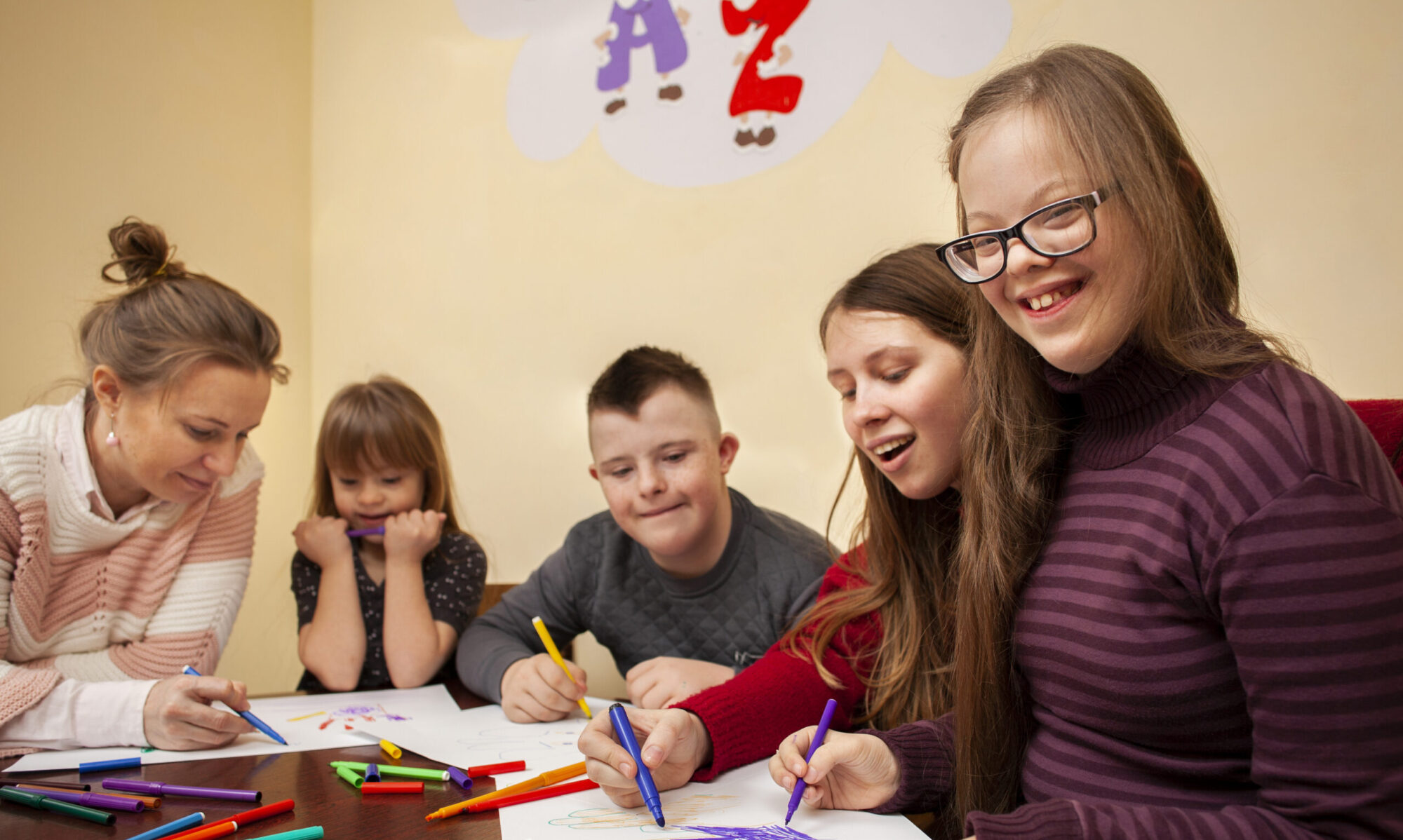
5 Reasons We Love Inclusive Teachers

When we think back to our favorite teacher it’s often not what the person said or did that we remember, but how that person made us feel. The best teachers lift us up, show us our worth, and make space for us to truly belong. For Teacher Appreciation Week, we want to lift up and show our gratitude to inclusive teachers. Those that go out of their way to do the hard work of including all learners together.

What Makes a Teacher Inclusive?

  1. Inclusive Teachers are explicit about belonging. So, you successfully advocated for your child to be in the regular classroom for most of the day, but when you visit your child at school it seems he/she is like an island in the classroom. Your child doesn’t have their name on a desk, their classmates don’t know them, and the general education teacher ignores them. Parents realize that getting into a regular classroom doesn’t always equate to meaningful inclusion. That’s why parents are always so grateful when an inclusive teacher clearly defines meaningful inclusion in their classroom. Little things like explicitly modeling how to include a student with a disability, creating a physical space that shouts “You belong here” assigning peer models, not grouping by ability, using a paraeducator to support all students and the teacher, and social-emotional curriculum can go a long way to create a space of belonging and inclusion.

2. Inclusive Teachers have a Growth Mindset. Let’s be honest. Colleges of Education do not teach special education law and research to special education teachers, let alone general education teachers. I have a Master’s in Secondary Education and only took one class on teaching students with disabilities. So it’s always incredible when I meet a regular or special education teacher or paraeducator who has an open mind and is willing to relearn teaching strategies that will be effective for all learners. Teachers with a growth mindset take responsibility for improving their teaching practices and see setbacks and feedback as an opportunity to grow their skills. These types of teachers also have high expectations for all learners, and actively seek out new challenges.

Related Blog Post: Back To School Guide for Inclusive Education

3. Inclusive Teachers make time for UDL. Universal Design for Learning (UDL) is supported by research and the law. It’s a teaching approach that works to accommodate the needs and abilities of all learners and eliminates unnecessary hurdles in the learning process. It’s also the most effective way to include even students with the most significant disability in the regular classroom. Inclusive teachers know worksheets and direct teaching are the least impactful way to reach any student. They get that teachers should never teach just one way, and learners don’t need to show what they learned just one way. Inclusive teachers always make the least dangerous assumption and believe that all learners deserve the chance to show what they know and can do.

4. Inclusive Teachers build relationships. The best teachers care deeply about all their students, even and especially the “hard” students. Inclusive teachers know that all students do well when they can, and building a bond with their students is the best way to motivate all learners. When was the last time you wanted to work for a rude or disrespectful boss? Never! We’d leave, but we expect kids to just suck it up when it comes to dealing with rude or disrespectful teachers. Inclusive teachers understand the power of relationships and create a safe space for learners to belong.

Related Blog Post: 7 New Research Studies to Win the Fight for Inclusion

5. Inclusive Teachers expose students to culturally relevant material. We currently live in a world where many teachers are afraid to teach culturally relevant material that speaks to a student’s lived experience as a disabled person, a person of color, or non-gender confirming, etc. It takes courage and moxy to go against the current political trend and explicitly honor a child’s true self. Inclusive teachers know that a child with a disability is going to perform higher and be more engaged if they see someone like themselves in a lesson plan. Nondisabled peers are going to broaden their perspective of the human condition and will be more likely to treat their disabled peers as equals when they understand the history of the disability community and our fight for inclusion. Inclusive teachers create advocates for change and inclusion. And those students will one day be doctors, lawyers, and teachers themselves who will remember what they learned and will hopefully include a person with a disability in their work, home, and community.

Thank you to the inclusive teachers of the world that have opened their hearts and shaped the future into a more inclusive place for us all. We appreciate and celebrate you!

Back To School Parent-To Parent-Guide To Inclusion

It’s that time of year. Back to school shopping, first day of school social media posts, and well planned out lunches. But if you’re a parent to a child with a disability, you have the added anxiety of IEP meetings, checking in to see if your child and his teacher have all the needed supports, and wondering if your child will be meaningfully included.

Start the school year right by sharing information about your child, as well as what inclusion means to you. Being intentional about disability acceptance could be the key to friendships with typical peers in the general education classroom. Parents of typically developing classmates may not know what to say to their child about your child’s differences. They may even be apprehensive about having a child with a significant disability in their child’s class.

Dispelling any myths and educating parents about the benefits of inclusion is a great way to start out the school year.

I got you covered. Below is a parent-to-parent guide that you can print and share. Also included are tips to create your own customized “all about me” page highlighting your child.

Read Related Post: 3 Words That Will Transform Your Child’s IEP Meeting

I suggest you wait until the second or third week of school to share these resources with classmates’ parents. You want parents to spend time with these documents, and too much information is sent home at the start of the school year. This is a conglomerate of information I’ve seen and learned over the years as a non-attorney special education advocate. Feel free to print and share the PDF version below:

Read Related Post: Promoting Inclusion through Universal Design for Learning

If you’re looking for an easy way to create a customizable “All About Me” page look no further than www.canva.com. Canva’s image-driven bold templates are sure to catch anyone’s attention. Check out the one I made for my son a few years ago:

Added Bonus: I have my son hand-deliver this to teachers during the first IEP meeting or Back to School Night before school begins. He also shares his most current work. This gives teachers a glimpse of a highly-capable student, instead of the weakness-based legal documents they’re used to reading about students.

How do you introduce your child and the idea of inclusion to teacher and classmates? Share any resources in the comments section below.

From Awareness to Inclusion this October

October is Down Syndrome Awareness Month, and Disability History Month in the state of Washington. As my journey with my own son with Down syndrome has evolved I realize that I want more than awareness. I’d love for our society to move from awareness and acceptance to true inclusion.

I think it’s important that we move past simple awareness campaigns to something that persuades actual action. But how? How do we raise awareness and persuade people to truly accept people with disabilities for who they are?

Outside of the classroom, there’s many small, yet powerful actions you can take. Advocating for laws that end sub minimum wages, and promote community inclusion can be as easy as sending a letter to your representative or showing up to a rally. Another powerful step towards equity is working with people with disabilities to understand how they want to be respected and supported. Always question yourself and others. Do you or people around you still harbor ableist feeling like pity or inferiority of people with disabilities? Learning from these moments and moving forward is an important first step towards acceptance, and something I still practice and struggle with sometimes. We should always invite people to change and evolve in their perspective; that’s what advocacy is about.

When and how should parents formally introduce their child in a classroom setting, and promote disability acceptance? 

First, let’s talk about what NOT to do. You might have come across the use of disability simulations: marshmallows in the mouth to simulate low tone and lack of intelligibility, hands in mittens to simulate poor fine motor skills, blindfolds to simulate–well, being blind. Do you notice what all these simulations highlight?

What a person can’t do, rather than how individuals with disabilities successfully adapt to their environment with the right modifications and supports.

Instead of promoting empathy and awareness, research studies show disability simulations actually promote fear, apprehension, and pity towards their classmate with a disability. Also, because the simulation is only for a short time, it’s hard for typical students to truly experience the classmate’s limitations in a meaningful way.

Inclusion Activities in Grade School

Trying to promote acceptance will take more time and thought than awareness campaigns but they’re worth it. I invited a local self-advocate with a disability to come talk to our entire school body about acceptance. I hope that this will make a lasting impact.

During the COVID pandemic you can modify these assemblies by having local members of your community with disability submit recorded videos that you can then share during the school’s morning announcements. This month I organized a number of different videos for my son’s school, including one from our school’s Physical Therapist where he introduces his service dog and explains how the dog is used to help students with disabilities. My own children even asked to create a video to talk about inclusion.

You can also reach parents through your school’s newsletter. I’ve created a Parent-to-Parent Guide that talks to parents about disability rights, inclusion, and tips on how their child can be an ally to classmates with disabilities. You can use my guide with proper citations.

Supports for Teachers:

Many teachers and parents like to take a more broad approach to awareness of differences in lower grades. For instance, in kindergarten through 2nd grade you may not even mention the term “Down syndrome” or “Autism.” Many parents decide the discussion shouldn’t single their child out, but foster acceptance of all students. Children’s books are a great way to foster acceptance of people for who they are. Here’s some examples:

“What Happened To You?” by James Catchpole: A great book to introduce the idea of disability pride, and gently remind students that a person with a disability is not a lesson to be learned. The book reminds readers that people with disabilities want the same things as everyone else: belonging and inclusion. Pity has no place here.

“My Friend Isabelle” by Eliza Wilson: I love this book, because it starts with two friends that have so much in common, but also talks about differences. The reader only finds out that one character has Down syndrome by reading the jacket note at the end of the book. It also has a guide to help teachers and parents incorporate the book into a classroom lesson. Watch the YouTube click below for a video version of the book.

“Just Ask: Be Different, Be Brave, Be You” by U.S. Supreme Court Justice Sonia Sotomayor: Did you know Justice Sotomayor lives with Type 1 Diabetes? She talks about her own life as well as the lives of other children with disabilities or health conditions in this beautiful children’s book. She uses the analogy of a garden to show how people’s differences can be their superpowers.

“King Louie and His Marshmallow Kingdom” by Louis Rotella: About a little king who rules over a kingdom where the sun always shines and every meal is a picnic. Louie explains to his friends that he loves to do kid-things, even though he’s different. This is one of my all-time favorites!

Awareness Activities with Older Students

Books can also be used with older students, and some may actually define a disability. But more hands-on or project-based activities are also fun at this age. Open discussions about what students already know about disabilities (or think they know) is imperative. Prior knowledge allows teachers and parents to assess where to start, as well as any preconceived notions students may have. Discussing inclusion is also important at this age. All kids want to be included.


“All the Way to the Top: How One Girl’s Fight for Americans with Disabilities Changed Everything by Annette Bay Pimentel: A phenomenal new book that looks at the Disability Rights Movement and the advocacy effort to get the Americans With Disabilities Act passed. It follows one young advocate that showed Congress how important access is for people with disabilities. This is a great book for 2nd or 3rd graders, who can start thinking about how they could advocate for people with disabilities in their own communities.

The Girl Who Thought In Pictures: The Story of Dr. Temple Grandin by Julia Finley Mosca: “If you’ve ever felt different, if you’ve ever been low,
if you don’t quite fit in, there’s a name you should know…Meet Dr. Temple Grandin—one of the world’s quirkiest science heroes!” When young Temple was diagnosed with autism, no one expected her to talk, let alone become one of the most powerful voices in modern science. Yet, the determined visual thinker did just that. 

Washington State Governor’s Office of the Education Ombuds (OEO) created the One Out of Five Project to promote disability pride and inclusion through simple lesson plans. You can get those here. The Governor’s Council for People with Disabilities also did a fabulous disability awareness campaign in Indiana and posted all of their lessons here. Some of their ideas include:

  • Students create a class motto for inclusion
  • Anonymously write questions students have about disability and difference, and have those questions read and answered as a class (or in private)
  • Create a classroom mural that depicts what an inclusive class, school, and community looks like
  • Perform a simple skit showing appropriate and inappropriate ways to interact with classmates with disabilities: people’s first language, asking before you help someone, inviting classmates to special occasions, treat your classmate the way you want to be treated
  • Show a movie or show that depicts someone with a disability as the main character
  • Evaluate their school or local business to see if they accessible for people with disabilities. If they’re not, come up with a plan to change that.
  • Invite a sign language interpreter to teach students some simple signs.

What are you planning to foster acceptance in your child’s classroom? Add some ideas in the comments sections.

The following are some other books that may help you foster acceptance in the classroom:

Accommodations vs. Modifications in Kindergarten

Everything is still possible in kindergarten, even for students with significant disabilities. Inclusion should come naturally, because all the students enter kindergarten at different levels. With the use of accommodations that changes “how” students with disabilities learn, many students with intellectual disabilities can meet the same kindergarten standards.

Still, expectations have changed a lot since I was in kindergarten 30 years ago. Writing journals, addition math problems, and mandatory reading levels are an actual thing now. I’m blown away by the standards kindergarteners must meet.

Read Related Post: Inclusion Must Start in Preschool

Thinking about how my son with Down syndrome would meet these new, rigorous standards made me nervous. I knew accommodations could help him access the kindergarten curriculum, but would he also need modifications to change what he’s taught and is expected to learn? Using modifications should never legally lead to a more segregated setting, but I knew from other family’s stories across the nation that often it does.

Ultimately, understanding my son’s potential, setting high expectations, and presuming competence helped guide his kindergarten year.

With three years of preschool under his belt, we decided to start the school year with only accommodations to allow our son to meet the same grade-level expectations as all the other kindergarteners. With so many students at different levels in his general education classroom, he often knew just as much as the majority of students in his class. Every family has to make their own choice about changing the grade-level content to meet their child’s needs. I’m an advocate of giving the student a chance to perform to grade-level standards with accommodations first, then moving on to modifications if needed.

My twin boys, who are in the same general education class do the same work, but their different ability levels are obvious. I admit that I compare the work that they bring home, and have been proud of how much individual progress both of them have made. Below you can compare a typical assignment they do each day.

Although my twin boys learn the same content, accommodations do change how my son with Down syndrome accesses that content. Here are his kindergarten accommodations:

  • paraprofessional
  • slant board
  • short writing utensils
  • foot rest
  • large font
  • less content on each page
  • more time to work on assignments and tests
  • Accept approximations for expressive assessments
  • Accept pointing to an answer rather than expressively saying an answer
  • visual cues and prompts
  • number line
  • sit near the instruction
  • visual timer
  • tablet with touch screen
  • small, one-click mouse

If the first semester of kindergarten was smooth sailing, the second half has tip the boat a bit. The few students who were behind my son have caught up in most areas. Some concepts, like “more or less” in math have been difficult for my son to pick up without a lot of concrete examples. Still, I’m glad I started with just accommodations. It gave me time to feel out the IEP team and kindergarten curriculum to see what was possible.

Read Related Post: 5 Tips for Including Students with Down Syndrome in General Education Classroom

I learned that my son’s IEP team members would not use modified IEP goals as an excuse to pull him out of general education. They’ve agreed to push all resources into general education so far. That gives me more confidence to define how the content may change to meet his level. For example, because my son had difficulty counting to 100 expressively, the team created an IEP goal to start by counting to 30 by ones and 100 by tens. He can also point to numbers that he has a hard time saying expressively.

As my son goes into first grade, I know modifications to the curriculum will be an important way for my son to continue accessing the grade-level content at his level. Modifications allow students who are far behind their classmates to access the grade-level curriculum at their own level, or can change the grade-level curriculum completely. 

Some great resources to help create appropriate modifications include’s Nicole Eredic’s new book “Inclusion In Action” with over 40 modifications for students with the most significant needs. Paula Kluth’s book “Universal Design Daily: 365 Ways to Teach, Support, and Challenge All Learners” is also a great gift to give your child’s general education teacher and will help all the students in the class.


On social media, join the “Educational Strategies for Students with Down Syndrome” page. Parents often share modified content that works. You can also follow Nicole Eredic’s Live Binder page that has specific modified assignments being added all the time. Click here to find it.

What accommodations or modifications does your student use that helps them access the grade-level content? Share any resources that you have in the comments section.

How to Advocate Now for Extended School Year Services

Extended School Year (ESY) is an under-used and misunderstood part of special education. I’ve struggled to get my own son with Down syndrome meaningful ESY services. I was told that ESY was just for students who have fallen behind. At the time, my son was in his first year of preschool and the school district argued that he hadn’t yet fallen behind. After reading the law myself I realized my son was eligible for ESY services in order to received a Free and Appropriate Education (FAPE). I learned that I didn’t have to wait for my son to regress to get ESY services.

Extended School Year is any special education or related service provided to a student with a disability outside of the regular school year. The service must be tailored to the child’s Individual Education Plan (IEP) and at no cost to the parent. Summer school instantly comes to mind when we think of ESY, but don’t limit yourself to this idea alone. It can be ANY time school is not in session (before or after school, and winter or spring break included). ESY services can also be for a particular related service like speech, OT, or PT. It can go beyond academics and must be customized for your child. For instance, any social-emotional, functional, or behavior needs your child may have. Schools can conduct ESY services themselves or pay for your child to receive the services from a private provider.

Just remember this key question: Is ESY services needed to ensure your child receives a Free and Appropriate Education?

Read Related Post Here: Extended School Year: A Necessary Part of inclusion?

In my son’s case I argued that he was at a pivotal moment in emerging speech skills. The district had initially argued that ESY was only for regression and recoupment. I found that my state’s ESY eligibility policy also included maintaining skill level or work on emerging skills.

It’s important to start gathering data now to advocate for ESY. You don’t want to wait until the end of the school year to ask for ESY for your child. The school should be collecting data during and after winter break, spring break, after school, etc. The more specific the data you and the school gather the more likely you can successfully make your case for ESY for your child. You can use IEP progress reports, test scores, evaluations, behavior charts, pre and post tests, and school work before and after breaks.

Advocacy Tips to get ESY: 

  1. Make sure you look for your state requirements for ESY: The federal regulations give states discretion as to how to approach ESY. Services can vary from state to state, but must comply with the federal basic guidelines that you read above. For example, states cannot limit the type, amount or duration of ESY. ESY must also be customized for the student. A quick google search will help you find these regulations. I usually type in “Washington State Special Education Regulations” into google, and when I get into the document I scroll down to the table of contents and look for Extended School Year.
  2. Watch out for the “Regression and Recoupment” limit: Regression and Recoupment looks at how much information the student will lose over break and how long it will take them to relearn the information. Most states look at more than just regression and recoupment. Courts have said states CAN use only regression and recoupment to determine ESY, but they don’t have to limit their eligibility to just this determination. In my son’s case I argued that he was at a pivotal moment in emerging speech skills. The district had initially argued that ESY was only for regression and recoupment. I found that my state’s law included emerging skills, and was successful in getting his ESY by using this factor.
  3. Using other factors to advocate for ESY: Some states have expanded what factors can make a student eligible for ESY. Some of these factors can include working on emerging skills, the degree of impairment, the child’s rate of progress, critical point of instruction where the school must continue provide services so the student doesn’t fall behind. Interfering behaviors that may prevent a student from receiving FAPE during the school year can also be a factor. Also, special circumstances like Least Restrictive Environment (LRE) concerns. This is a big one in the Down syndrome community. For example, a state may decide that a student must be included in a summer school environment so the student can remain in the least restrictive environment during the break and work with typical peers.
  4. Use Case Law to make your case: Courts have interpreted ESY differently across the country. But some often cited cases include Cordrey v. Eukert (1990), which found that ESY is required to prevent serious skill loss. This case has also limited eligibility for ESY. This case reminds us that you really need to have specific data to get ESY for your child. Kenton County School Board v. Hunt (6th Circuit 2004) the regression must be more than normal regression that all students see over break, and will take longer to recoup than typical students. M.M. v. School District of Greenville County (4th Circuit 2002) asks if the child’s progress made during the school year will be significantly jeopardized if he doesn’t receive ESY.

Read Related Post Here: 3 Words That Will Transform Your Next IEP Meeting

We recently moved to a new state and my son is now in kindergarten. At our first IEP meeting I asked for the district’s ESY policy. His IEP automatically included a “no” check mark under the question “does this child require ESY services?” I specifically had to ask for a Prior Written Notice (PWN) stating that although he is not eligible for ESY yet, that the school would begin taking data to determine eligibility.

It may be up to you to initiate the ESY eligibility process. The federal law doesn’t give a timeline as to when ESY has to be considered; another reason to check your state regulations. Some districts are not going to broadcast that ESY is a viable option to ensure your child receives FAPE, and the quality of those ESY services will have to be reserved for a whole separate blog post.

Has your child received ESY services? What did you have to do to get him or her services? What type of services did he/she receive and was it worth it? Comment below.