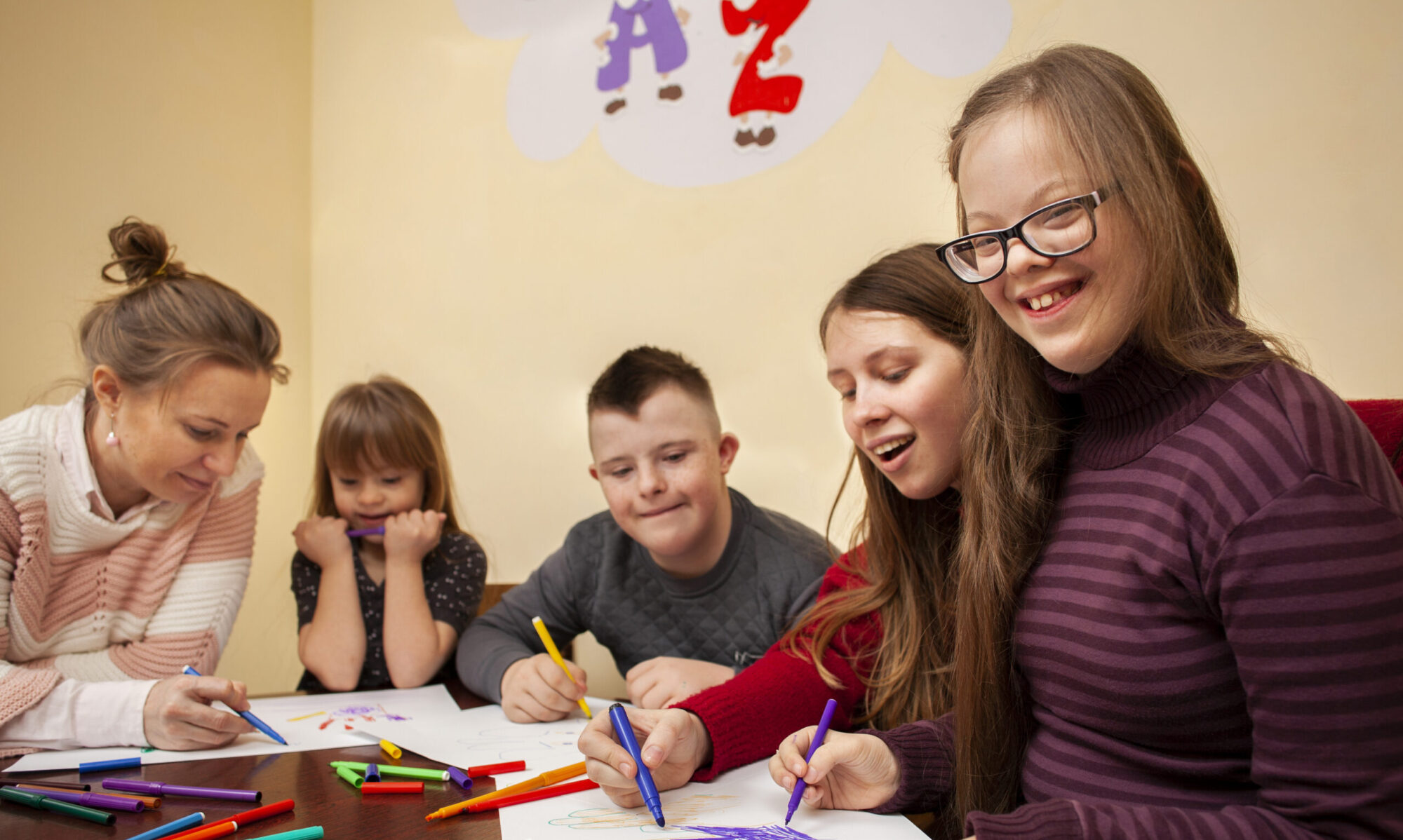
It’s that time of year. Back to school shopping, first day of school social media posts, and well planned out lunches. But if you’re a parent to a child with a disability, you have the added anxiety of IEP meetings, checking in to see if your child and his teacher have all the needed supports, and wondering if your child will be meaningfully included.
Start the school year right by sharing information about your child, as well as what inclusion means to you. Being intentional about disability acceptance could be the key to friendships with typical peers in the general education classroom. Parents of typically developing classmates may not know what to say to their child about your child’s differences. They may even be apprehensive about having a child with a significant disability in their child’s class.
Dispelling any myths and educating parents about the benefits of inclusion is a great way to start out the school year.
I got you covered. Below is a parent-to-parent guide that you can print and share. Also included are tips to create your own customized “all about me” page highlighting your child.
I suggest you wait until the second or third week of school to share these resources with classmates’ parents. You want parents to spend time with these documents, and too much information is sent home at the start of the school year. This is a conglomerate of information I’ve seen and learned over the years as a non-attorney special education advocate. Feel free to print and share the PDF version below:
If you’re looking for an easy way to create a customizable “All About Me” page look no further than www.canva.com. Canva’s image-driven bold templates are sure to catch anyone’s attention. Check out the one I made for my son a few years ago:
Added Bonus: I have my son hand-deliver this to teachers during the first IEP meeting or Back to School Night before school begins. He also shares his most current work. This gives teachers a glimpse of a highly-capable student, instead of the weakness-based legal documents they’re used to reading about students.
How do you introduce your child and the idea of inclusion to teacher and classmates? Share any resources in the comments section below.
Tis the season to PCS! Your husband is on TDY, so it’s up to you and one power of attorney to secure the movers, sell the house, organize all 18,000 pounds of stuff you plan to move, and sell that couch that won’t fit in your new house in a new state. You can’t see out the minivan because 3 kids, 2 dogs, and all your personal items must make it across country to your moms for the next two months before you find permanent digs at your new duty station.
Military families are extremely resilient. We bloom where we’re planted. We often make fast friends, throw ourselves into new careers or hobbies, play tourist in our new town, while leaving it better than when we arrived.
Military life also presents real stressors and challenges, especially for families with children with disabilities. The Exceptional Family Member Program (EFMP), a.k.a. the PCS gatekeeper, throws in a whole new wrench into the works. Orders often center completely around the military child with a disability, rather than the active duty member. You can’t go to your dream duty station, Germany, because the services are supposedly inadequate for your child. You have to say goodbye to that excellent Speech Pathologist who did PROMPT, and the gap in service while moving could mean a real gap in your child’s communications skills. You heard from another military wife that the schools in the neighborhood you want to live in don’t even follow the law, much less do inclusion.
How can a military family advocate for full inclusion for their child with a significant disability when they’re dealing with so many other moving parts? How does a military child maintain a consistently inclusive educational career when they move every 2 to 4 years?
These are two very difficult questions that I’m not sure I can tackle in one post or even have a complete answer to. My hope is that I can post a few tips that works for my son with Down syndrome, and other military families will chime in with what’s worked for them. I’d love to do a follow-up post with other family’s experiences. Here it goes!
3 Tips to Finding Inclusion As a Military Child with a Disability:
Secure a solid IEP before you PCS:
Use those military orders to your advantage. Dangling the orders in the face of your child’s current IEP team if needed. Tell them you’re moving so writing in a full time paraprofessional, daily communication with parents, and modified homework given to the student a week before it’s due into the accommodations section of the IEP should be no big deal. Sometimes this is all an IEP team needs to hear to make some real effective changes to the IEP.
The Individuals with Disabilities Education Act (IDEA) requires the new school district you move to to provide a comparable IEP for at least 30 days. This gives you time to make your case to keep the current IEP or improve upon it. The new IEP team must also give you a Prior Written Notice (PWN) explaining WHY they won’t follow the IEP from out of state. Many schools don’t want to make a denial of comparable services in writing, so make sure you ask for the PWN.
Stalk Social Media Groups at your new duty station:
Social media opens up a whole new world for families of children with disabilities. There’s a closed group for everything, and could be a great starting point to find an inclusive school.
WARNING: some parents’ idea of inclusion may not be in line with your idea of inclusion. I had to learn this the hard way when my son started preschool at our duty station in Ohio. Although the public preschool included 50% of students without IEPs, starting in kindergarten kids were segregated. Luckily, we PCSed before I had to fight for inclusion.
Be specific on social media: ask what percentage of time their child spends in general education. You’re looking for at least 80% or more. Ask if proper supports are given, and if the school actually follows through with their child’s IEP.
Get Serious with a Freedom of Information Request:
Did you know you can find out how many restraints or seclusion cases a district had in a year? Or how many due process cases a district had and the outcome? If the district had any Civil Rights Complaints made against them. All of this is public information, so once you’ve chosen one or two schools get down to business with a freedom of information request.
A request through the district or state office of education (special education office) can reveal so much about the school you’re hoping to choose. Anything from state complaints to individual employee complaints. Go to the state’s Parent Training and Information Center to find out how to make the request for public records in your new state.
Side note: this is completely different than looking at school rankings on line (think “Great Schools” and other such sites). Often the traditional rankings tell you nothing about how the district does special education. In fact, a very high rated school in Ohio was notorious for segregating kids with IEPs. So beware!
Lastly, reach out to a local special education advocate to get their take on districts that are following the law and including kids with disabilities in general education. The Council of Parent Attorneys and Advocates has a directory of advocates by state. Advocates often are filing state complaints and civil rights complaints all the time, so they will know which school districts to stay away from.
I called a local advocate before we planned to PCS to Washington state, and I’m still friends with her today. My son is also 93% included in general education with appropriate supports in a state that is ranked 3rd lowest in the nation for inclusion. Doing your homework pays off!
What tips do you have for military families PCSing with a child with a disability? How did you find an inclusive school? What do you wish you would have done differently?
Having a child with an intellectual disability often poses a crisis of childhood prolonged. Do you treat your child like their chronological age or their assumed mental age? “Mental Age Theory” was coined by the same man that created the Intelligent Quotient (IQ) test and compares a child’s physical age with their intellectual or emotional performance. Proponents argue that it’s a useful tool to determine what a person can or cannot accomplish. Many within the disability community disagree, arguing that this thinking denies individuals’ right to an adult life, and ignores the idea of least dangerous assumption. We don’t know what’s possible, for anyone!
Parenting a child with an intellectual disability often presents a much more gray area than a simple for or against the “mental age” theory. I want my son with Down syndrome to learn the same content as his typically developing twin brother. I want him to participate in age-appropriate activities and understand common cultural references. But he should also have the power to choose how he wants to spend his free time. For example, he really likes Paw Patrol and the talking Elmo doll. I know from my typical son’s activities that these choices aren’t necessarily age appropriate. Do I allow him free choice? The answer is YES, balanced with some intentional exposure to new activities as well.
My son with Down syndrome is very persistent about getting his daily dose of talking Elmo doll or some other toddler show or toy. But an opportunity presented itself. I waited until we moved across country and got rid of many of my kids’ toys, including some of those toddler toys. I soon learned that he was fine with age-appropriate shows and toys most of the time. He has forgotten about Elmo. Now he obsessively sings the opener to Super Why and wants to beat his brother in a round of Checkers. He’s moved on, because I pushed him to experience the next age-appropriate activities.
It’s important to note that I still give my son free choice in his desired activities. For example, he used his birthday money to choose a singing Mickey doll. He loves it! It was his choice. The problem is not with free choice, but presuming that they should only be exposed to activities at their mental age. My son often needs some intentional exploration of new age-appropriate activities to really start enjoying them. That does not mean that I force him to give up all of his desired activities. It can be both ways!
I’m hyper sensitive to this and other age-appropriate behaviors and activities. I want to balance my son’s right to choose his highly desirable activities with my desire to ensure he’s exposed to the same things as his classmates. And I think it’s just that: exposure. When I see adults with developmental delays still watching Barney or reading Dr. Seuss I have to think that may be they’ve been given no other choice. It could be their free choice, but it could also be that they’ve never been intentionally exposed to anything else. It’s a hard balance though: the desired activity versus the exposure to new age-appropriate activities.
It’s so important that all people are exposed to age-appropriate, culturally relevant content at their cognitive level. If they still choose to partake in kiddie activities that’s cool too. But when a person is never given the opportunity to learn about Shakespeare or algebra or politics or sports that’s a problem. How can we expect our loved ones with developmental disabilities to be active members of their community and carry on a conversation about things that most people understand. They don’t have to know everything about everything, but how can we expect our loved ones to be included if they’re only exposed to toddler activities?
What’s your take? Do you struggle with this? Comment below.
When I gave feedback as a teacher to parents with a student who misbehaved I always used a “complement sandwich.” It went something like, “Johnny always helps his friends with map skills, but he often talks out of turn. I know he’s a smart young man and can learn to raise his hand first when others are talking.”
Troy loves being the helper at school
So, when I think about my own smart young man’s behavior, I’ll start with a complement sandwich. Just this week, the bus driver told me “Troy is the most polite boy he’s ever met. He’s always saying please and thank you; most kids twice his age don’t do that.” I blushed instantly. My child is amazing, I thought. That same day I got a call from his teacher. Troy has been pulling off his shirt at circle time. She had to threaten to throw it away, before he would stop. Oh, dear!
Troy is an amazing kid, but he’s also VERY impulsive and loves to get attention (any kind of attention). If you’re thinking this sounds like most 4-year-olds, you’re right. Still, Troy’s persistence in impulsivity, avoidance, and negative attention-getting trumps most preschoolers. When I compare his behavior to his typical twin’s there’s one big difference: the threat of consequences in one moment doesn’t occur to Troy the next time he decides to exhibit the same behavior. He just doesn’t remember, or doesn’t care.
In fact, 30% of children with Down syndrome have behavior problems. Left untreated, these behaviors often cause problems with keeping a job and living independently as an adult.
I’ll be honest, sometimes Troy’s behavior drives me crazy. When he’s thrown food he doesn’t like for the hundredth time or decides to do the “lumpkin” right in the middle of Kroger because he doesn’t want to leave I often just want to SCREAM. That’s why I bought a new book especially targeted to behavior of kids with Down syndrome called “Supporting Positive Behavior in Children and Teens with Down Syndrome” by David Stein. I was lucky enough to also see the author speak at this summer’s National Down Syndrome Congress‘ Convention in Sacramento.
I often don’t know what to do about Troy’s behavior in the heat of the moment. Stein says that’s normal, and when you don’t know what to do think about your relationship with your child. Do they feel safe? Can they communicate their needs in some way, whether it’s verbal or through a visual? Stein says the most important factor in our loved one’s development is their relationship with parents or guardian. Attachment helps your child stay regulated and motivates them to do their best.
When Stein spoke about the “brain-based reasons” for misbehavior in children with Down syndrome, I realized why Troy was so different than his typical twin. He explains that their are “key differences in the frontal lobe, hippocampus, temporal lobe, brain stem, and cerebellum that leads to different functioning in: communication, social engagement, the “social-emotional radar,” information processing, motivation, and executive functions.”
The best advice I got from Stein’s book and workshop was his “respond, don’t react method.” It’s a simple concept that’s not always easy to implement. He gave 4 tips for setting our family up for success:
Establish routines (we do this already, because I’m an obsessive routine person…and it really works for Troy)
Visual schedule (I wish I was better about implementing this. We do have a food schedule that Troy loves. This takes a lot of planning and prep work. I could use one for when we’re out and he doesn’t want to leave)
Brief, simple language (sometimes Troy just doesn’t understand what I’m asking him to do when he’s upset or I don’t understand him)
Keeping emotions in check (this is the hardest one; I always feel like Troy is misbehaving to upset me…logically, I know this is untrue, but it’s hard to remember this in the heat of the moment)
Stein says it’s important to think ahead of your child’s common behavior problems. I finally did this when Troy’s “lumpkin” situation got out of hand. He’d fall to the ground and weigh a thousand pounds any time he didn’t want to leave the pool, library, park, etc. I created a simple visual schedule for his most common destinations. For example, at the pool I showed a picture of the pool, then the shower and dressing room, then eating a granola bar in the van, then watching his favorite show at home. I told him if he could watch Jake and the Neverland Pirates if he just followed the steps. He loved the visual schedules and it solved the problem for those locations.
Everyone wants a quick fix when it comes to behavior problems. Like anything else though, it takes time and thought. All your problems will not be solved overnight, but Stein says you’re looking for long-term positive change. I highly recommend “Supporting Positive Behavior in Children and Teens with Down syndrome.” It’s a thought-provoking book, that you’ll come back to again and again.
How do you use positive behavior supports for you child? Comment below with your stories.
In three short weeks my first born sons’ will start kindergarten. As I prepare to send them out into the world, I am convinced that EVERYTHING IS STILL POSSIBLE.
Isn’t that what kindergarten is about, after all? By their very nature, kindergarteners are self-confident, adaptable, curious, eager to learn, and for them everything is still possible. Look at those boys! Both are the very essence of what a kindergartner should be. What a refreshing way to live!
When I became pregnant with my twin boys I had the same optimistic outlook, but 35.5 weeks later as I held them it seemed none of my dreams were still possible. As my sons’ birth story unfolded, I allowed the world’s perception of an intellectual disability envelope me. All the can nots and will nots strangled me in that moment. I could not see past Troy’s disability. I had forgotten all I had learned from dear Sister Immaculata in kindergarten: that everything is still possible.
It’s taken 5 years of preparation to believe everything truly is still possible: That’s 3 preschool teachers, 3 pediatricians, 5 specialists, 23 therapists, 208 hours of therapy to learn to walk, 520 hours to learn to write letters and cut with scissors, 520 hours to learn to jump and ride a trike, 650 hours to learn to speak in short phrases, 850 hours of advocacy training, 2,737.5 hours to potty train (this is probably an underestimate), and countless sleepless nights.
You might wonder how I could believe this, against these odds. But it’s these very odds that make me believe everything is still possible. Troy is amazing in his tenacity, adaptability, and hard work, and he comes by it honestly. Although Troy has been at the center of this hard work, our whole family has been there every step of the way. Our family has always loved a good challenge. We will beat the odds, or learn and grow trying.
So, bring it on kindergarten! We’ve done our homework; we’re ready for you. I started this blog knowing this time would come fast. I made a bet then that my twin sons would graduate together in the year 2031, and both would have the opportunity to go to college. I’ve learned since that this is not only possible, but is happening right now. There’s over 260 college programs for students with intellectual disabilities. Self-advocates with Down syndrome are multi-million dollar business owners, international speakers, models, reality TV stars, athletes, husbands, wives, and loved family members.
I am confident now that my very unique twins can strive for the same things in life: success, independence, security, happiness, and most of all love. Everything is still possible!
School’s back! Learn how to make this catchy bio for your child’s teachers here.