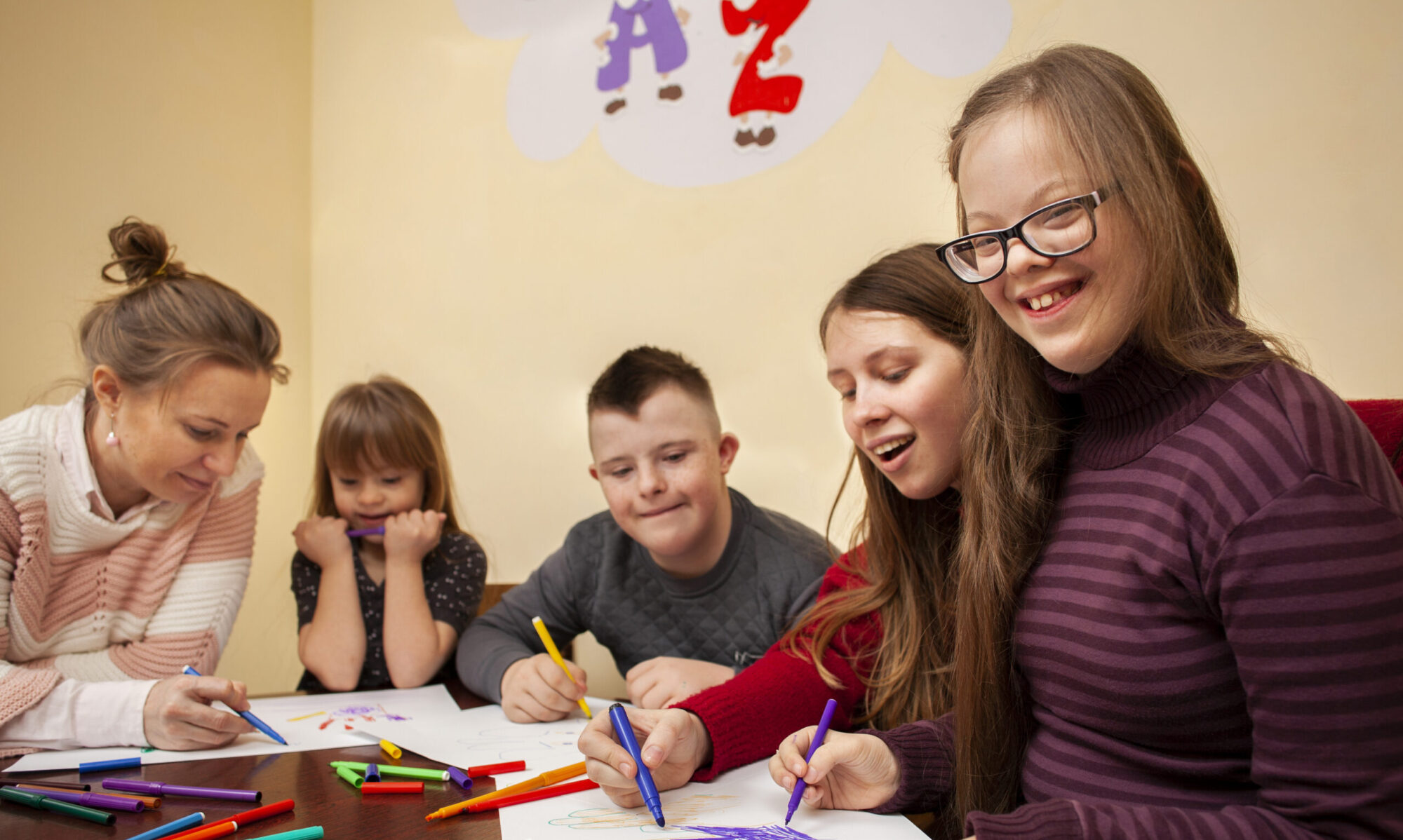
Enjoying the Quiet Before the Storm

A typical week for me may seem like a hurricane to others. It includes 24-hour care of my three kids under 5-years-old, at least three private therapy sessions for my son with Down syndrome, typically one medical appointment, swim lessons, preparing 3 square meals a day, and keeping house (whatever that entails in 2017 LOL!).

I do this with no family support system (the closest lives 500 miles away), and my husband works 80+ hours a week as an Emergency Medicine resident (although he’s amazingly helpful even with his insane schedule).

Looking at our crazy life, one would NOT imagine these days are the sunniest. But in many ways, this is the quiet before the storm!

As the school year fast approaches and my twin boys enter their third and final year of preschool, I realize this is the last year our young family will enjoy the safety of naivety. I have one more year to bask in the glory of unasked questions, the freedom of play, and power of a small circle of family and friends who accept us for who we are: PERFECTLY IMPERFECT!

Troy (back left) enjoying life with his typical twin, Hunter

That’s one more year of easy-peasy IEP meetings, no homework or standardized tests. One more year of kids playing with Troy on the playground without asking why he’s so little or can’t talk like them. One more birthday where the boys want a party with the same friends, same theme, and same gifts. One more year where my boys think of themselves as they are: TWINS.

Next year, my first born sons will start “real school”, and boy has it changed a lot in the generation since I attended kindergarten. You’ve likely heard the news: kindergarten is the new 1st, or is it 2nd grade.

As we peacefully go through life in the safety of our home, I often worry if Troy will be ready. Of course he will, whether I’m ready or not. I also worry that his typical twin, Hunter, will struggle with the confirmed knowledge that Troy is indeed different. The words “Down syndrome” come up a lot in our house, and even though Hunter uses these words freely in conversation he has yet to assign it to his twin brother.

As a parent of a child with a disability, I’ve practiced in my mind how I might explain this revelation of difference to my typical children. Will I choke when the time comes to pass on this sage advice? 

Troy’s sister, Cora

My 2-year-old typical daughter, Cora, is the perfect playmate and foe to Troy. Theirs is a love-hate relationship. But I’ve noticed lately she’s been innately mastering milestones that Troy is just starting to find easy: jumping, verbalizing complete sentences, dressing independently.

How will I navigate the rough seas of a younger child surpassing an older one?

Still, these intimate family dynamics will likely not be what causes the biggest waves a year from now.

Instead, it may be the storm outside our doors.

It may be the teachers or school administrators who deny equitable education to my son with Down syndrome.

The older students who ask Hunter why his twin can’t do the same things he can.

The sports coaches who can’t find a spot for Troy to play on a peewee team.

The parents who remark about how “cute” Troy is, while quietly worrying about the impact of his presence in their typical child’s class.

They say meteorology is the only profession where you can be wrong 50% of the time. So, here’s hoping my predictions for the storm to come are unfounded! 

Even if my predictions do come true, I realize now it will be ok. We’ve been through a lot as a family, even before our kids were born. Even through rough times, we’ve held tight to each other knowing we’d see brighter days.

And what I’ve learned and hope to instill in my children is the sunniest path isn’t always the prettiest. Sometimes the storm helps you put life into perspective.

Sure, if I we could have it all, I’d wished my kids easy, fun-filled lives, full of lots of interesting friends, successful careers, heaps of money, and perfect marriages. But if we can’t have it all; If I can only choose a few, EASY wouldn’t make it on my wish list.

Instead, I’d rather my children live an authentic life, where they feel compelled to stand up for what is right and good in this one life we’re given. This is the rainbow after the storm in a life connected to Down syndrome. We are the lucky few!


College Scholarships for Students with Down Syndrome Is The Pot at the End of the Rainbow

College acceptance for students with Down syndrome is a real possibility, as you learned in my very first blog post. But once you’re accepted, how do you pay for college tuition? 

Ruby’s Rainbow, that’s how!

Ruby’s Rainbow is an amazing non-profit that grants post-secondary scholarships to students with Down syndrome. The scholarship recipients can use the money for a university, community college, or vocational program.

Ruby’s Rainbow creator and Executive Director, Liz Plachta says the non-profit gives over 40 scholarships every summer, each worth from $3,000 to $5,000 dollars.

This year, the organization raised a record $137,500 for 47 Rockin’ Recipients. Check out the winners here.

Ruby’s Rainbow is such an important organization, because college tuition for students with Down syndrome can sometimes costs more than typical college tuition.

At Syracuse University’s InclusiveU program, tuition can increase by $10,000 dollars to $24,000 a year if a student needs addition supports. That’s enough to make college out of reach for this group of students.

“Parents weren’t expecting to pay for college for their child who was born with Down syndrome a generation or two ago,” Plachta says. If a student with Down syndrome decides to go to a community college, Ruby’s Rainbow scholarships could cover the whole cost.

Also, the Higher Education Opportunity Act allows college students with cognitive disabilities to apply for pell grants or work study funds, but they still can’t get a student loan.

Ruby, center, with her dad and mom

The inspiration for Ruby’s Rainbow is Plachta’s daughter, Ruby, who is now 7-years-old and rocks an extra chromosome.

“I knew I wanted Ruby to have the same opportunities as her older sister. I didn’t even know if people with Down syndrome went to college when Ruby was born. But I started researching and found college programs for student with cognitive disabilities…

…At that point, I was full force ahead. I wanted to raise expectations!” says Liz Plachta, Ruby’s Rainbow creator.

And raise expectations is just what she did!

“The non-profit’s growth has blown me away!” Plachta says. This year Ruby’s Rainbow almost doubled their applicants and recipients. Since 2012, the organization has provided more than $400,000 in scholarship money to over 150 students with Down syndrome.

“When we first started, my goal was to raise $2,000 dollars and give one scholarship. That first year we raised $20,000 and gave 10 scholarships!” explains Plachta. 

One of the first scholarship recipients, Alex Bender, just graduated from University of Cincinnati’s 4-year Transition and Access Program (TAP).

Alex Bender, Ruby’s Rainbow Scholarship Recipient

“I love my college, University of Cincinnati, a ton! Now that I graduated my plans are to get a Job at University of Cincinnati Bearcats Athletics Department,” Bender explains.

Bender plans to live in a house or apartment near the University of Cincinnati with friends. She says Ruby’s Rainbow helped make all this possible.

Plachta says her next goal is to raise scholarship amounts. “Right now our scholarships make a small dent in college tuition. I want to make our impact even bigger,” Plachta says.

Of course, all of these scholarships are made possible through generous donations.

“I see a piece of my daughter, Ruby, in every single applicant we review. I hate to turn anyone away, but right now we don’t have the funds to give every applicant a scholarship,” Plachta explains.

Ruby’s Rainbow’s biggest fundraiser is on March 21st or World Down Syndrome Day. They ask donors for 3 ways to help:

  1. Donate $21 (representing the 21st chromosome–people with Down syndrome have 3 copies of this chromosome)
  2. Make a pledge to be kind to people of all abilities
  3. And ask 3 friends to do the same

Plachta expects to announce this year’s winners in August sometime.

To find out how you can donate, apply, or find out about this year’s recipients visit Ruby’s Rainbow at www.rubysrainbow.org 


5 Ways You Know You’ve Become Your Child’s Best Advocate

Five years ago my biggest worry was buying the cutest matching outfits for my unborn twin boys. All that changed when one of our boys was born with Down syndrome.

Troy (in the back) and Hunter (in the front)

Troy completely changed our family’s perspective, and set me down a path of advocacy that has changed my life forever.  

An outsider may believe these changes would be for the worse, but I continue to be amazed at how many new, unique doors have opened for me because of Troy. I continue to be amazed at how “normal” and happy our family continues to be amongst the messiness of a seemingly scary diagnosis. We truly are the #luckyfew!

Everyone’s path is different, even in the small world of the Down syndrome community. But I’ve found some shared characteristics amongst many of the parents of children with special needs that I’ve met.

Most parents possess that innate strength to do anything to protect their child. Special needs parents just have to flex that muscle more often.

In five short years, I’ve become a champion for my son and his right to a life of self-determination and choice. And I realize I’m not alone. Many disability advocates can identify with the following actions, or something similar to them.

5 Ways You Know You’ve Become Your Child’s Best Advocate

1. Your child’s personal file is larger than your own.

Troy is a really healthy, smart fellow. Still, Down syndrome automatically comes with a long list of doctors appointments, therapy sessions, and Individualized Education Plans. All of this has been compiled on hundreds of pages in two giant 3-ring binders.

Experience has taught me that you don’t know where you’re going, unless you know where you’ve been. Troy’s records help me quickly reference what’s happened in the past, so I can advocate for the best future possible.

2. You can recite federal, state, and local laws that impact your child, and you often know more about these policies than the experts do.

You can recite the meaning of countless acronyms: IDEA, IFSP, IEP, FAPE, LRE, SSI, BIP, ADA, ABA, UDL, ASL
You know your child’s rights under the law, and realize that in many situations it’s up to you to see that laws are enforced.

Personally, I’m working with my Ohio state legislator, Niraj Antani, to introduce a bill that would end organ transplant wait list discrimination for individuals with disabilities. Rep. Antani seeks advice from disability advocates on this subject, because he realizes we are the experts.

In terms of the recent Senate health care bill, Better Care Reconciliation Act (BCRA), I’ve been advocating tirelessly alongside fellow disability advocates to see that Medicaid is not cut. Many legislators are unaware of the important impact of Community and Home Based services Troy and other individuals with Down syndrome receive through Medicaid. It’s our job to educate those in power on the power of legislation, and how it’s revolutionized the disability community in the past generation.

3. You’ve become fast, close friends with complete strangers.

Social media is a powerful force in the disability community. It’s brought together like-minded advocates from around country to rally for a common cause. I have dozens of friends that I’ve never met, but feel a special bond with because of Troy. When I meet these fellow special needs parents at conferences or advocacy meetings, it’s like meeting a distant loved one. There’s an instant connection and a desire to share your path with others like you. It’s what makes us the #luckyfew.

4. Your hobby or new career path includes advocating for your child.

I have interviewed and spoken with so many amazing parents, siblings, and family members that have transformed a seemingly scary diagnosis into an opportunity to change people’s perceptions and create opportunities for their loved ones. Everything from volunteering for their local Down syndrome association to blogging about their experience to starting a business that specializes in special needs planning and marching on Capitol Hill.

Before I had Troy I taught middle school history, and assumed I would go back to teaching once my twin boys were in school. Now I’m applying for the Council of Parent Attorneys and Advocates Special Education Advocacy Training to become an advocacy expert. My number one priority in doing this training is ensuring Troy gets the education he needs and deserves, but I would also love to help other families along their journey. I’ve always wanted a job that serve others, and I’m proud to say that Troy has helped me continue on this career path in a new and surprising way.

5. Your vacations include meetings with your legislator or advocacy calls

#PureMichigan

We just spent a week in Michigan with family, and I really wanted to turn off all things advocacy. I was feeling disability advocacy fatigue big time, especially with the endless fight to #SaveMedicaid. I did a fairly good job of this with trips to the lake, shopping, and running a race with my mom. Still, I couldn’t help but call a fellow disability advocate friend to find out about an important advocacy meeting she had while I was gone.

Even my vacations have been planned around advocating for Troy. We coordinated a trip to see family in California with the National Down Syndrome Convention. I visited my favorite city, the District of Columbia, this past spring to advocate on Capitol Hill.

Of course, you can take a totally different path and still be your child’s best advocate.

I have friends who purposely disconnect from any disability-related advocacy efforts. I can respect and understand their choice to do so. In the end, it’s about loving your children for who they are and supporting their path to a life of self-determination and choice. There’s many ways to get there. Which path have you chosen? Tell me about it below.

Using Improv Theater to Build Confidence in Self-Advocates

What a better reflection of the uncertainty of life than Improv Theater. Improvisation is a type of theater in which the plot, characters, and dialogue are made up in the moment. Like life, you will never see the same improv show twice. 

This month, I got a chance to take some of my favorite adult self-advocates with Down syndrome out to a local Improv Theater. We got to see our very own Communications Workshop Educator, Stephanie Radford (heavy on the “RAD”), perform and boy did she steal the show. It’s a great precursor to this month’s workshop that focuses on improv skills. Read more about our past workshops here.

My family and some of my favorite self-advocates get a chance to see Stephanie Radford (bottom left) perform Improv

Although improv can be down right scary, with no sense as to what’s coming next, it’s also been shown to build confidence and decrease anxiety.

This seems oxymoronic, but it’s true. The lack of planning and structure requires role players to depend on each other.

Stephanie Radford (right) performing Improv

Psychology Professor, Gordon Bertmant, explains “if all play authentically to each other, fear of failure loses its sting—a net of support is constructed from the openness, trust, and acceptance.”

For individuals with Down syndrome, who often struggle with small talk and conversational speech, improv may seem unattainable but the net of support makes it worth learning.

The goal of our monthly Communications Workshops is to prepare our self-advocates to lead our Buddy Walk. This will require thinking on their toes and good conversational skills. Improv adds another tool to our tool belt.

“When you think of Improv remember the ‘Yes, and….’ Rule,” explains Communications Workshop Educator, Stephanie Radford. “You want to agree with the person you’re talking to and add something to their line of thinking.”

Stephanie Radford directing some of our self-advocates through an improv scene

Radford had the self-advocates practice having a conversation with a peer who always said “NO!” This “denier” proved that a good conversation cannot thrive without the “Yes, and…” rule. The self-advocates practice this rule, and agreed that a conversation flows much better when you agree and add something to the conversation.

Sally courageously gets on stage and tells us about her road trip. Here’s a picture she shared of her trip.

This was perhaps our hardest workshop to date. At least one self-advocate was petrified to get on stage. Others had a hard time adding appropriate information to a conversation to keep it going. Still, by the end of the session self-advocates were doing a better job of understanding that all good conversations rely on the support of each person participating. Even our most scared self-advocate took the stage at the end and used her improv skills to tell us about her recent road trip to South Carolina.

We’re so impressed at the progress our self-advocates have made in four short workshop sessions. A positive net of support and a new toolbox full of communication skills have nudged our self-advocates to be more self-confident in their interactions with other people. I can’t wait to see them in action at the Buddy Walk this year!

Teaching Your Child with Down Syndrome to Read

Of all my children, I never would have guessed that the family book worm would be my child with Down syndrome. Troy has a special devotion to certain books. The sound of the words, the clues in each picture, the feel of the book, even the taste (LOL). He simply adores books and reading!

Troy reading his FAVORITE book

We all know that literacy opens doors to a life of learning and opportunities. Learning to read positively impacts learning in all subject areas, provides access to the curriculum, improves speech, and is essential to an independent life. But just a generation ago, it was believed children with Down syndrome could not learn to read. 

Now we know that even the very youngest children with Down syndrome can learn literacy skills and almost all can be taught to read at a level essential for independently living. So, where do we start?

I use a combination of reading for pleasure with all my children, and some more focused literacy building developed specifically for children with Down syndrome. By the way, I use these specially developed programs for my typical kids too.

Troy really enjoys Orange County’s Online Learning Program, and it’s completely free with a guest login. You print off books that your child might enjoy. Watch Troy read his favorite LP book, “Sports.”

Like most early literacy programs, this approach focuses on acquiring high interest and common sight words. Children with Down syndrome excel at the visual memory skills needed for reading sight words. 

Obviously, Troy just memorized this book, but he also shows comprehension later with a matching game. Watch below.

The beauty of this approach is that you can start even before your child is verbal. They can match picture to picture, they can use sign language, or you can read and they can point to the words.

Sue Buckley’s Down Syndrome Education Online uses a similar approach. Both programs start with a whole word approach, build vocabulary through pictures, memorize sight words and use them in sentences, and eventually introduce phonics and sound blends.

It may seem intimidating to teach your child with Down syndrome to read, but really there’s only 5 simple steps: 

  1. Read: (a book from either LP Online or DSE Online)

  2. Match: either picture to picture or word to word, which I did with Troy from about 2 to 4-years-old

  3. Select: give you child a choice between 2 pictures or words and ask them to choose the right picture or word

  4. Name: hold flash cards of either pictures or words and have your child name or sign them

  5. Check: for comprehension by matching picture to word, draw a line from picture to word, or make generalizations in the real world (example: read the zoo book, then visit the zoo)

After doing the Easy Readers with Troy for the past three years, we’re now slowly moving on to building sentences. Troy has great sentence awareness. He can show me the front and back cover, and even say the author and illustrator of his favorite books.

Now I’m trying to get Troy interested in building sentences by creating his own book, which his typical twin brother already loves.

Buy some blank books at Target in the dollar section

I found these awesome blank books in the dollar section of Target. Then we print out pictures of a favorite topic like superheroes, Paw Patrol, or family members.

After gluing a picture on a page we come up with a simple sentence to correspond with the picture. I write the sentence on a strip of paper and cut each individual word. The boys glue on each word in the correct order and we add punctuation at the end. Then we read our books.

This is a hard skill for Troy, because he can’t verbalize a novel sentence by himself, or sit through the creation of an entire book. But we’re starting small by giving him a choice between 2 or 3 pictures in one sitting, and helping him come up with the sentence. The point is to keep him interested, while understanding the structure of a sentence.

My twin boys falling asleep to a good book each night

I love this approach and have used both program’s apps on our iPad. Troy loves them too. The apps include: VisualLearn, Special Words, and See and Learn.

If your child is past this stage check out my dear friend’s blog, Sassy Southern Gal, for advice on more advanced readers.

What works for you and your child, and what’s challenging when it comes to literacy? Let me know below.