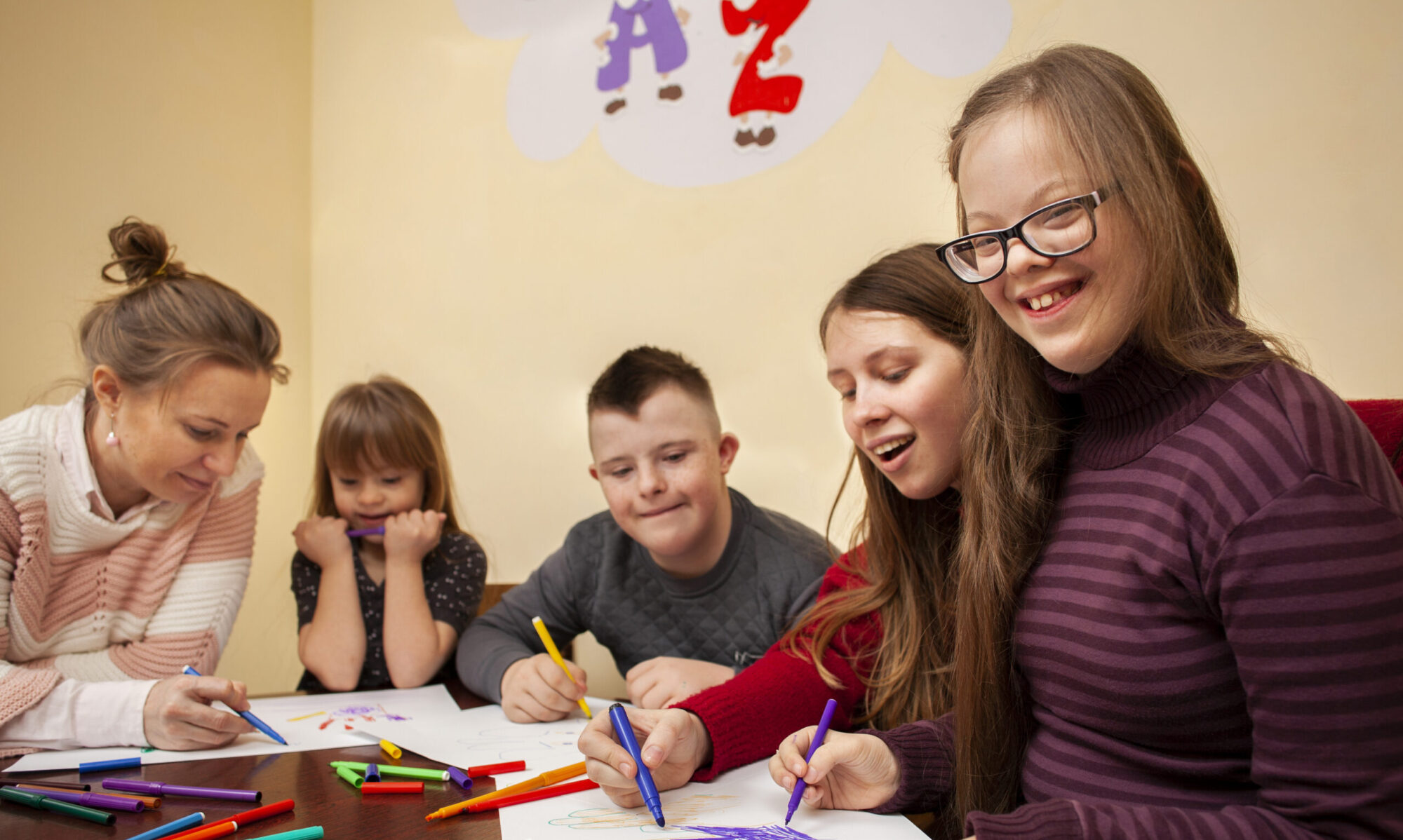
5 Tips for Including Students with Down Syndrome in a General Education Classroom

Having your student with Down syndrome included in the general education classroom with proper supports can often seem like a pipe dream. Just look at the statistics: only 16% of our loved ones with intellectual disabilities (ID) are included in general education classrooms most of their school day.

But the research and federal law back up full inclusion with support, so how do we get there? Well, I was lucky enough to find inclusion expert, Nicole Eredics from The Inclusive Class. This amazing inclusion teacher has created a huge database of resources to support full inclusion for even students with Down syndrome. You can also buy her book (shown below) with over 40 modifications for students with the most significant needs.

Read Related Post Here: $10 MillIion Dollar Grant Awarded to Support Inclusion for Students with Significant Cognitive Disabilities 

Nicole Eredics moved to California from British Columbia, where she started her career in teaching. “In British Columbia the system is set up for mandatory inclusion. That’s the norm. All teachers were trained how to include every type of learner in their classroom. We all co-taught, and inclusion never happened in isolation. I was shocked by the lack of support for inclusion when I moved to the states,” Eredics says.

From this stark difference, The Inclusive Class blog was born. Eredics uses webinars, research-based evidence, podcasts and loads of resources to teach parents and teachers how to successfully include all learners. She says students with Down syndrome can in fact be included, but that child needs a lot of support. “You can’t place a child with an intellectual disability with same age peers if you’re not getting any support,” Eredics explains.

5 Tips From the Inclusive Class To Help Support Inclusion for Students with Down Syndrome: 

  1. Show your child’s school what successful inclusion looks like.

    “When inclusion isn’t the standard, the parent is going to have to be on the ground making it happen,” Eredics explains. Get to know the school climate, the principal, staff, and teachers. Share the video below with your child’s school, and watch more examples of what inclusion looks like here. Sometimes seeing is believing.

2. Teach the team about your child. 

“You know your child best, so show the school what he’s capable of doing,” explains Eredics. This should include describing in detail your child’s strengths, weaknesses, wants and needs. Check out the one-page bio of Troy. A fellow rockin’ mom was the original creator of this idea. Go here if you want to create one.

Eredics says videos are also helpful. Show your child interacting with peers, doing a favorite activity, mastering a skill. “Many teachers are fearful of how a student with an intellectual disability will impact their classroom. It’s important to  facilitate and encourage a strong relationship with the school, where they feel comfortable asking you about your child,” Eredics says.

Read Related Post Here: 3 Steps to Prepare for Your Child’s Next IEP Meeting

3. Demand that your students with Down syndrome gets the support he needs.

Eredics says students with intellectual disabilities obviously needs a well-planned IEP, but more important parents should ensure the IEP is being carried out with fidelity and that the student has  one-on-one support.

“The child is either going to need a paraprofessional to help facilitate the physical participation in the classroom or the class should be co-taught. I have never seen a student with ID successfully taught without the support of one of those teaching methods,” Eredics describes.

4. Ensure your child has appropriate accommodations and modifications.

Just as important as a paraprofessional or co-teaching method, is appropriate accommodations and modifications. There is a difference, and both are needed. “Accommodations are the pathways to learning like eyeglasses to see, a special pencil grip to write, or an audio book to read along,” Eredics explains.

Modifications may also be needed for students with Down syndrome, because it allows them to access grade-appropriate curriculum at their level. “They’re still learning the same content, but learning expectations are different. Content can be simplified, or the child can learn one aspect of the material. Alternative assessments and eventually alternate diplomas fall under modifications,” says Eredics. Click here to get more details about accommodations and modifications.

Eredics says it may also be helpful for parents to help create modifications. “There was never an expectation that the parent must do more at home, but we also were glad to work with parents that wanted to help. Request the textbook, curriculum, and lesson plans ahead of time,” says Eredics. Many states have actually modified the Common Core for students with the most significant cognitive disabilities, and many teachers don’t even know about this resource. Click here to get the Essential Elements.

Read Related Post Here: Promoting Inclusion through Universal Design for Learning 

5. Get teacher buy-in!

Eredics says the biggest barrier to inclusion for students with Down syndrome is the teacher. “If you have a teacher who’s not willing and resistant, inclusion will never work. The teacher is not only responsible for academics, but also the social aspect of the classroom. They create a community and set the tone. If the teacher is excluding the student, it doesn’t matter how much you advocate. Even though you have the law on your side, it really comes down to that teacher’s personality. Over the years, talking to people this is the #1 problem. Point blank,” she says.

Eredics encourages parents to volunteer in their child’s school and start learning who the teachers are in higher grades. Request teachers who seem to have heart and an open-mind. Start the inclusion conversation before they even begin school. And don’t be afraid to request a change of teacher if your child is being excluded.

Nicole Eredics’s book for parents and teachers called Inclusion in Action: Practical Strategies to Modify Your Curriculum will be available next month. “The book includes specific modifications for students who have intellectual disabilities,” says Eredics. Stay tuned for more information and a book review.

Check out her website here: www.theinclusiveclass.com 

Is your child with Down syndrome included in a general education classroom? What has been the biggest reward and challenge? I’d love to hear about your experiences. Comment below.

“I Have A Dream…”

“I have a dream. It’s a dream deeply rooted in the American dream…”-Martin Luther King

I have a dream one day our sons and daughters with disabilities will be valued as equal members of their community. I have a dream teachers and principals will set high expectations for our children, realizing the value of inclusion with their typical peers.

I have a dream those non-disabled peers will one day become employers and community leaders who provide adults with intellectual and developmental disabilities (I/DD) the opportunities they deserve to fulfill their true potential. That those typical peers will become caregivers, researchers, therapists, and medical professionals who look at people with disabilities, not as a problem to be fixed or eliminated, but as a beautiful expression of humanity to be shared with the world.

Rev. Dr. Martin Luther King Jr. speaking. (Photo by Julian Wasser//Time Life Pictures/Getty Images)

On Monday, January 18, 2021, we celebrate Martin Luther King’s birthday and are reminded of how interlinked the disability community’s struggle is with the African American community. Without downplaying the abhorrent past of slavery, there’s still a lot of connections to be made. Both movements are struggles for basic human rights: freedom, equality, and justice.

Read Related Post Here: Advocates Urge Congress to Increase Funding for Down Syndrome Research

The Civil Rights Act of 1964 woke up parents of children with disabilities. The public and their representatives in Congress began to understand how segregation and unequal educational opportunities were the anti-thesis to the American dream. Before the 1970s, many children with disabilities were not given the opportunity to attend school at all. As Congress was formulating the Individuals with Disabilities Education Act (IDEA) of 1975, there were 36 pending court cases over the rights of students with disabilities.

More than 30 years after the civil rights movements began, great progress has been made for both black Americans and people with disabilities. The most abusive and neglectful institutions have closed their doors. Courts have expanded their interpretation of the 14th Amendment’s “equal protection clause” to include minorities and those with disabilities. Segregation has legally ended for both groups (including the Americans with Disabilities Act (ADA), Rehabilitation Act–including section 504, and IDEA for people with disabilities).

Read Related Post Here: How School Boards are Using Endrew F. Supreme Court Case Against Students with Down Syndrome

But we know, even though both groups have made great gains legally, they still face prejudice and exclusion. Only 16.35% of students with I/DD are included in a regular education classroom with supports for most of their school day. Black students are overrepresented in special education and are more likely to be identified as having an intellectual disability than their white peers. The intersectionality between race and disability is ever apparent.

The Supreme Court recently ruled in Endrew F. that schools must provide a “more meaningful benefit” to students with disabilities, but some school districts and national organizations are interpreting this to mean students with the most significant disabilities must be segregated to earn this benefit. (Read more about this here).

In this highly partisan time it often seems like one step forward and one step back. For example, last year the Department of Justice scrapped ADA guidance that promotes integrated work for people with disabilities. With unemployment for people with I/DD at 75%, this is a step backwards. We need more guidance, not less. (Read more about the rescinded ADA guidance here). Fortunately, the U.S. House of Representatives recently passed the Raise the Wage Act, which will phase out sub-minimum wages. Click here to email your Senator to support this bill.

Let’s make the year 2021 about fully realizing the rights and humanity of people with disabilities of every race. There’s so much more we can do for and alongside our brothers and sisters with disabilities.

Progress will continue! It will take tireless action from self-advocates and allies. When our government and institutions waver in indecision about full inclusion for our loved ones, we must forge forward. So what can you do this Martin Luther King Day to advocate for someone with Down syndrome?

Call to Action

  1. Advocate: learn about your student with a disabilities rights and how to advocate at the IEP table by signing up for a FREE webinar here, read online resources or order an advocacy book here, joining the Council of Parent Attorney’s and Advocates here, or the National Down Syndrome Advocacy Coalition (NDAC) here.
  2. Think College: make it your child’s long-term IEP goal to go to college. There’s more than 260 college options for students with I/DD. Check it out here.
  3. Donate: give to your local Down syndrome affiliate, or to a specific cause. Global Down Syndrome Foundation has been raising money this year to create updated, evidence-based medical guidelines for adults with Down syndrome. Click here to find out more.
  4. Legislate: support national legislation to end organ transplant discrimination of people with disabilities. You can read about the state legislation I helped advocate for in Ohio here. Read about the federal bill here.

How do you feel about the state of disability rights? What do we need to do right now to continue moving forward? Comment below.

Federal Appeals Court to Decide if Student with Down Syndrome Can Stay in General Education Classroom

If you are a parent or teacher of a child with Down syndrome, you’ll want to follow the proceedings of a Ninth Circuit case that may change how and where school districts place students with intellectual disabilities. You can watch the proceedings LIVE, Thursday April 11th here.

The case revolves around a 2nd grade Arizona boy with Down syndrome whose parents refused to send him to a self-contained classroom at a different school, because they argue he was making progress at his homeschool in general education. Starting in kindergarten, the student attended his neighborhood school in a regular classroom with a paraprofessional, and was pulled out 110 minutes for “intensive instruction” in reading, math and writing.

Related: 5 Tips for Including Students with Down Syndrome in the General Education Classroom

“Student was demonstrating progress on his IEP goals, including the majority of the goals that were implemented by the resource teacher (academic/social- behavior goals). Additionally, the student’s resource teacher admitted that his communication skills greatly improved from two-word phrases, which were limited to things he knew about, such as about his mom, dad, or sister, or naming things that he knew, to three to four-word phrases. The impact on his typical peers and teachers was described by his kindergarten teacher as ‘amazing’,” according to the plaintiff’s open brief (parent’s attorney filed).

The Gilbert Unified School District has 30 days after the plaintiff’s brief to file their own, but the following link gives you a more detail description of the district’s possible argument. Click here.

Ninth Circuit Court of Appeals

Despite his progress, the Gilbert Unified School District in Arizona decided just a few months into his kindergarten year that the boy should have 20 more minutes of “intensive instruction.” This time in a self-contained classroom at another school. The school district said the new school would be better for the student, and provide him with “more services at his level with peers in a small environment that could have been better for him.” This subjective opinion was the only evidence they used to propose a change in the boy’s IEP.

The parents argued that it amounted to a change of placement without the proper evaluation of his progress under his current IEP, but the district argued it was just a change in location. Although the Special Education Director testified the model of teaching was different at the new school, where the students would be in a self-contained class 100% of the day using a replacement curriculum.

Sound familiar? It’s likely, if you have a school-aged child with Down syndrome, your child or someone you know has fought a similar battle. After 30 years of research and federal law to back up inclusion with proper supports, parents are still fighting for their child to be included in kindergarten of all places. And the battle often gets more difficult as students progress through school.

But Endrew vs. Douglas County has give parents an opportunity to demand more for our children. The U.S. Supreme Court ruled that schools must provide special education that enable students with even the most significant cognitive disabilities to meet “challenging” and “appropriately ambitious” goals. For these students, progress may be measured against “alternate academic achievement standards” designed to promote further education, work, and independence.

Related: Realizing the Promise of the Endrew Supreme Court Case

The Ninth Circuit Court of Appeals must now decide if the school district made a change in placement and threatened the student’s access to a Free and Appropriate Education in the Least Restrictive Environment as the parents argue, or if it was simply a change in location as the school district contends.

The National Down Syndrome Congress and National Down Syndrome Society have written amicus briefs in support of the Arizona boy, stating the Supreme Court’s Decision in Endrew announced a “Markedly More Demanding” standard for educating students with disabilities, reflecting the IDEA’s high expectation for students. The organizations’ amicus brief also describes the research that proves “students with disabilities benefit from being included in regular classrooms with non-disabled peers.” You can read both briefs here and here.

Fortunately, the Individuals with Disabilities Education Act (IDEA) allows the Arizona boy to stay in his current placement while the court proceedings continue. He’s now in a regular 2nd grade classroom at his homeschool, and his parents say he continues to make progress.

The map below shows the states that will be impacted by the Ninth Circuit of Appeals decision. If you live in a different district the court decision doesn’t have to be followed, but could be used as a possible argument by parents or a school district in similar due process hearings.

The parents and school district can still appeal to the U.S. Supreme Court if they are unhappy with the Ninth Circuit’s decision. I’ll keep you posted on the court case as it unfolds.

You can read about the family in a local Gilbert, Arizona news story here.
You can also read a more recent blog post about the Arizona boy’s mom who has fought for the last 2-years to ensure he remains at his neighborhood school. Click here.

Have you or someone you know had to fight a similar battle for inclusion? Are you frustrated that we’re still fighting this fight more than 30 years after the Individuals with Disabilities Education Act (IDEA) was passed? Tell me about it below.

Teaching Cultural Literacy Promotes Inclusion for Students with Down Syndrome

Two years ago, my twin son’s preschool teacher gave them an assessment to identify common consumer products or stores like: Kroger, McDonald’s, and Walt Disney.


They both failed miserably. We were new to town and were used to shopping at the Commissary at our previous duty station. My kids, at barely 3-years-old, had not yet experience the magic of the golden arches or Mickey Mouse on repeat. I was offended by the vulgar consumerism in this assessment; not to mention the fact that my son with Down syndrome couldn’t yet verbalize his own name…how was he going to say “Kroger.”

Read Related Post Here: Promoting Inclusion Through Universal Design for Learning

So much about this assessment was wrong, but the essential idea behind it is important to understand. “Cultural Literacy,” coined by educator E.D. Hirsch, means having a familiarity with information that is common knowledge. His ideas became the basis of the common core standards. The problem is too many students with Down syndrome are not accessing the general education curriculum, and are therefore missing huge chunks of information that most Americans know and understand without explanation.

Special Educator, Janet Romo, says students with Down syndrome’s lack of cultural literacy only leads to unemployment, exclusion, and isolation. “My Master’s in Special Education really didn’t prepare me to teach students with intellectual disabilities. The textbooks will tell you these students need a lot of repetition, but often schools are just teaching life skills on repeat. I searched for modified lesson plans aligned to the general education curriculum, but there was nothing available. When my own daughter with Down syndrome reached middle school I realized there was no way for her to access the curriculum in a general education Social Studies class,” Janet explains.

So, Janet began creating her own. She now has a business and private Facebook group called Austin & Lily: Intellectual Disabilities and Education, that features tips for teachers and entire units of study aligned to general education curriculum at various reading comprehension levels. “I went back for my doctorate and focused on inclusion of students with Down syndrome. I now teach at the university level, and realized there was a great need for lesson plans to specifically teach these students grade-level curriculum at their level,” Janet says.

Read Related Post Here: 5 Tips to Include Students with Down Syndrome in the General Education Classroom

“It takes me about 8 hours to develop one book as part of a unit of study. I’ve stayed away from the high order thinking. I lay it out on a more basic level. They need to have pictures representating what you’re teaching. The research shows the more realistic the image the better, because they’re looking at these images literally,” Janet explains. Austin & Lily now has units of study for Social Studies and Current Events at all grade levels. You can find them here.

Austin & Lily Unit on George Washington

The Individuals with Disabilities Education Act (IDEA) and the recent Endrew Supreme Court Case require school districts provide meaningful benefit to students with disabilities in the least restrictive environment and with the general curriculum. Janet says many students with Down syndrome are good readers, but often can’t comprehend what they’re reading. Offering a visualization of the content can help build cultural literacy.

“I’m an advocate of the more background knowledge a person has the less difficult it is to visualize. Students with intellectual disabilities need to be exposed to a lot of vocabulary, people, places, things. Background knowledge needs to be built up. If you’re going to read a book about the Arctic, a good teacher must build up background knowledge, like a powerpoint about what happens in the Arctic, images, and words used there. All this prepares the student for the book. We’re preparing them for life by building up these schemas to help them understand,” Janet describes.

Janet says she plans to move on to creating units for other subjects, and says it will be a never-ending venture. Her goal is to sell licenses of her material to school districts. She wants all students with Down syndrome to have a basic understanding of common topics like Shakespeare, American Government, Biology and Current Events.

As for my twin boys, after living in Ohio for three years, both give a shout out to Kroger when we drive by now. They’ve only been to McDonald’s once, but my son with Down syndrome has an affinity for Mickey Mouse. Although I disagree with the way their preschool assessment was done, I do agree with Janet. Cultural literacy is one way to better inclusion in society.

Check out Austin & Lily’s products here, and join Janet’s private Facebook group here.

What successes and barriers to learning Cultural Literacy has your student with Down syndrome faced?

From Awareness to Advocacy at the Buddy Walk

Our local self-advocates proved how important advocacy is at our 15th Annual Miami Valley Down Syndrome Association (MVDSA) Buddy Walk.

Nothing About Us, Without Us!

Often good-intentioned parents and loved ones create fundraising events like the Buddy Walk to spread awareness about Down syndrome, but don’t include actual people with Down syndrome in leadership or advocacy roles. This mind set has got to change

Down Syndrome Affiliates in Actions gave me the idea of having our local self-advocates lead the Buddy Walk with a advocacy table. This idea started six months ago with a Self-Advocate Communications Workshop that you can read about here and here. At the workshop, teens and adults with Down syndrome learned the skills they need to become self-advocates and lead our Buddy Walk.

Related Post: “I Can!” A Communications Workshop for Teens and Adults with Down Syndrome

Our mantra is “I Can!” and our local self-advocates proved they can stand up for themselves and speak out about issues that are important to them. I’m so proud of them all: Anna, Walter, Sarah, Joe, Megan, Adam, Olivia, Bill, Pete, and Sally. After my own son, Troy, they all are the reason I have become such an impassioned advocate. They will always hold a special place in my heart!

Us at the Advocacy Table (from left: Adam, me, Joe, Bill, and Walter. The three guys in orange were are amazing UD Athlete volunteers that held down the fort while we all walked; oh, and there’s Sally way to the right)

These amazing self-advocates were the first faces hundreds of Buddy Walkers saw as they entered Fifth-Third Stadium. Capable, independent, proud! Imagine how powerful this is for a new parent who’s attending the Buddy Walk for the first time. They’re still scared; not sure what to expect. May be they’ve never met a person with Down syndrome. It’s so important that the leaders of the Buddy Walk, or any awareness campaign, be the very people we are trying to support. It’s imperative that they are seen for who they are: More alike, than different!

Self-Advocate, Walter May, giving a speech on home base at Fifth-Third’s Field

Each self-advocate had a special role at the Buddy Walk. I want to give a huge shout out to Walter May, who braved the masses and gave a rousing speech that had the whole Dragon’s Baseball stadium cheering! How inspiring to see an adult with Down syndrome, who’s proud of who he is, tell others about his experiences and what he values.

Related Post: Advocacy- Organ Transplant Waitlist Discrimination Bill

Anna, Olivia, and Joe escorted our VIP guests including Andrea Harker from Montgomery County Developmental Disabilities Services, Tamara Hawes from U.S. Representative Mike Turner’s office, and Ohio State Representative Niraj Antani. These three self-advocates had to get out of their comfort zone and talk to a lot of strangers. But after months of practice they nailed it.

Representative Niraj Antani also spoke about the newly introduced Ohio House Bill 332 that will ensure all people with disabilities can receive life-saving organ transplants like everyone else. I’ve been working with Rep. Antani all summer to introduce the bill, so it was so exciting to see our hard work coming to fruition. The bill would end discrimination on organ transplant waitlists. You can read a personal story of discrimination here in Ohio right here.

Related Post: Rockin’ An Extra Chromosome

Of course, we were able to fit in some fun amongst all the seriousness of advocacy. In fact, it was said by our Executive Director, Willie Cox, that our Advocacy Table was the most popular place to be. We had a party atmosphere! Playing Plinko, giving out Down syndrome bling, and spreading love.

Self-Advocates, Anna and Pete, showing attendees how to win big with Plinko
Self-Advocates, Olivia (left) and Megan, with Dragon’s Baseball mascot, Gem
Self-Advocate, Sally, went to the dark side LOL
Who’s the fairest Self-Advocate in all of the land?

I’m used to spending the entire Buddy Walk with my family, but they seemed to have a rockin’ time without me. My typical son, Hunter, absolutely LOVES the Buddy Walk. He talks about it all year long. Troy, on the other hand, can take it or leave it.

Have any questions about our Self-Advocate Table or want to start your own? Comment below and I’ll be in touch.