Self-Advocates Learn Body Language Speaks Louder than Words

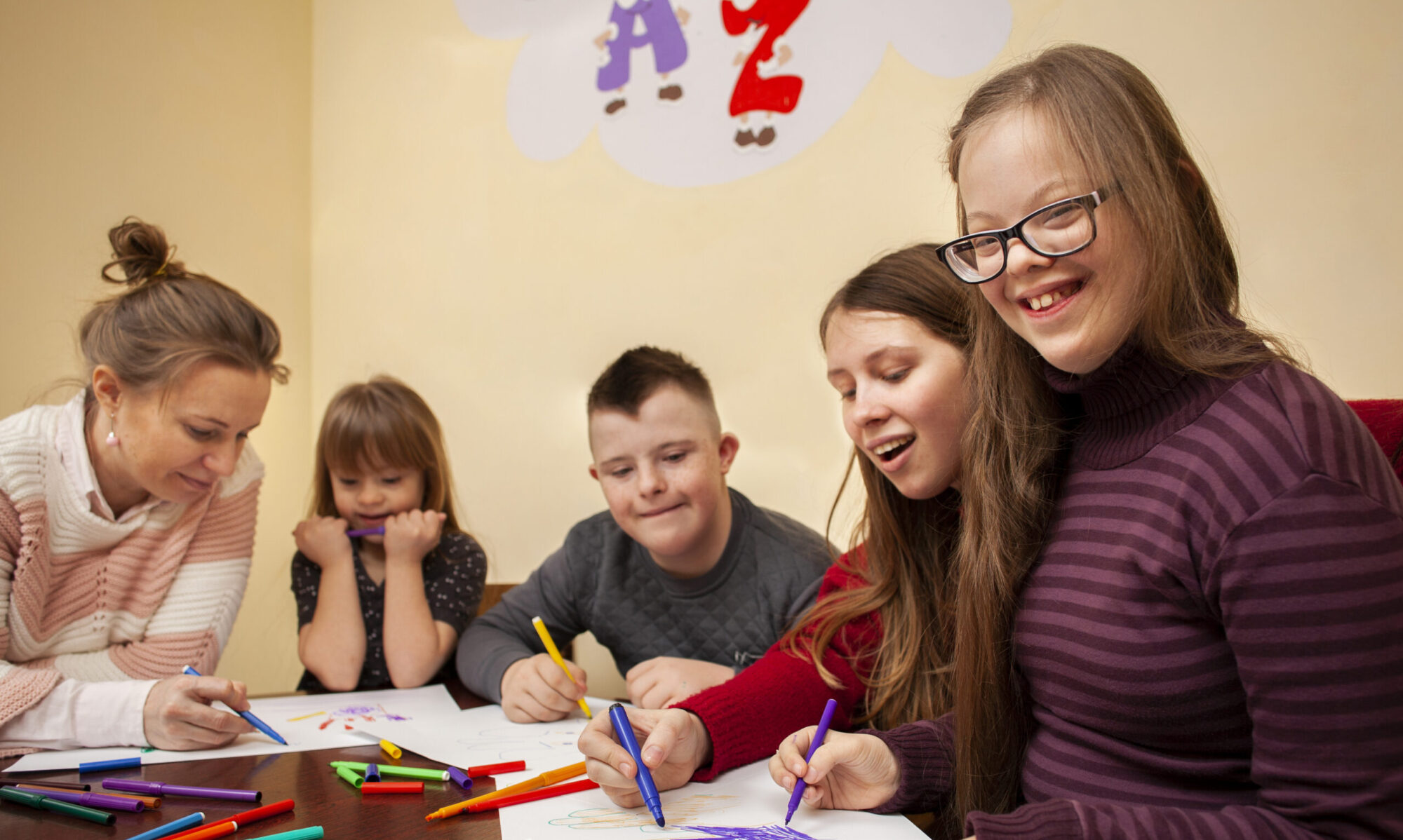
The adult self-advocates in our monthly communications workshop are learning how body language shapes people’s perceptions. 

Every month a group of up to 9 self-advocates get together to hone their communication skills. Our short-term goal is to prepare these adults with Down syndrome to lead our advocacy table at the Buddy Walk in September. In the long-term, our hope is these new communication skills will lead to more involvement in the community and employment opportunities.

Self-advocate, Anna, watching herself talk in the mirror

This month’s topic is non-verbal communication, which experts say makes up for 70% of any given conversation. All of us used body language long before we learned to talk. For individuals with Down syndrome, non-verbal communication may be their primary mode of communicating their needs and wants.

What is your body telling your audience?

That’s the question we posed to our self-advocates. Although they all used many non-verbal cues in conversation, almost all were unaware of the impact of those cues. A long look in the mirror brought some of our negative body language to light.

Lack of eye contact and looking “closed off” were two of the most common mistakes we learned by taking a look in the mirror.

Anna is a particularly confident communicator. She always made great eye contact and uses hand gestures to explain her point. But after seeing herself in the mirror she remarked “I need to remember to keep smiling.”

Theater Educator, Stephanie Radford (emphasize on the “RAD”), gave our self-advocates pointers on “matching”. This technique requires the listener to copy the expression and emotion of the talker. “It’s important to show you are listening and empathize with the talker, without saying a word,” Radford explains.

Theater Educator, Stephanie Radford

Radford stresses the action of body language is more memorable than what you say.

This is especially important for our self-advocates who are often unsure of what to say or concerned that they might not be intelligible or understood. At the Buddy Walk we stressed that their body language should exude an air of confidence and openness.

They’ll be introducing Congressmen and our mayor at the Buddy Walk, as well as teaching attendees about Down syndrome and programs our local group provides self-advocates. It’s important that they use their expression, eye contact, and gestures to show they’re the experts on all things Buddy Walk related.

In three short sessions I have have seen improvement in our self-advocates communications skills. I can’t wait to see them in action during our 15th Annual Buddy Walk!

To learn more about our self-advocate communication workshop click here.


Continue reading “Self-Advocates Learn Body Language Speaks Louder than Words”

“Faith” in Inclusion Leads Student with Down Syndrome to Make History

A standard high school diploma can seem out of reach for students with Down syndrome. But with inclusion and a lot of hard work, 19-year-old Faith did just that! 

Faith (bottom left) performing with her typical peers

Faith became the first person with Down syndrome to graduate with a regular high school diploma in Martin County, Florida School District. Also unprecedented, she was included in general education throughout her educational career. 

“I’m really happy to graduate with a standard diploma. I learned chorus, I learned drama. I like drama, I like to act. I was in Romeo and Juliet, Wizard of OZ, Beauty and the Beast. I was in Jubilate chorus too. I like all my friends,” Faith says.

Faith was on track to earn a special certificate of completion until 2014, when Florida special education law changed to allow students with disabilities to try for a standard diploma. Students with disabilities can use alternate assessments and something called “access points,” which allows them to access the general curriculum in a modified way with supports. They still must pass alternative assessments and earn enough credits to receive a standard diploma.

The school district told her mom, Paulette, that on top of being the first student with a significant disability to receive a standard diploma, Faith was the first to use the “access points” in a general education setting. “That has always seemed odd to me, that a special curriculum offering access to the general education curriculum would cause the student to be excluded from the gen ed class,” Paulette describes. 

Paulette said inclusion wasn’t easy. She received a lot of push back when Faith entered kindergarten and again as she entered middle and high school. But she always set high expectations and was able to find at least one educator who supported their efforts or had an open-mind.

“At Faith’s first IEP meeting, her preschool teacher remarked that Faith had done well in the preschool, developed friendships, learned the alphabet and how to write her name. Then this wise and wonderful woman said: ‘I am not trained in special education, no one is in our private school. Faith has been successful. Certainly with all the resources of the public school system she can continue to be included with typical children,'” Paulette describes.

Faith (bottom, third from the left) performing with the Senior Jubilates

“At the beginning of 8th grade our supportive inclusion specialist called the high school to tell them to get ready, they would be including their first student with Ds. The ESE director at the high school laughed and told her they didn’t do that. The first year of high school was rocky, but then the woman retired and the new director was fully on board with making history!” Paulette remembers.

Faith’s inclusive experience allows her to be comfortable in many situations. She’s danced and acted alongside her typical peers. With appropriate supports and modifications she dissected a frog in a general education Biology class, which she described as a “yucky experience.”

“I have friends in drama club and Jubilate. I have friends from economics, history, math. I learned all things and got A’s. My mom helped me to learn in other classes,” Faith describes.

“Faith has made a difference in the lives of many typical students over the years. She has changed the attitude of people she has shared the classroom with. They know that although it is challenging, people with Ds can learn and be a valued member of a group,” Paulette says.

Faith is set to begin vocational training at a local hospital with Project Search. Her goal is to be a musical theater actress, but says she wouldn’t mind working in a movie theater for now to earn money. 

Faith’s mom hopes that their story will lead other parents to fight for inclusion. “I really want parents of younger kids to follow the path we have blazed. Faith is a pioneer and I have led the wagon train. I am willing to help parents who want help with IEP meetings or just for a listening ear. I don’t want our experiences to be an anomaly. I want us to be an example of success,” Paulette explains.

As for Faith, she has her own advice for students with Down syndrome that want to follow in her footsteps: “My advice to other kids with Ds is get a standard diploma. Take drama, chorus, English, economics, history. My teachers are impressed with me and my activities. I learned about Beowulf, Hamlet, Romeo and Juliet and I did projects. Read a lot of books. That’s it.”

Faith and her family at graduation. Faith’s mom, Paulette, to the right of Faith.