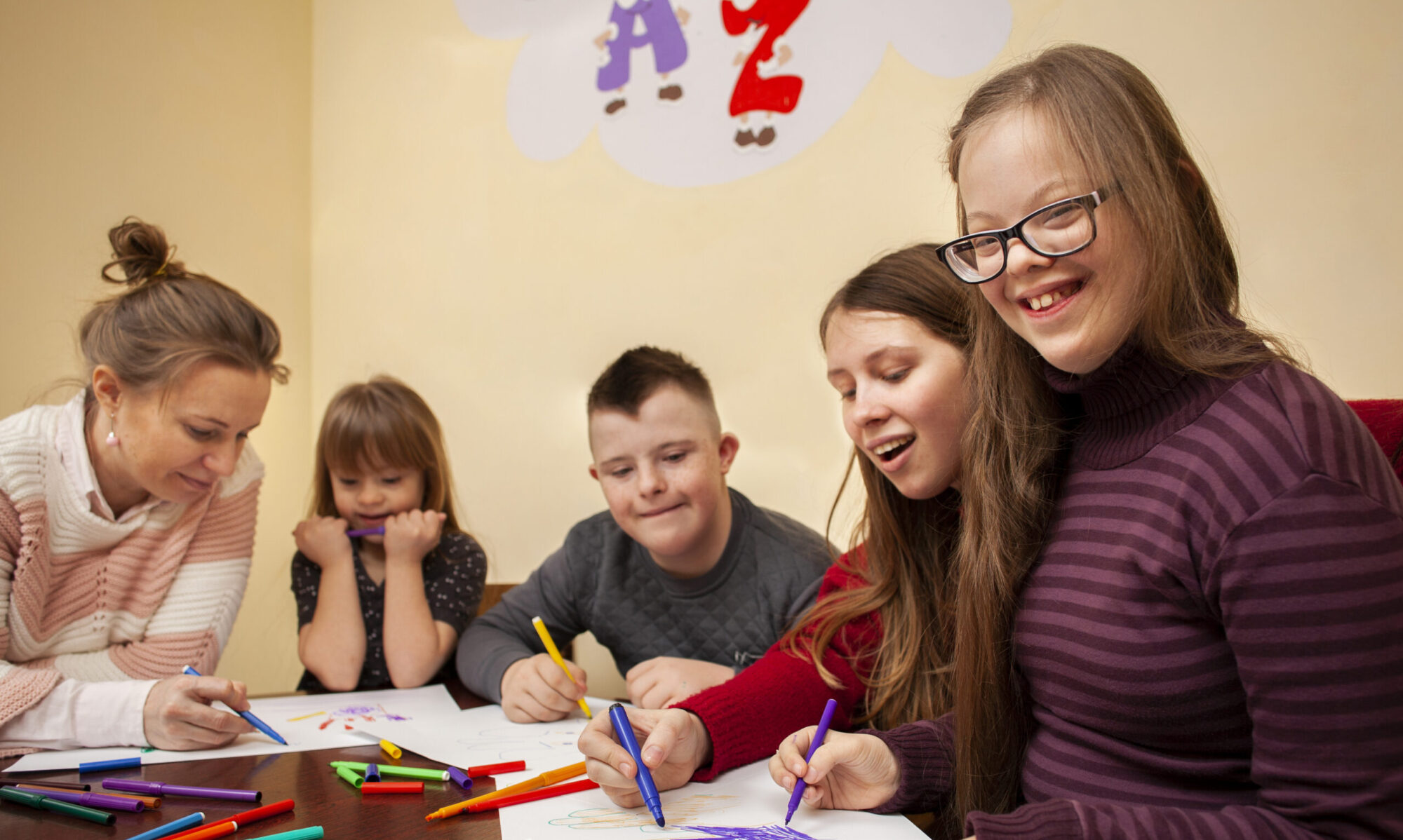
It’s that time of year. Back to school shopping, first day of school social media posts, and well planned out lunches. But if you’re a parent to a child with a disability, you have the added anxiety of IEP meetings, checking in to see if your child and his teacher have all the needed supports, and wondering if your child will be meaningfully included.
Start the school year right by sharing information about your child, as well as what inclusion means to you. Being intentional about disability acceptance could be the key to friendships with typical peers in the general education classroom. Parents of typically developing classmates may not know what to say to their child about your child’s differences. They may even be apprehensive about having a child with a significant disability in their child’s class.
Dispelling any myths and educating parents about the benefits of inclusion is a great way to start out the school year.
I got you covered. Below is a parent-to-parent guide that you can print and share. Also included are tips to create your own customized “all about me” page highlighting your child.
I suggest you wait until the second or third week of school to share these resources with classmates’ parents. You want parents to spend time with these documents, and too much information is sent home at the start of the school year. This is a conglomerate of information I’ve seen and learned over the years as a non-attorney special education advocate. Feel free to print and share the PDF version below:
If you’re looking for an easy way to create a customizable “All About Me” page look no further than www.canva.com. Canva’s image-driven bold templates are sure to catch anyone’s attention. Check out the one I made for my son a few years ago:
Added Bonus: I have my son hand-deliver this to teachers during the first IEP meeting or Back to School Night before school begins. He also shares his most current work. This gives teachers a glimpse of a highly-capable student, instead of the weakness-based legal documents they’re used to reading about students.
How do you introduce your child and the idea of inclusion to teacher and classmates? Share any resources in the comments section below.
October is Down Syndrome Awareness Month, and Disability History Month in the state of Washington. As my journey with my own son with Down syndrome has evolved I realize that I want more than awareness. I’d love for our society to move from awareness and acceptance to true inclusion.
I think it’s important that we move past simple awareness campaigns to something that persuades actual action. But how? How do we raise awareness and persuade people to truly accept people with disabilities for who they are?
Outside of the classroom, there’s many small, yet powerful actions you can take. Advocating for laws that end sub minimum wages, and promote community inclusion can be as easy as sending a letter to your representative or showing up to a rally. Another powerful step towards equity is working with people with disabilities to understand how they want to be respected and supported. Always question yourself and others. Do you or people around you still harbor ableist feeling like pity or inferiority of people with disabilities? Learning from these moments and moving forward is an important first step towards acceptance, and something I still practice and struggle with sometimes. We should always invite people to change and evolve in their perspective; that’s what advocacy is about.
When and how should parents formally introduce their child in a classroom setting, and promote disability acceptance?
First, let’s talk about what NOT to do. You might have come across the use of disability simulations: marshmallows in the mouth to simulate low tone and lack of intelligibility, hands in mittens to simulate poor fine motor skills, blindfolds to simulate–well, being blind. Do you notice what all these simulations highlight?
What a person can’t do, rather than how individuals with disabilities successfully adapt to their environment with the right modifications and supports.
Instead of promoting empathy and awareness, research studies show disability simulations actually promote fear, apprehension, and pity towards their classmate with a disability. Also, because the simulation is only for a short time, it’s hard for typical students to truly experience the classmate’s limitations in a meaningful way.
Inclusion Activities in Grade School
Trying to promote acceptance will take more time and thought than awareness campaigns but they’re worth it. I invited a local self-advocate with a disability to come talk to our entire school body about acceptance. I hope that this will make a lasting impact.
During the COVID pandemic you can modify these assemblies by having local members of your community with disability submit recorded videos that you can then share during the school’s morning announcements. This month I organized a number of different videos for my son’s school, including one from our school’s Physical Therapist where he introduces his service dog and explains how the dog is used to help students with disabilities. My own children even asked to create a video to talk about inclusion.
You can also reach parents through your school’s newsletter. I’ve created a Parent-to-Parent Guide that talks to parents about disability rights, inclusion, and tips on how their child can be an ally to classmates with disabilities. You can use my guide with proper citations.
Many teachers and parents like to take a more broad approach to awareness of differences in lower grades. For instance, in kindergarten through 2nd grade you may not even mention the term “Down syndrome” or “Autism.” Many parents decide the discussion shouldn’t single their child out, but foster acceptance of all students. Children’s books are a great way to foster acceptance of people for who they are. Here’s some examples:
“What Happened To You?” by James Catchpole: A great book to introduce the idea of disability pride, and gently remind students that a person with a disability is not a lesson to be learned. The book reminds readers that people with disabilities want the same things as everyone else: belonging and inclusion. Pity has no place here.
“My Friend Isabelle” by Eliza Wilson: I love this book, because it starts with two friends that have so much in common, but also talks about differences. The reader only finds out that one character has Down syndrome by reading the jacket note at the end of the book. It also has a guide to help teachers and parents incorporate the book into a classroom lesson. Watch the YouTube click below for a video version of the book.
“Just Ask: Be Different, Be Brave, Be You” by U.S. Supreme Court Justice Sonia Sotomayor: Did you know Justice Sotomayor lives with Type 1 Diabetes? She talks about her own life as well as the lives of other children with disabilities or health conditions in this beautiful children’s book. She uses the analogy of a garden to show how people’s differences can be their superpowers.
“King Louie and His Marshmallow Kingdom”by Louis Rotella: About a little king who rules over a kingdom where the sun always shines and every meal is a picnic. Louie explains to his friends that he loves to do kid-things, even though he’s different. This is one of my all-time favorites!
Awareness Activities with Older Students
Books can also be used with older students, and some may actually define a disability. But more hands-on or project-based activities are also fun at this age. Open discussions about what students already know about disabilities (or think they know) is imperative. Prior knowledge allows teachers and parents to assess where to start, as well as any preconceived notions students may have. Discussing inclusion is also important at this age. All kids want to be included.
“All the Way to the Top: How One Girl’s Fight for Americans with Disabilities Changed Everything by Annette Bay Pimentel: A phenomenal new book that looks at the Disability Rights Movement and the advocacy effort to get the Americans With Disabilities Act passed. It follows one young advocate that showed Congress how important access is for people with disabilities. This is a great book for 2nd or 3rd graders, who can start thinking about how they could advocate for people with disabilities in their own communities.
The Girl Who Thought In Pictures: The Story of Dr. Temple Grandin by Julia Finley Mosca: “If you’ve ever felt different, if you’ve ever been low, if you don’t quite fit in, there’s a name you should know…Meet Dr. Temple Grandin—one of the world’s quirkiest science heroes!” When young Temple was diagnosed with autism, no one expected her to talk, let alone become one of the most powerful voices in modern science. Yet, the determined visual thinker did just that.
Washington State Governor’s Office of the Education Ombuds (OEO) created the One Out of Five Project to promote disability pride and inclusion through simple lesson plans. You can get those here. The Governor’s Council for People with Disabilities also did a fabulous disability awareness campaign in Indiana and posted all of their lessons here. Some of their ideas include:
Students create a class motto for inclusion
Anonymously write questions students have about disability and difference, and have those questions read and answered as a class (or in private)
Create a classroom mural that depicts what an inclusive class, school, and community looks like
Perform a simple skit showing appropriate and inappropriate ways to interact with classmates with disabilities: people’s first language, asking before you help someone, inviting classmates to special occasions, treat your classmate the way you want to be treated
Show a movie or show that depicts someone with a disability as the main character
Evaluate their school or local business to see if they accessible for people with disabilities. If they’re not, come up with a plan to change that.
Invite a sign language interpreter to teach students some simple signs.
What are you planning to foster acceptance in your child’s classroom? Add some ideas in the comments sections.
The following are some other books that may help you foster acceptance in the classroom:
“I have a dream. It’s a dream deeply rooted in the American dream…”-Martin Luther King
I have a dream one day our sons and daughters with disabilities will be valued as equal members of their community. I have a dream teachers and principals will set high expectations for our children, realizing the value of inclusion with their typical peers.
I have a dream those non-disabled peers will one day become employers and community leaders who provide adults with intellectual and developmental disabilities (I/DD) the opportunities they deserve to fulfill their true potential. That those typical peers will become caregivers, researchers, therapists, and medical professionals who look at people with disabilities, not as a problem to be fixed or eliminated, but as a beautiful expression of humanity to be shared with the world.
Rev. Dr. Martin Luther King Jr. speaking. (Photo by Julian Wasser//Time Life Pictures/Getty Images)
On Monday, January 18, 2021, we celebrate Martin Luther King’s birthday and are reminded of how interlinked the disability community’s struggle is with the African American community. Without downplaying the abhorrent past of slavery, there’s still a lot of connections to be made. Both movements are struggles for basic human rights: freedom, equality, and justice.
The Civil Rights Act of 1964 woke up parents of children with disabilities. The public and their representatives in Congress began to understand how segregation and unequal educational opportunities were the anti-thesis to the American dream. Before the 1970s, many children with disabilities were not given the opportunity to attend school at all. As Congress was formulating the Individuals with Disabilities Education Act (IDEA) of 1975, there were 36 pending court cases over the rights of students with disabilities.
More than 30 years after the civil rights movements began, great progress has been made for both black Americans and people with disabilities. The most abusive and neglectful institutions have closed their doors. Courts have expanded their interpretation of the 14th Amendment’s “equal protection clause” to include minorities and those with disabilities. Segregation has legally ended for both groups (including the Americans with Disabilities Act (ADA), Rehabilitation Act–including section 504, and IDEA for people with disabilities).
But we know, even though both groups have made great gains legally, they still face prejudice and exclusion. Only 16.35% of students with I/DD are included in a regular education classroom with supports for most of their school day. Black students are overrepresented in special education and are more likely to be identified as having an intellectual disability than their white peers. The intersectionality between race and disability is ever apparent.
The Supreme Court recently ruled in Endrew F. that schools must provide a “more meaningful benefit” to students with disabilities, but some school districts and national organizations are interpreting this to mean students with the most significant disabilities must be segregated to earn this benefit. (Read more about this here).
In this highly partisan time it often seems like one step forward and one step back. For example, last year the Department of Justice scrapped ADA guidance that promotes integrated work for people with disabilities. With unemployment for people with I/DD at 75%, this is a step backwards. We need more guidance, not less. (Read more about the rescinded ADA guidance here). Fortunately, the U.S. House of Representatives recently passed the Raise the Wage Act, which will phase out sub-minimum wages. Click here to email your Senator to support this bill.
Let’s make the year 2021 about fully realizing the rights and humanity of people with disabilities of every race. There’s so much more we can do for and alongside our brothers and sisters with disabilities.
Progress will continue! It will take tireless action from self-advocates and allies. When our government and institutions waver in indecision about full inclusion for our loved ones, we must forge forward. So what can you do this Martin Luther King Day to advocate for someone with Down syndrome?
Call to Action
Advocate: learn about your student with a disabilities rights and how to advocate at the IEP table by signing up for a FREE webinar here, read online resources or order an advocacy book here, joining the Council of Parent Attorney’s and Advocates here, or the National Down Syndrome Advocacy Coalition (NDAC) here.
Think College: make it your child’s long-term IEP goal to go to college. There’s more than 260 college options for students with I/DD. Check it out here.
Donate: give to your local Down syndrome affiliate, or to a specific cause. Global Down Syndrome Foundation has been raising money this year to create updated, evidence-based medical guidelines for adults with Down syndrome. Click here to find out more.
Legislate: support national legislation to end organ transplant discrimination of people with disabilities. You can read about the state legislation I helped advocate for in Ohio here. Read about the federal bill here.
How do you feel about the state of disability rights? What do we need to do right now to continue moving forward? Comment below.
More than 54 million American school children are learning at home right now. Seven million of those students have disabilities. Since the outbreak of the Coronavirus in March, 45 states have ordered schools closed, and 15 states are keeping schools closed until the end of the school year. That list will surely grow as the virus peaks (find an updated list here).
In two weeks, Department of Education Secretary, Betsy DeVos, is set to offer guidance to Congress on whether or not to issue waivers that could postpone or eliminate school districts’ responsibility to provide a free and appropriate education to school children. It’s important to note, DeVos cannot waive educational disability rights; only Congress can do that. DeVos does have the power to waive rights and responsibilities under general education laws though and already has. Read more here.
Parents of children with disabilities have 2 very important tasks during school closures:
Write and/or call your Congressperson THIS WEEK. We don’t have much time. Share your child’s personal story with distance learning during the pandemic, and tell them educational waivers are not needed. The law already provides amendments and timeline extensions when there are exceptional family circumstances. School districts and parents need to work collaboratively to decide if extensions should happen on an INDIVIDUAL basis. We need to urge Congressmen to let the law do its job- NO WAIVERS! Read why and how below.
Document, Document, Document! You know the old adage: if it’s not in writing or on video, it doesn’t exist. You should be taking data of your child’s progress, or lack of progress during this time. Take baseline data now (a video of them reading, writing, doing math, anything related to their Individual Education Plan (IEP)). Keep that documentation up as school closures continue. If your school won’t do teletheraphy, and you decide to pay out of pocket for private teletheraphy make sure you document it. Read why and how below.
The Department of Education released guidance on March 21, 2020, stating that school districts should provide distance learning to all kids during school closures and shouldn’t use federal disability law, like the Individuals with Disabilities Education Act (IDEA) or Section 504, as an excuse not to. School districts will need to be equitable and innovated in their plans to do distance learning while Americans are social distancing. Read more here.
This is good news for disability advocates. That means virtual IEPs, evaluations, and teletherapies should be happening. School district should be lending out computers and providing wifi to those who need it. Most importantly, these distance learning opportunities should be individualized for your child with a disability. A lot of school districts across the country are already providing these learning opportunities. Why would we stop these collaborative and innovative efforts? All children deserve these rights and access to distance learning. Learn more about how school districts are providing access and best practices for distance learning here.
The COVID-19 pandemic highlights issues of equity unlike any other crisis we’ve seen. The students who are likely to fall behind during school closures are those who are poor or have disabilities. Parents should be reasonable, but school districts should also be working diligently to provide equitable access to distance learning. Don’t be afraid to ask for services and accommodations, when all students are expected to learn online. This is why advocating against educational waivers is so important.
Some organizations, like the National Association of State Directors of Special Education (NASDSE) and the Council of Administrators of Special Education (CASE), are asking DeVos to provide a 45 day extension, once schools are back in session, for all IDEA timelines. NASDSE and CASE are also asking for flexibility in school districts’ documentation of FAPE, data collection, and corrective action plans. This would impact preschool programs, state complaint and due process, initial and reevaluations, as well as the development, review and revision of IEPs. Read their March 31, 2020 letter here.
Special Education advocates are strongly against this. On April 3, 2020, the Council of Parent Attorneys and Advocates (COPAA) sent a letter to DeVos reminding her that the Department of Education on March 21st already appropriately responded to the crisis, and should “fully uphold all tenets and requirements of IDEA and 504.” The letter goes on to state that IDEA already provides flexibility for individualization and collaboration between districts and parents, and “students with disabilities cannot afford the lengthened delay that would result from a blanket pause in timelines.”
NASDE did write a joint statement with COPAA on March 23, 2020, that all rights and responsibilities under federal disability law should remain. Now that organization wants flexibility in the law. But COPAA and other special education advocates are arguing that IDEA already provides needed flexibility and collaboration between parents and school districts to provide a free and appropriate education at this time.
So, here’s where you come in. Please write to your Congressperson TODAY! Find your representatives and their contact information here.
Tell them your child’s story regarding COVID-19 and school closures. Please share good examples of how your school district is already providing a Free and Appropriate Education through distance learning. Urge your Congressperson to issue NO WAIVERS during or after school closures. Remind them that federal law under IDEA already provides flexibility in timelines and services under exceptional family circumstances. Send your email soon. DeVos is set to issue her recommendations in two weeks. Read an example of a good letter here and here. Make sure you personalize your email.
Lastly, start collecting data on your child’s progress and/or regression during this time. The IEP document allows for parent training. If you don’t know how to take data, request that your school teach you simple ways to take data. And easy way to do this is to take video of your child now and and throughout the school closure time. Make sure you timestamp any data entries. Also, if you’re paying for teletheraphy or other private distance learning make sure you receive invoices and data from those private providers. You may be able to advocate for compensatory education upon return to school to make up for any lost learning.
If you’re busy with homeschooling now, use this simple email format:
Dear (Enter your Congressperson’s name):
IF YOUR CHILD IS RECEIVING APPROPRIATE SERVICES DURING THIS TIME: I’m writing to you today to tell you about my child with a disability’s experience with distance learning during the COVID-19 school closure, and urge you to uphold all of the tenets and responsibilities of the Individuals with Disabilities Act (IDEA) even during this time. My child is receiving needed accommodations and services during distance learning. I’m working with my child’s IEP team virtually, and we hope that our collaborative will ensure my child continues to make meaningful progress. Many school districts around the nation are providing innovative and equitable ways to meet the needs of students with disabilities. My child and other children across the nation cannot afford more delays that would come from federal timeline waivers. Soon, Department of Education Secretary Betsy DeVos will issue guidance regarding waivers under IDEA and other educational laws. I urge you to resist any call for waivers. IDEA already provides this flexibility. Thank you for your time and consideration!
IF YOUR CHILD IS NOT RECEIVING APPROPRIATE SERVICES DURING THIS TIME: I’m writing you today to tell you about my child with a disability’s experience with distance learning during the COVID-19 school closures, and urge you to uphold all of the tenets and responsibilities of the Individuals with Disabilities Education Act (IDEA) even during this time of crisis. Although my child with a disability is not receiving all of the needed accommodations and services during this time, I’m convinced from other examples of success in distance learning across the nation that I can work collaboratively with my child’s school district to ensure meaningful progress is made. My child and other children across the nation cannot afford more delays that would come from federal timeline waivers. Soon, Department of Education Secretary Betsy DeVos will issue guidance regarding waivers under IDEA and other educational laws. I urge you to resist any call for waivers. IDEA already provides this flexibility. Thank you for your time and consideration!
Is your child’s school district providing equitable distance learning opportunities? Comment below with your experience during COVID-19 school closures.
The Individualized Education Plan (IEP) can be an intimidating document. It can also make or break a student’s experience in special education. Parents often sit passively in IEP meetings where pre-written goals are recited to them. It can often feel like you have no input, but it doesn’t have to.
Parents are often their child’s best advocate. Use your expertise to become the mastermind of your child’s IEP. Don’t leave it to school staff to write the IEP from their perspective. Interject your wants and needs for your child. The Individuals with Disabilities Education Act (IDEA) gives parents the explicit right to be an equal member of the IEP team, and have their requests considered.
You might be thinking: “I do this. I’m always making requests and the school staff always say no.” But are your requests in writing? Are your requests formally made before and during an IEP meeting, not just in an email? Are you asking for Prior Written Notice explaining the school’s decision to accept or deny your requests? You’ve heard the saying: If it’s not in writing, it doesn’t exist. You must formalize your requests, and require the school staff to formalize their denials. This last part is really important; most schools don’t want to formally deny parents’ requests because it creates a paper trail that parents can use in dispute resolutions.
Read on to learn how to formalize your requests:
You should be asking for a draft of your child’s IEP at least a few days before the meeting. A few days before the school sends you a draft IEP, send them a parent input form (see a sample parent input form below). Ask the IEP author to copy and paste your concerns into the IEP. It’s important to have your actual words inserted into the legal document. I do this for my own son and the families I advocate for, and I’m always amazed at how many of our requests are inserted into the draft.
Sending it ahead of time gives everyone a heads up of what to expect at the meeting. It cuts down on the time of the meeting, and allows the team to get to all of the parent’s concerns. For example, I notice in a lot of meetings the IEP team will spend so much time reading word for word about the present levels. Many parents have already read and accepted this information at the evaluation meeting. Present levels are often copied and pasted from the evaluation report. If you send in requests and get a draft IEP ahead of time, you might feel more comfortable skipping entire sections that you agree with or have already read.
Often the IEP team never gets to topics like Extended School Year (ESY) and special transportation, because they used up all the meeting time on the first half of the IEP. But if you wrote in the parent input form that you have concerns about these topics they must address them, either at the meeting or in a Prior Written Notice (PWN). Always ask them to answer all your requests in the PWN, even if you didn’t get to those concerns in the meeting.
Check out an example of a Parent Input form that I use for my own son and the families I advocate for. I got this from fellow advocate, Helen Caldart, at the Special Education Advocates League of Pierce County, WA. It’s easy to use and follows most IEP formats. Feel free to share and use with credit to Helen Caldart. You can find more of her amazingly helpful documents at www.sealk12.org.
How do you prepare for your child’s IEP and make official requests? Do you put your requests in writing? Tell me about your experiences with this below.