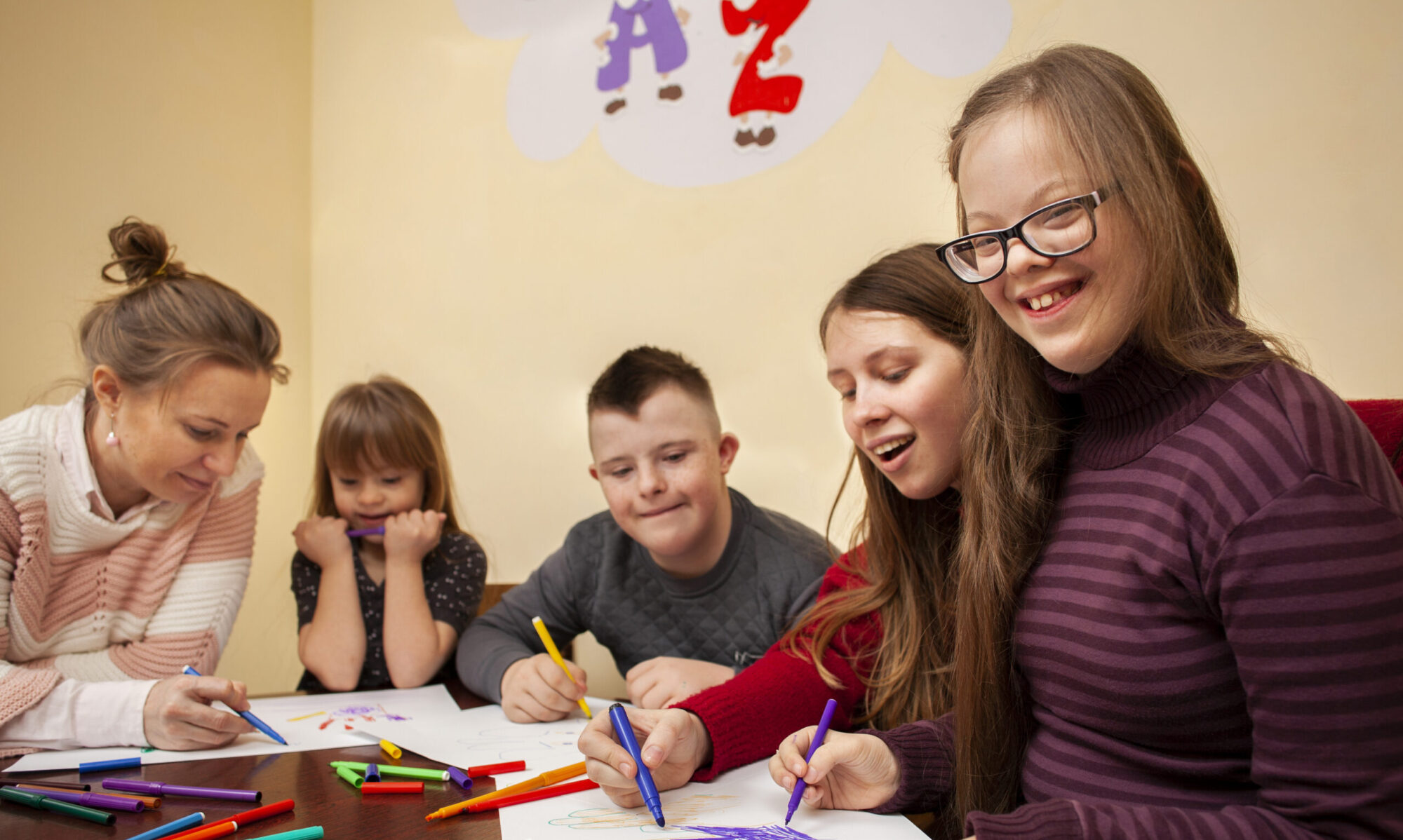
Finding Inclusion as a Military Child with a Disability

Tis the season to PCS! Your husband is on TDY, so it’s up to you and one power of attorney to secure the movers, sell the house, organize all 18,000 pounds of stuff you plan to move, and sell that couch that won’t fit in your new house in a new state. You can’t see out the minivan because 3 kids, 2 dogs, and all your personal items must make it across country to your moms for the next two months before you find permanent digs at your new duty station.

Military families are extremely resilient. We bloom where we’re planted. We often make fast friends, throw ourselves into new careers or hobbies, play tourist in our new town, while leaving it better than when we arrived.

Military life also presents real stressors and challenges, especially for families with children with disabilities. The Exceptional Family Member Program (EFMP), a.k.a. the PCS gatekeeper, throws in a whole new wrench into the works. Orders often center completely around the military child with a disability, rather than the active duty member. You can’t go to your dream duty station, Germany, because the services are supposedly inadequate for your child. You have to say goodbye to that excellent Speech Pathologist who did PROMPT, and the gap in service while moving could mean a real gap in your child’s communications skills. You heard from another military wife that the schools in the neighborhood you want to live in don’t even follow the law, much less do inclusion.

How can a military family advocate for full inclusion for their child with a significant disability when they’re dealing with so many other moving parts? How does a military child maintain a consistently inclusive educational career when they move every 2 to 4 years?

These are two very difficult questions that I’m not sure I can tackle in one post or even have a complete answer to. My hope is that I can post a few tips that works for my son with Down syndrome, and other military families will chime in with what’s worked for them. I’d love to do a follow-up post with other family’s experiences. Here it goes!

3 Tips to Finding Inclusion As a Military Child with a Disability:

  1. Secure a solid IEP before you PCS:
    • Use those military orders to your advantage. Dangling the orders in the face of your child’s current IEP team if needed. Tell them you’re moving so writing in a full time paraprofessional, daily communication with parents, and modified homework given to the student a week before it’s due into the accommodations section of the IEP should be no big deal. Sometimes this is all an IEP team needs to hear to make some real effective changes to the IEP.
    • The Individuals with Disabilities Education Act (IDEA) requires the new school district you move to to provide a comparable IEP for at least 30 days. This gives you time to make your case to keep the current IEP or improve upon it. The new IEP team must also give you a Prior Written Notice (PWN) explaining WHY they won’t follow the IEP from out of state. Many schools don’t want to make a denial of comparable services in writing, so make sure you ask for the PWN.
  2. Stalk Social Media Groups at your new duty station:
    • Social media opens up a whole new world for families of children with disabilities. There’s a closed group for everything, and could be a great starting point to find an inclusive school.
    • WARNING: some parents’ idea of inclusion may not be in line with your idea of inclusion. I had to learn this the hard way when my son started preschool at our duty station in Ohio. Although the public preschool included 50% of students without IEPs, starting in kindergarten kids were segregated. Luckily, we PCSed before I had to fight for inclusion.
    • Be specific on social media: ask what percentage of time their child spends in general education. You’re looking for at least 80% or more. Ask if proper supports are given, and if the school actually follows through with their child’s IEP.
  3. Get Serious with a Freedom of Information Request:
    • Did you know you can find out how many restraints or seclusion cases a district had in a year? Or how many due process cases a district had and the outcome? If the district had any Civil Rights Complaints made against them. All of this is public information, so once you’ve chosen one or two schools get down to business with a freedom of information request.
    • A request through the district or state office of education (special education office) can reveal so much about the school you’re hoping to choose. Anything from state complaints to individual employee complaints. Go to the state’s Parent Training and Information Center to find out how to make the request for public records in your new state.
    • Side note: this is completely different than looking at school rankings on line (think “Great Schools” and other such sites). Often the traditional rankings tell you nothing about how the district does special education. In fact, a very high rated school in Ohio was notorious for segregating kids with IEPs. So beware!

Lastly, reach out to a local special education advocate to get their take on districts that are following the law and including kids with disabilities in general education. The Council of Parent Attorneys and Advocates has a directory of advocates by state. Advocates often are filing state complaints and civil rights complaints all the time, so they will know which school districts to stay away from.

I called a local advocate before we planned to PCS to Washington state, and I’m still friends with her today. My son is also 93% included in general education with appropriate supports in a state that is ranked 3rd lowest in the nation for inclusion. Doing your homework pays off!

What tips do you have for military families PCSing with a child with a disability? How did you find an inclusive school? What do you wish you would have done differently?

7 NEW Research Studies to Help You Win the Fight for Inclusion

One of my most popular posts included 7 evidence-based research studies that prove the benefits of inclusion for students with and without disabilities. Still, I had a few readers comment that the research studies I cited were too old to be impactful. I was completely irked by these comments, because no one would ever say research from the 1990s showing the benefits of desegregation on black and white students is not still impactful and true today. Still, I have come across so many new studies that show the benefits of inclusion, that I thought I would update my original post. In fact, as you’ll read below there are absolutely NO research studies that show an academic advantage for students with intellectual disabilities in a segregated setting. I hope you’ll share these newer research studies with your child’s IEP team or other potential non-believers.

______________________________________________________________________________

“Almost 30 years of research and experience has demonstrated that the education of children with disabilities can be made more effective by having high expectations for such children and ensuring their access to the general education curriculum in the regular classroom, to the maximum extent possible.”

Most parents of students with with an Individualized Education Plan (IEP) have heard a variation of the quote above, especially if you’ve tried fighting for inclusion. I assumed this statement was just hyperbole. I figured there was some truth in it, but that there was probably just as much research showing self-contained classes were more beneficial than inclusion. At least that’s what most school districts and even many parents would have you believe.

Imagine my surprise then, when I read the EXACT quote above in the introduction to the Individuals with Disabilities Education Act (read it for yourself right here). The actual law, supported by both Democrats and Republicans, states that a regular classroom with proper supports is best for ALL students with disabilities. I was a bit taken back, and wanted to know more about this research the law touted.

Read Related Post Here: My Original Post with 7 Evidence Based Research Study that Prove Inclusion Works

What I found was even more surprising. Did you know there’s not one quantitative research study, since research began on the topic, that shows an academic advantage for students with intellectual disabilities in separate settings? None! Zip! Nada! Here’s the research study citation to prove it: Falvey, Mary A. (Spring 2004) Toward realization of the least restrictive educational environments for severely handicapped students. Research and Practice for Persons with Severe Disabilities. 29 (1), 9-10. 

Luckily, I’ve learned a lot more about the research that supports proper inclusion in the Least Restrictive Environment for students with even the most severe disabilities as part of the Council of Parent Attorneys and Advocates Special Education Training. It’s a year-long course I completed for my own son’s entry into public education, as well as to fulfill my goal to help other families advocate for inclusion for their child.

So, without further ado, below are 7 NEW quantitative research studies that show the benefits of including students with disabilities in a general education classroom:

  1. A 2013, quantitive study of more than 1,300 students between the ages of 6 and 9 years old within 180 school districts found that access matters. The study found a strong relationship between the amount of time spent in general education and achievement in math and reading for students with disabilities.
    • Citation: Cosier, M., Causton-Theoharis, J., & Theoharis, G. (2013). Does Access Matter? Time in General Education and Achievement for Students With Disabilities. Remedial and Special Education34(6), 323–332. https://doi.org/10.1177/0741932513485448

2. A 2010, synthesis of research studies shows the academic effects that peer tutoring has on students with disabilities (regardless of disability type). The literature overwhelmingly reveals that peer tutoring has a positive effect on the academic outcome of students with disabilities in grades 6 through 12.

  • Citation: Okilwa, Nathern S. A.; Shelby, Liz, (2010). The Effects of Peer Tutoring on Academic Performance of Students with Disabilities in Grades 6 through 12: A Synthesis of the Literature. Remedial and Special Education, v31 n6 p450-463 Nov-Dec 2010

Read Related Post Here: So you survived IEP season? 3 steps to get organized NOW for the next one

3. A 2012, comparative study followed 34 students with Intellectual Disabilities (ID) fully included in general education with supports with a control group of 34 students with ID in special schools. Included children made slightly more progress in literacy skills than children attending special schools. The researchers concluded that inclusive education is an appropriate educational placement for students with ID who require extensive supports in school.

4. A study looking at the outcome of 11,000 students with all types of disabilities found that more time in a general education classroom correlated to less absences from school, fewer referrals for misbehavior, and more post-secondary education and employment options.

  • Citation: Wagner, M., Newman, L., Cameto, R., and Levine, P. (2006). The Academic Achievement and Functional Performance of Youth with Disabilities: A Report from the National Longitudinal Transition Study-2 (NLTS2). (NCSER 2006-3000). Menlo Park, CA: SRI International

5. A 2017, study found that 41.7% of student with learning disabilities made progress in math in general education classes compared to 34% in traditional special education settings, without the presence of nondisabled peers.

  • Citation: Sharp, N. (2017). Inclusion in the early childhood classroom: What should this look like? (Master’s thesis, Northwestern College, Orange City, IA). Retrieved from http://nwcommons.nwciowa.edu/education_masters/32/

6. A 2011, study finds that there’s nothing “special” about the four walls of a special education classroom. The research suggest that the purported rationale for self-contained special education in the literature–issues of community, distraction-free environments, specialized curriculum/instruction, and behavioral supports–were not present in the six observed self-contained settings. Implications for school leaders are discussed and the rationales for the utilization of self-contained classrooms are strongly questioned.

  • Citation: Does Self-Contained Special Education Deliver on Its Promises? A Critical Inquiry into Research and Practice. Causton-Theoharis, Julie; Theoharis, George; Orsati, Fernanda; Cosier, MeghanJournal of Special Education Leadership, v24 n2 p61-78 Sep 2011.

7. Many schools and parents make the argument that typical peers may be negatively impacted by the presence of students with disabilities. Especially those students with behavior problems. But a 2013, study found that inclusion does NOT compromise a typical students academic or social outcome. No significant difference was found in the progress of the low-, average-, or high-achieving pupils from classrooms with or without inclusion.

So with all this proof, why are students with intellectual disabilities still only being included in general education 17% of their day on average? Tell me below why you think this is the reality for our loved ones. I’ll do a blog post giving my answer as well.

When Being “You” is a Form of Activism

You know what’s ice cold these days? The newest trend since goths vs. jocks? Being yourself! The art of self-promotion is palpable; just look on social media. Everyone is selling a version of themselves; the more unique, the more dope. Many people with disabilities also develop and embrace an innate sense of self. My son and many kids and adults I’ve met with an extra chromosome love who they are. They truly are dope! The problem is they’re often not allowed to be themselves and still fit in. The trend doesn’t extend to them.

If they’re even given a chance to be included in a regular classroom or competitive paying job (which is far too few), the onus is always put on the person with the disability to change to fit in. Society often can’t be burdened to do the simplest of accommodations to allow them to show us their gifts. When a person with a disability shows us who they are in the classroom or at work it becomes a form of activism. As if to shout: “LOOK AT ME! This is who I really am. Take it or leave it!” Too often society looks the other way.

Read Related Post: Accommodations Mean Access

Children with disabilities are supposed to be educated alongside their typical peers to the maximum extent possible. Supports for these students should be exhausted before moving to a more segregated setting. It’s federal law in the United States! But it’s not what’s happening for far too many students with disabilities almost a half a century after the Individuals with Disabilities Education Act (IDEA) passed. Unemployment for adults with developmental disabilities stands at 80%! Many adults with ID work in sheltered workshops getting paid well below minimum wage.

In my current state of Washington, only 8% of students with Intellectual Disabilities (ID) are included in the regular classroom for the majority of their day. Washington state ranks amongst the lowest in the nation for educational inclusion, but the numbers in supposedly inclusive minded states aren’t where they should be either. In fact, a study from the American Journal on Intellectual and Developmental Disabilities found that inclusion rates for students with ID are actually declining since the 1990s. Nationwide, only 17% of students with ID are spending more than 80% of their day in general education.

The fact that someone like my son, who has Down syndrome, spends more than 90% of his day with his typical twin in a regular classroom is an anomaly here in Washington state and in many places across this country. Even though the law says it should be the norm. Legally a student should start in regular education before a more restrictive setting is ever discussed.

Read Related Post: 7 Research Studies You Can Use At Your Child’s Next IEP Meeting to Win the Fight for Inclusion

Now I’m taking it a step further. Not only do I want you to include people with Intellectual Disabilities, but I want you to truly accept them for who they are. Most people don’t really get what this means. This is how I know: they’ll say something like “Oh sure, we accept them, but they have to keep up in class.” No, actually they don’t! That’s what the Individual Education Plan (IEP) is for: to give specially designed instruction, accommodations, and modifications so a child can be educated in the least restrictive environment. Not to keep up, but to make meaningful progress in light of their disability.

We know behavior is communication. When a student with a disability struggles in a regular classroom they’re often telling us that they’re not afforded the same right to be themselves as other typical students.

Too often, employers or schools ask: “How do we change this person so they can be included?” How do we turn this question around? Instead, how can we change the environment to include this person?

Universal Design for Learning (UDL) supports the idea that all learners are different, and providing different modes of representation in learning can help reach all students. UDL teaches us that it’s the environment, not the student, that needs to change. Here’s a great video from Understood.org showing how UDL works in a classroom.

Following the heart of IDEA also leads to acceptance of students with disabilities. Really exhausting those supports is an important first step to acceptance. Just because a student needs direct support throughout their day doesn’t mean they’re not benefiting from everything a regular classroom provides. Just because a student with ID doesn’t master all the content, doesn’t mean it wasn’t worth the teacher’s time.

Inclusion shows us that life can be about so much more than just keeping up. It’s about meeting people where they’re at, supporting each other to move forward, and accepting people for who they are.

If parenting a child with an intellectual disability has taught me anything it has taught me this: It’s time we embrace the person and the process, and stop obsessing about the end product. So, thank you to all the “activists” out there who are showing the world who you really are, and asking us to meet you where you’re at.

From Awareness to Acceptance this #WDSD

March is Developmental Disabilities Awareness Month, and March 21st is World Down Syndrome Day. As my journey with my own son with Down syndrome has evolved I realize that I want more than awareness. I’d love for our society to move from awareness to acceptance, recheck our ableist tendencies, and provide a more equitable world for our loved ones with disabilities.

I admit I once wore those “crazy socks” for World Down Syndrome Day, but now realize the campaign does little to persuade people to actually accept my son. The organizers of his trend even changed the name to “wacky socks,” because of the inherent ableism in it’s name: “crazy” socks. I think it’s important that we move past these awareness campaigns to something that persuades actual action. But how? How do we raise awareness and persuade people to truly accept people with disabilities for who they are?

Outside of the classroom, there’s many small, yet powerful actions you can take. Advocating for laws that end sub minimum wages, and promote community inclusion can be as easy as sending a letter to your representative or showing up to a rally. Another powerful step towards equity is working with people with disabilities to understand how they want to be respected and supported. Always question yourself and others. Do you or people around you still harbor ableist feeling like pity or inferiority of people with disabilities? Learning from these moments and moving forward is an important first step towards acceptance, and something I still practice and struggle with sometimes.

When and how should parents formally introduce their child in a classroom setting, and promote disability acceptance? 

First, let’s talk about what NOT to do. You might have come across the use of disability simulations: marshmallows in the mouth to simulate low tone and lack of intelligibility, hands in mittens to simulate poor fine motor skills, blindfolds to simulate–well, being blind. Do you notice what all these simulations highlight?

What a person can’t do, rather than how individuals with disabilities successfully adapt to their environment with the right modifications and supports.

Instead of promoting empathy and awareness, research studies show disability simulations actually promote fear, apprehension, and pity towards their classmate with a disability. Also, because the simulation is only for a short time, it’s hard for typical students to truly experience the classmate’s limitations in a meaningful way.

Awareness Activities in Grade School

Trying to promote acceptance will take more time and thought than awareness campaigns but they’re worth it. I invited a local self-advocate with a disability to come talk to our entire school body about acceptance. I hope that this will make a lasting impact.

Many teachers and parents like to take a more broad approach to awareness of differences in lower grades. For instance, in kindergarten through 2nd grade you may not even mention the term “Down syndrome” or “Autism.” Many parents decide the discussion shouldn’t single their child out, but foster acceptance of all students. Children’s books are a great way to foster acceptance of people for who they are. Here’s some examples:

“My Friend Isabelle” by Eliza Wilson: I love this book, because it starts with two friends that have so much in common, but also talks about differences. The reader only finds out that one character has Down syndrome by reading the jacket note at the end of the book. It also has a guide to help teachers and parents incorporate the book into a classroom lesson. Watch the YouTube click below for a video version of the book.

“The Day the Sheep Showed Up” by David McPhail: About farm animals who had never met a sheep before. The sheep teaches them that they are more alike than different. Great metaphor for accepting those that are different, and fabulous for new readers.

“King Louie and His Marshmallow Kingdom” by Louis Rotella: About a little king who rules over a kingdom where the sun always shines and every meal is a picnic. Louie explains to his friends that he loves to do kid-things, even though he’s different. This is one of my all-time favorites!

Awareness Activities with Older Students

Books can also be used with older students, and some may actually define a disability. But more hands-on or project-based activities are also fun at this age. Open discussions about what students already know about disabilities (or think they know) is imperative. Prior knowledge allows teachers and parents to assess where to start, as well as any preconceived notions students may have. Discussing inclusion is also important at this age. All kids want to be included.

The Governor’s Council for People with Disabilities did a fabulous disability awareness campaign in Indiana and posted all of their lessons here. Some of their ideas include:

  • Students create a class motto for inclusion
  • Anonymously write questions students have about disability and difference, and have those questions read and answered as a class (or in private)
  • Create a classroom mural that depicts what an inclusive class, school, and community looks like
  • Perform a simple skit showing appropriate and inappropriate ways to interact with classmates with disabilities: people’s first language, asking before you help someone, inviting classmates to special occasions, treat your classmate the way you want to be treated
  • Show a movie or show that depicts someone with a disability as the main character
  • Evaluate their school or local business to see if they accessible for people with disabilities. If they’re not, come up with a plan to change that.
  • Invite a sign language interpreter to teach students some simple signs.

What are you planning to foster acceptance in your child’s classroom? Add some ideas in the comments sections.

The following are some other books that may help you foster acceptance in the classroom:

3 Tips to Survive Your Child’s Next IEP Meeting

IEP season is upon us! It’s like preparing for Christmas or Hanukkah without any of the joy. Still, the results of an IEP (good or bad) will have a much more lasting impact on your child’s life than any holiday gift they receive. It’s important to get the process right. Here’s some useful tips:

Other than your child, you are the most important person on your child’s IEP team. That’s because you know your child best. Likely, you’ve become an expert on your child’s strengths and weaknesses.

Read Related Post: 3 Words That Will Transform Your Next IEP Meeting

If you’re reading this, I know you’ve spent countless hours scouring the Internet for expert advice on inclusion and educational best practices.

Still, an IEP meeting can often feel like an episode of David and Goliath. You playing the part of David.

So, now is the time to get organized. Rally the troops, because this year’s IEP meeting is going to be EPIC…in a good way!

Here’s 3 tips to make your child’s IEP meeting run as smoothly as possible: 

  1. Never go alone to an IEP meeting!
    • An IEP team meeting can include countless school personnel, often with their own agenda.
    • If you can afford it, find an non-attorney special education advocate in your area by searching the Council of Attorney and Advocates directory here. A good advocate can cost you anywhere from $100-$1000, but it may be worth your weight in gold to have someone in your corner who knows the law. 
    • If you can’t afford an advocate, invite an friend, pastor, neighbor….anyone who is less emotionally invested than you are and who can take good notes. 
    • Many state Parent Training and Information Centers (PTIs) provide free non-attorney special education advocates. Click here to find your state’s PTI center.

2. Organize all those documents CHRONOLOGICALLY!

  • As a former teacher, I realize failure to document can come back to bite you in the “you know what.” Keep all of your child’s records – from evaluations to letters home to IEPs to that adorable little Mother’s Day painting he made you this year. But how?
  • First, go out and buy the BIGGEST 3-ring binder you can find.
  • MOST IMPORTANT: Organize your documents chronologically! I’ve tried creating categories for my son’s IEP folder, but I soon realized the categories are ENDLESS (IEP, ETR, Behavior, Communications, Resources, etc). Also, some of the documents could really be under more than one category (which category do you choose then?).
  • My best advice, create a table of contents with the following: date, author, type, significance. Number each document and place them in order of date. Then you can quickly look back at your table of contents to find your child’s “1st grade ETR”. 

Read Related Post: Using the Recent Endrew F. Supreme Court Case at Your Child’s Next IEP Meeting

3. Put EVERYTHING in WRITING!

  • Communication is EVERYTHING! Save it all: emails, letters home, even text messages.
    • Make all requests in WRITING! I have so many clients who complain that they asked for a 1:1 aide for their child and the school said “no.” If you ask for the aide in writing your child’s school has to provide Prior Written Notice explaining why they denied your request. Often school’s don’t want to official deny a request in writing. Read about Prior Written Notice here
    • At the end of each email I send to school personnel I always write: “please add this to Troy’s educational record.” Emails can often get lost in the ether, but they can be very powerful if you need to make a case for a change in your child’s IEP later. Make sure you make them a part of your child’s official record.
    • The easiest way to save emails if you don’t have a physical copy and don’t want to print it out, is through email files. Most emails (I use Gmail) allow you to create folders.
    • I have a folder for Troy in my email, and even have sub-folders (for behavior, IEP, and therapies). Any time I get an email I save it in the appropriate folder. I even email text messages to my email to save.
    • This is especially important if, for instance, you keep getting an email about your child’s behavior. Keeping a paper trail (or in this case, an email trail) will be crucial for getting your child the help they need. Most schools require evidence of a continued problem before they’ll shell out money for say a formal behavior assessment.
    • If you have a verbal conversation with school staff about your child, go home and document it. It can be as easy as starting a list of conversations with the date in the Notes app on your iPhone. If you document the conversation the day it happens it becomes part of your child’s official record.

Let me know what you think of these 3 tips below. And tell us how you make your child’s IEP meeting as magical and impactful as Christmas morning! Comment below.