Small Talk Leads to Big Rewards

Our group of adult self-advocates are learning that small talk is where real opportunities begin.

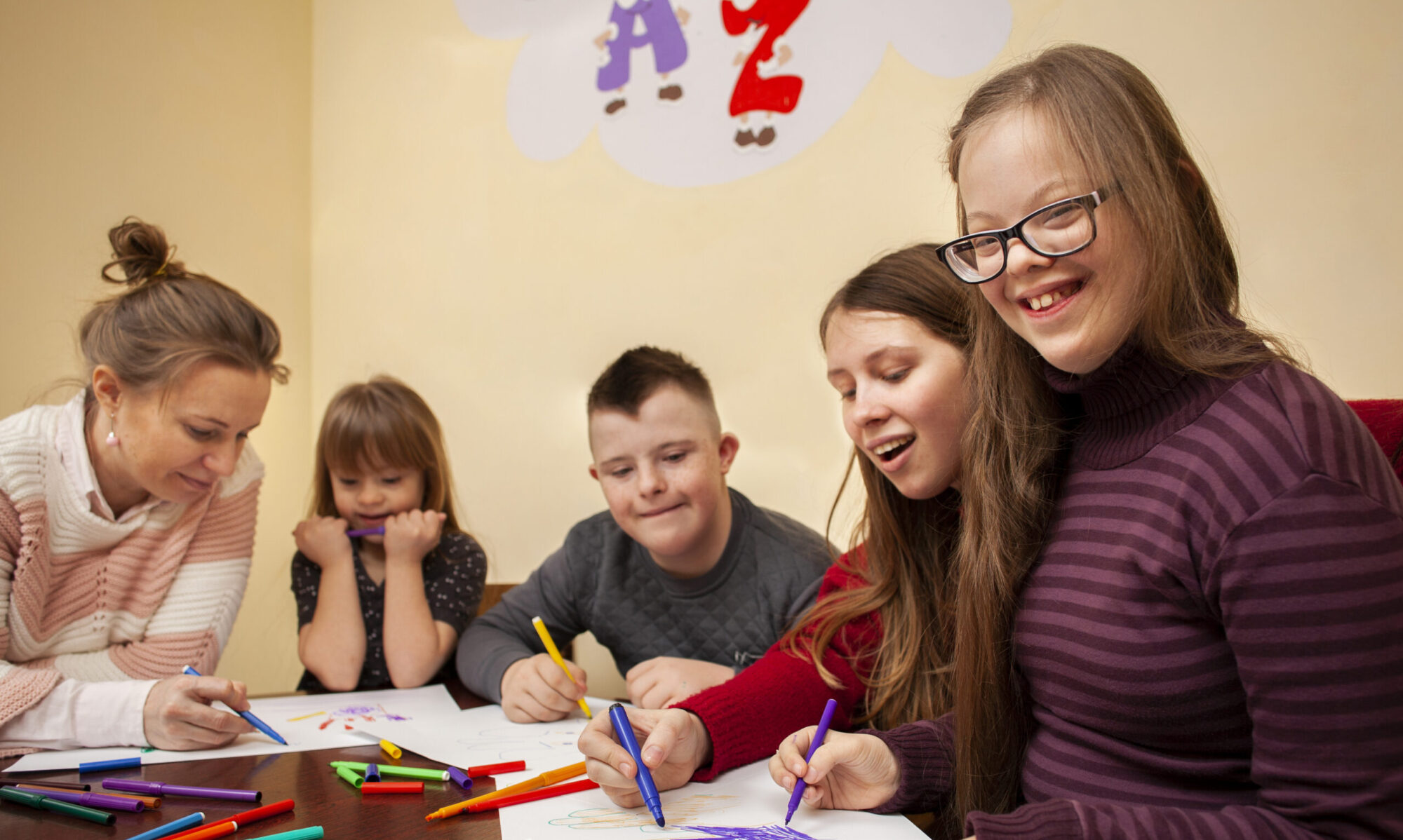
These adult self-advocates meet once a month to hone their communication skills. It was an idea I got from a program out of Maryland. Our mantra is “I can,” and you can read about our first session here.

Our end goal is for these nine self-advocates to act as our 15th Annual Buddy Walk Ambassadors. They’ll educate attendees about Down syndrome and the programs our local Down syndrome group provides. They will also escort VIP guests like Ohio Representative Niraj Antani. Since we know where we’re going and what we’re doing (advocating at the Buddy Walk), now we’re learning how small talk will get us there.

Small talk is like a free, unknown gift. There’s no initial cost or risk, but the outcomes are endless.

Joe making small talk with Megan

Small talk can lead to just a pleasant exchange with a stranger or an amazing job offer. You’ll never know what you’ll get unless you try.

But conversational skills require you to think on your toes. This can be hard for anyone, and it was an obvious challenge for some of our self-advocates.

35-year-old Joe had a 14-year start on the rest of us!

He’s a loyal employee of Kroger grocery store for the last 14 years, and is now a natural at making small talk. I watch him do this every time I visit Kroger, and he is a great coach for our other self-advocates.

Our amazing Theater Educator, Stephanie Radford (heavy on the “RAD”), added another tool to our communication toolbox with a conversational acronym: FORD.

“If you get to the Buddy Walk and can’t think of anything to say to Congressman Antani, remember FORD,” Stephanie urges.

Small talk usually revolves around FORD, which stands for (Family, Occupation, Recreation, and Dreams). These are always safe topics to bring up to a complete stranger.

By the end of our session we created a web of small talk with questions like:

“What do you like to do with your family?”

“Do you work?”

“What’s your favorite hobby?”

“If you won the lottery what would you do with the money?”


It seems so simple, and studies show that small talk actually makes us smarter. It forces you to take someone else’s perspective and boosts our ability to problem solve.

Another great point Stephanie makes, is people love to talk about themselves.

How better to engage Buddy Walk attendees and get them to listen to our advocacy message than to ask them about themselves first.

I love how each of these self-advocates are so open to learning new techniques that will help them become better communicators. It takes a lot of courage to step out of your comfort zone. That’s why we love the informal workshop approach, because they have a safe space to practice skills like small talk.

15th Annual Buddy Walk: HERE WE COME! 


InclusiveU: What College Should Look Like for Students with Intellectual Disabilities

Many people agree, college is some of the best years of life.

It’s the first time we live independently. We make decisions that will shape our life forever. It’s a place were lasting relationships are made.


This experience is no different for Josh, a recent graduate of Syracuse University.

He cheers for the Giant Orange in the Otto’s Army section of the SU football stadium. He hangs out with his friends at the UU and interned at SubCat, a professional recording studio off campus.

SubCat was my favorite internship. I could find out information about getting a job and how to work with the people involved in the job, like the boss or co-workers,” Josh says.

All of these experiences are extraordinary compared to your typical college student, because Josh has Down syndrome.

There are currently more than 260 college programs available to students with intellectual disabilities. The cream of the crop is Syracuse University’s InclusiveU program in New York state.

Related: Yes, My Son with Down Syndrome Can Go to College

I got the privilege to hear InclusiveU executive director, Beth Myers, speak at the first annual NDSS #DSWorks conference in Washington, D.C. I learned how the program fully integrates students with intellectual disabilities into the fabric of campus life.

InclusiveU is one of only a few college programs that practices full equitable inclusion.

This means students with intellectual disabilities declare a major, enroll as an audit student for certificate (which is open to all students), take the same classes as their typical peers, and live with them in the dormitory.

Josh recall’s his favorite professor: “My favorite memory was working on the lights with David Bowman, one of my teachers. He was a really fun guy to be with. Doing the lights for the stage is one of my goals for the future and part of my major.”

A peer-to-peer program helps to facilitate this inclusion.

Josh says, “I got to go to classes, I would study with my peer partners, Cindy and Lindsay. My favorite classes were the classes at Syracuse Stage and stage techniques, were really fun. I graduated with a certificate in Visual and Performing Arts.”

Modifications and adapted coursework allows students to experience a wide-range of courses on campus.

Students have full access to the course catalog, but they can’t take Writing 400 unless they’ve passed the prerequisite courses.

InclusiveU uses Project Search to help students with independence skills. I love it. The reason why I loved Project SEARCH was because I could explore all the job opportunities I liked,” Josh explains.

The 42 students currently in the program are expected to complete three employment internships on or off campus. They also take seminars in communication skills, professional dress, employment, and self-advocacy.

Entry into the program includes a written application and in-person interview. The student doesn’t need a high school diploma, and the program doesn’t look at GPA or SAT scores. InclusiveU accepts students who are non-verbal, non-readers, and who have low mobility.

Related: Inclusion for Students with Down Syndrome is Just a Click Away

During the #DSWorks seminar I learned that the biggest barrier to more higher education opportunities like InclusiveU is money (isn’t it always?).

Tuition for InclusiveU can run upwards of $23,000 a year. Medicaid waivers, pell grants, scholarships, and federal financial aid are now available to students with an intellectual disability. Still, the cost can be prohibitive. And starting a program like this takes a lot of advocacy and a lot more money.

For Josh, the experience was priceless!

He learned to live independently and hopes to use the skills he learned in his eventual career: “I want to work at pop concerts (Lady Gaga, Ke$ha) working on live audio, lights and special effects. I would like to also work on a TV show specifically a reunion show (Brady Brunch, Full House) being an assistant.”​

I will miss the people at Syracuse University and InclusiveU when I move to Florida.”

Congratulations Josh! You’re an inspiration. Inclusion Evolution and the Down syndrome community wishes you the best of luck!

Do you know someone with Down syndrome that is attending college? Tell me about your experience below or private message me.

← Back

Thank you for your response. ✨

Federal Vouchers Are No Choice for Students with Cognitive Disabilities

I want my son, Troy, to take advantage of every opportunity available to him. When it comes to education I’m exploring all avenues: public, private, and even homeschooling. So what about vouchers?

Educational vouchers as espoused by the current administration seem like another opportunity for students with disabilities. Parents can take federal dollars away from their child’s public school and use it towards a private school of their choosing.

“We have to do something different than continuing a top-down, one-size-fits all approach,” Department of Education Secretary, Betsy DeVos argues.

More local control, more customization of education. Sounds good, right?

The problem revolves around federal laws that protect students with disabilities. The Individuals with Disabilities Education Act (IDEA) requires PUBLIC schools to provide a free and appropriate education (FAPE) to students with disabilities in the least restrictive environment (LRE). These students are also guaranteed an individualized education plan (IEP) under federal law.

Asked yesterday, during a Department of Education Appropriations Hearing, whether or not DeVos would stop private schools taking federal taxpayer dollars from discrimination she said: “states should decide whether students taking vouchers are protected by special-education laws.” 

This is a boon for private schools. They get federal taxpayer money and they don’t have to worry about the federal government holding them accountable.

Truth be told, many public schools do a poor job following federal special-education laws.

But here’s the bottom line: parents can always hold public schools to account if they’re not following the law. There’s always recourse through due process and courts. And federal courts more often than not have ruled in parents favor. As DeVos said there may be no such recourse for for parents taking federal vouchers to a private school under her plan. 

To me this is unacceptable. I don’t know about you, but I don’t want my tax money going to private schools that disregard federal law. All the while, public school funding is expected to take $1.9 billion dollars in cuts under Trump’s proposal.

Since DeVos’ controversial appointment hearing, I knew this day was coming. I knew vouchers were on the horizon.

To minimize the damage in my mind, I had lofty hopes that DeVos would reveal some magic plan where all kids with disabilities could use vouchers and still be protected under IDEA…because they are using FEDERAL TAXPAYER DOLLARS at these private schools. I now realize that’s just wishful thinking.

I still consider Troy going to Catholic school with his brother and sister (like my husband and I did). Of course, we can still send Troy to private school IF they accept him (there’s only 125 Catholic inclusive schools in America today). Even if we can find a private school that will take him, Troy will have to forfeit his federal civil rights. I’m not sure I want to take that risk, knowing our federal government doesn’t have his back.

Call To Action: A Nation Is Judged By How It Treats Its Most Vulnerable

Most people would agree my son, Troy, is amongst America’s most vulnerable citizens. Born with the most common chromosomal condition, Troy will always need some support to lead a successful, healthy life.

That’s why it’s so disheartening to hear that many in Congress and the President of the richest, most powerful country on Earth wants to gut a program that helps Troy and millions of other Americans lead healthy, more self-reliant lives.

President Trump’s new budget slashes $610 billion dollars from Medicaid over the next decade. The program currently provides healthcare for 1 in 5 Americans.

Tackling all that’s wrong with a proposal like this in one blog post is impossible. But here’s what I can do: share how it will impact us personally and ask you to take action.

Because here’s what many people don’t realize: Medicaid is not just healthcare for poor adults. Two-thirds of the program’s spending goes to the elderly and people with disabilities.

I can speak to the latter part of this population. When Troy was first born it wasn’t his health that concerned me most. We’re fortunate enough to receive excellent health coverage through the United States Armed Forces, and Troy is one of the healthiest kids I know.

Instead, I was worried about what would become of Troy. Would he ever drive a car, hold down a job, or live on his own? What happens when my husband and I pass on?

In the past 4 1/2 years, long-time disability advocates have shown me the promise of early intervention, school supports and therapies, as well as adult home and community based services. Their kids are living healthy, purposeful lives with the right support. For sure, there’s still big worries, but the disability rights movement has come a long way.

How naive I am to assume Troy would receive the same rights as those that came before him. How stupid of me to assume Congress and our President would choose to protect my son over their own interests. How silly of me to assume the march for disability rights would continue in forward motion without a fight. 

Every single one of the services listed above is funded partially through Medicaid. States will be forced to cut these services first, because they will have to focus what little money is left on acute healthcare.

Right now, Troy receives speech, physical therapy, occupational therapy, and special bus services at school. 40% of America’s school children receive similar supports at school, and it’s all funded partially by Medicaid. Only 1 in 5 Medicaid dollars is spend on these school supports, which points to the effectiveness and efficiency of these services.

As an active duty military family, our hope is that we end up in a state that will at least raise taxes to pay for these lost federal dollars.

States will be forced into choosing two options:

  1. Per capita caps: states would receive a set amount of federal dollars for each beneficiary
  2. Block grants: a lump sum from the federal government

Both of these options strike fear into this momma’s heart, because the result is less home and community based services for my son depending on where we live.

I recently spoke to a fellow advocate who’s adult daughter with Down syndrome just got a full-time job. She told me she had to decide between working full-time and her daughter turning down the job offer, or quitting her full-time job so she could transport her daughter to and from work. Luckily, her daughter finally got off Ohio’s waitlist for these services, and she received transportation to work. Now they’re both working and paying taxes.

As of right now we’re on a state waitlist for transitional services. When Troy becomes an adult he will rely on home and community based services like transportation to work, job coaches, and independent living support aides to be a successful, productive citizen. But we’re military and will likely not end up in the state we’re in now; further complicating Troy’s adult transitional opportunities.

Future prospects for my son, as they stand right now, aren’t as good as they could be. Only 24% of people with cognitive disabilities are even employed. These cuts to Medicaid would take us back to the dark ages. 

Already America’s 5 million children and young adults with disabilities rely on their families for daily in home care. A recent article put the cost to all of these families at 1.5 billion hours and $11.6 billion dollars a year–if you calculate all that work at minimum wage.

Special needs families are already saving the American taxpayers billions of dollars. A few generations ago, all the cost of care for children like Troy would be placed on the state, as most were institutionalized or worse.

In our household we live by the saying “freedom is not free.” My husband has served his country proudly for the past 15 years. He has seen combat, and we have buried too many friends. Our family is the living embodiment of the sacrifice needed to make this country great. We sacrifice so children like Troy can live to their greatest potential. 

So here’s what you can do: Use the link below to email, call, or schedule an in-person meeting with your Republican Senator. They’re expected to take up this issue SOON! Tell them your personal story. If you don’t have one, feel free to tell them about Troy. We thank you for your advocacy! 

Contact your U.S. Senator Here


“Wonder” Book Review: How Loving Someone with a Visible Disability Forces You to Stand Out

The old adage don’t judge a book by its cover never resonates with me more than after I had Troy, my son with Down syndrome.

I’ll be honest, I’m a conformist. A follower even. I’ve blended my whole life. I was never the richest kid, or the smartest kid, or the prettiest either.

But what happens when you can’t blend, because you were born to stand out?

My Troy stands out. His visible disability brings instant judgement wherever we go:

From fellow moms: “Can he climb those playground stairs?”

From other kids: “Troy, let me help you with that.”

From his teachers: “I am shocked that he’s potty trained and knows all his letter sounds! But we’re still not sure he can keep up in higher grades. May be you should consider a resource room.”

Even from sweet grandmothers: “Oh, those children are always so happy. Your son is an angel sent from heaven!”

These comments are all well-meaning, which is what makes them sometimes hurt the most.

In my experience, I can more easily ignore and shut out the uneducated jerk who treats Troy like the plague.

It’s the good intentioned comments that I receive on a daily basis that weighs me down. I at once want to hug them for their desire to “want what’s best for Troy,” and punch them for instantly and subconsciously assuming “he can’t.”

Their comments often catch me off guard, because 99.9% of the time ALL I SEE IS TROYNOT Down syndrome.

It’s a constant internal struggle.

That’s why I simply adore a recent pick by my beloved book club called Wonder by Raquel J. Palacio.

It’s a pre-teen book (one of my personal fav book genres) about a boy named August (“Auggie”), who has a severe facial deformity. At 10-years-old he leaves the decade-long safety of his homeschooling career to enter a private middle school.

You can imagine the drama that ensues.

This thought-provoking, witty, and eloquently written book will have you reeling, especially if you’re directly connected to someone with a visible disability or just different.

Auggie is introspective, vulnerable, and hilarious.

The book starts out with Auggie declaring “I won’t describe what I look like. Whatever you’re thinking, it’s probably worse.”

He’s not a novel device or token disabled kid. Neither are the other characters, which I found especially fascinating.

There’s characters in the novel that never come to accept Auggie, or see him as anything other than “other.” But there’s also truly inspiring friends, who are amazing because they learn to see Auggie for who he truly is: a smart, funny kid.

I cried while reading the perspective of Auggie’s parents. They at once want to shield their child from this brutal world, but also push him to reach his highest potential. Any parent can find commonality in their story.

 And the perspective of Auggie’s sister, Olivia (“Via”) particularly stuck with me.

I worry about the impact of Troy’s disability on my typical children, as much as I worry about Troy.

Will they resent Troy, or my husband and I for the extra care that Troy sometimes needs? Will they be bullied, because their brother is different? Will this visible disability ruin their life?

Via taught me to take a deep breath, and embrace the mess that is life.

Yes, she does some time resent her situation (don’t we all at one time or another), but she’s the only character who somehow inherently embraces her brother and pushes him to live life like no one else.

Get this book! Have kids you know read it. You won’t be disappointed!

The movie version, starring Julia Roberts, Jacob Tremblay, and Owen Wilson, was supposed to come out this past February. It has been postponed to fall of 2017.

I “wonder” if viewers will be able to embrace this movie, understand it’s impact, and not judge a book by its cover.