Self-Advocates Learn Body Language Speaks Louder than Words

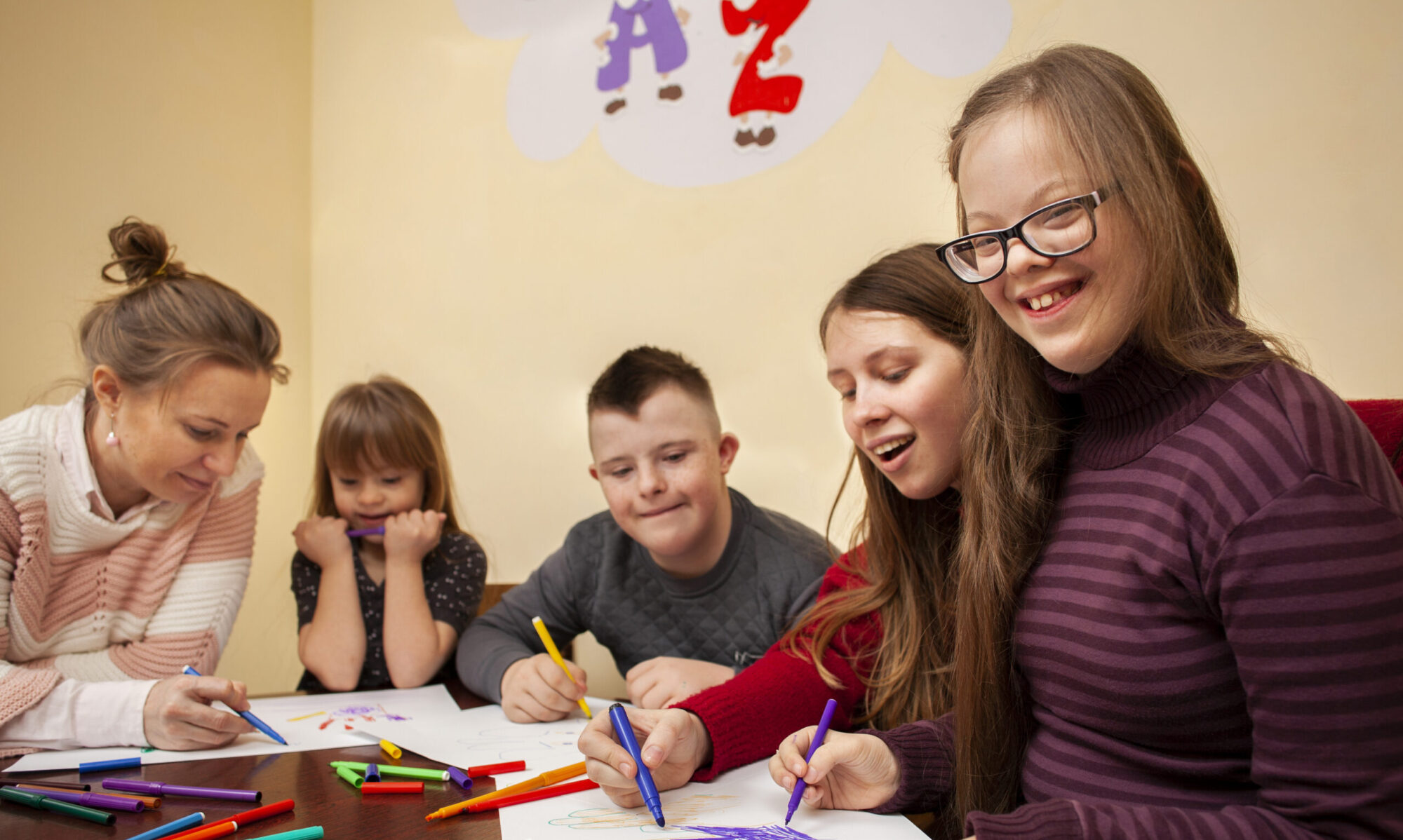
The adult self-advocates in our monthly communications workshop are learning how body language shapes people’s perceptions. 

Every month a group of up to 9 self-advocates get together to hone their communication skills. Our short-term goal is to prepare these adults with Down syndrome to lead our advocacy table at the Buddy Walk in September. In the long-term, our hope is these new communication skills will lead to more involvement in the community and employment opportunities.

Self-advocate, Anna, watching herself talk in the mirror

This month’s topic is non-verbal communication, which experts say makes up for 70% of any given conversation. All of us used body language long before we learned to talk. For individuals with Down syndrome, non-verbal communication may be their primary mode of communicating their needs and wants.

What is your body telling your audience?

That’s the question we posed to our self-advocates. Although they all used many non-verbal cues in conversation, almost all were unaware of the impact of those cues. A long look in the mirror brought some of our negative body language to light.

Lack of eye contact and looking “closed off” were two of the most common mistakes we learned by taking a look in the mirror.

Anna is a particularly confident communicator. She always made great eye contact and uses hand gestures to explain her point. But after seeing herself in the mirror she remarked “I need to remember to keep smiling.”

Theater Educator, Stephanie Radford (emphasize on the “RAD”), gave our self-advocates pointers on “matching”. This technique requires the listener to copy the expression and emotion of the talker. “It’s important to show you are listening and empathize with the talker, without saying a word,” Radford explains.

Theater Educator, Stephanie Radford

Radford stresses the action of body language is more memorable than what you say.

This is especially important for our self-advocates who are often unsure of what to say or concerned that they might not be intelligible or understood. At the Buddy Walk we stressed that their body language should exude an air of confidence and openness.

They’ll be introducing Congressmen and our mayor at the Buddy Walk, as well as teaching attendees about Down syndrome and programs our local group provides self-advocates. It’s important that they use their expression, eye contact, and gestures to show they’re the experts on all things Buddy Walk related.

In three short sessions I have have seen improvement in our self-advocates communications skills. I can’t wait to see them in action during our 15th Annual Buddy Walk!

To learn more about our self-advocate communication workshop click here.


Continue reading “Self-Advocates Learn Body Language Speaks Louder than Words”

Small Talk Leads to Big Rewards

Our group of adult self-advocates are learning that small talk is where real opportunities begin.

These adult self-advocates meet once a month to hone their communication skills. It was an idea I got from a program out of Maryland. Our mantra is “I can,” and you can read about our first session here.

Our end goal is for these nine self-advocates to act as our 15th Annual Buddy Walk Ambassadors. They’ll educate attendees about Down syndrome and the programs our local Down syndrome group provides. They will also escort VIP guests like Ohio Representative Niraj Antani. Since we know where we’re going and what we’re doing (advocating at the Buddy Walk), now we’re learning how small talk will get us there.

Small talk is like a free, unknown gift. There’s no initial cost or risk, but the outcomes are endless.

Joe making small talk with Megan

Small talk can lead to just a pleasant exchange with a stranger or an amazing job offer. You’ll never know what you’ll get unless you try.

But conversational skills require you to think on your toes. This can be hard for anyone, and it was an obvious challenge for some of our self-advocates.

35-year-old Joe had a 14-year start on the rest of us!

He’s a loyal employee of Kroger grocery store for the last 14 years, and is now a natural at making small talk. I watch him do this every time I visit Kroger, and he is a great coach for our other self-advocates.

Our amazing Theater Educator, Stephanie Radford (heavy on the “RAD”), added another tool to our communication toolbox with a conversational acronym: FORD.

“If you get to the Buddy Walk and can’t think of anything to say to Congressman Antani, remember FORD,” Stephanie urges.

Small talk usually revolves around FORD, which stands for (Family, Occupation, Recreation, and Dreams). These are always safe topics to bring up to a complete stranger.

By the end of our session we created a web of small talk with questions like:

“What do you like to do with your family?”

“Do you work?”

“What’s your favorite hobby?”

“If you won the lottery what would you do with the money?”


It seems so simple, and studies show that small talk actually makes us smarter. It forces you to take someone else’s perspective and boosts our ability to problem solve.

Another great point Stephanie makes, is people love to talk about themselves.

How better to engage Buddy Walk attendees and get them to listen to our advocacy message than to ask them about themselves first.

I love how each of these self-advocates are so open to learning new techniques that will help them become better communicators. It takes a lot of courage to step out of your comfort zone. That’s why we love the informal workshop approach, because they have a safe space to practice skills like small talk.

15th Annual Buddy Walk: HERE WE COME! 


Born This Way: Adult Self-Advocate Gives Hope that the Seemingly Impossible Can be Reached with the Right Motivation

Like 40% of individuals with Down syndrome, my son Troy has Childhood Apraxia.

It’s a motor speech disorder in which the brain has trouble planning to move the body parts (tongue, lips, jaw) needed for speech (see the video at the end). Some days I feel like Troy will never be understood by anyone outside of our immediate family.

But then I was lucky enough to meet Sean, from the Emmy Award winning reality television show, Born this Way.

We both decided to advocate on Capitol Hill this past April at the Buddy Walk on Washington, and I got to have dinner with him and his mom. This mom-son duo is a formidable force!

Lower right: Sean with his mom, Sandra, and California Congresswoman Maxine Waters

I was a bit star-struck! I mean, here’s a guy that’s co-starring in an award winning reality show entering its third season, and he has Down syndrome!

But I was even more inspired when Sandra, Sean’s mom, told me that Sean has Apraxia too, and she says “It was not so long ago I had to translate everything Sean said.”

How then, is it possible that Sean is on television, making celebrity appearances, and booking regular speaking engagements?

It’s because Sean dreams only one way:

BIG!

“I want to buy a house at the beach with a pool, a bowling alley, a movie theater and a man-cave in the basement.”

“I want to go on a date with Megan Trainor.”

This is how he opens his speeches these days. With what he calls his “crazy dreams.” Then he has the crowd repeat after him “It could happen!” In which he replies, “That’s what faith can do.”

These phrases are so well-known by fans of Sean’s that they’ve inspired Seanese —Sean’s newest business venture. Sandra hopes it won’t be lost on readers that “less than 5 years ago he was unintelligible, and today we celebrate his speech by immortalizing it on swag.”

But here’s what those with Apraxia and their loved ones need to know:

Sean’s hard-won success is a marathon, not a sprint.

Sandra never dreamt that Sean would be on television, but he did. He was involved in drama throughout school, and auditioned for a sitcom while in community college. Sean was confident that he would get the role, but his mom was honest with him: “I couldn’t understand your words, and if I couldn’t understand them, I know they couldn’t.”

But it seems this small failure served as further motivation for Sean. He took his mom’s advice and worked tirelessly on his intelligibility at every chance. Now look at him!

Born This Way opened doors for Sean once thought impossible. And has also helped Sean perceive himself in a new way.

In the first season, Sean was the self-proclaimed “Ladies Man.” But after watching himself on the show, he realized the saying’s true intent.

Sandra says Sean has “grown so much by watching himself on TV and learning from his mistakes in an authentic way.”

Sean’s also living in his own apartment, subsidized by HUD. He has a roommate who is a live-in-aide.

He had a job at Home Depot, but it didn’t give him the social outlet he was looking for. He loves kids, and is now starting a job at a trampoline park working with children.

Some within the Down syndrome community criticized Born This Way for only showing what they say are “high functioning” individuals with Down syndrome. But Sandra argues that Sean is not the smartest, or most intelligible. In fact, she says the show uses some pretty “creative captioning” so the cast can be understood.

What she says is unfair are the differences in adult transitional services throughout our nation.

It’s obvious the cast members benefit greatly from California’s system, which has no waitlist for job coaches and supported living services.

Sandra also makes an important point that “if we criticize television shows like Born This Way and stop watching it, we’ll lose the opportunity to open doors for all individuals with Down syndrome.”

Both Sean and Sandra have sage advice for parents like me and kids like Troy, who seem to not yet see the forest for the trees:

Sandra says it’s important parents find a speech pathologist and occupational therapist who are knowledgable in the therapy techniques for Apraxia, and practice with your child every day.

But more important “find out what your young adult LIKES, and help them learn about the types of jobs they can do to fulfill their dreams.”

I want Troy to have the best services and therapies to address Apraxia, but what Sandra and Sean taught me is even more important. If we want our children to be success in school and work, we have to focus on what’s really important: “Have good behavior and listen and be nice to everyone,” Sean says.

The rest will follow with hard work and the right motivation!

Season 3 of Born This Way aired May 16, 2017. You can catch up on Seasons 1 & 2, and watch current episodes here. Sean won’t reveal any real spoilers, but says parents of young children with Down syndrome will definitely want to tune in for a surprise this season.

You can help support Sean in his next business venture at https://seanese.com.

If you’re still trying to understand Apraxia, watch the video below: