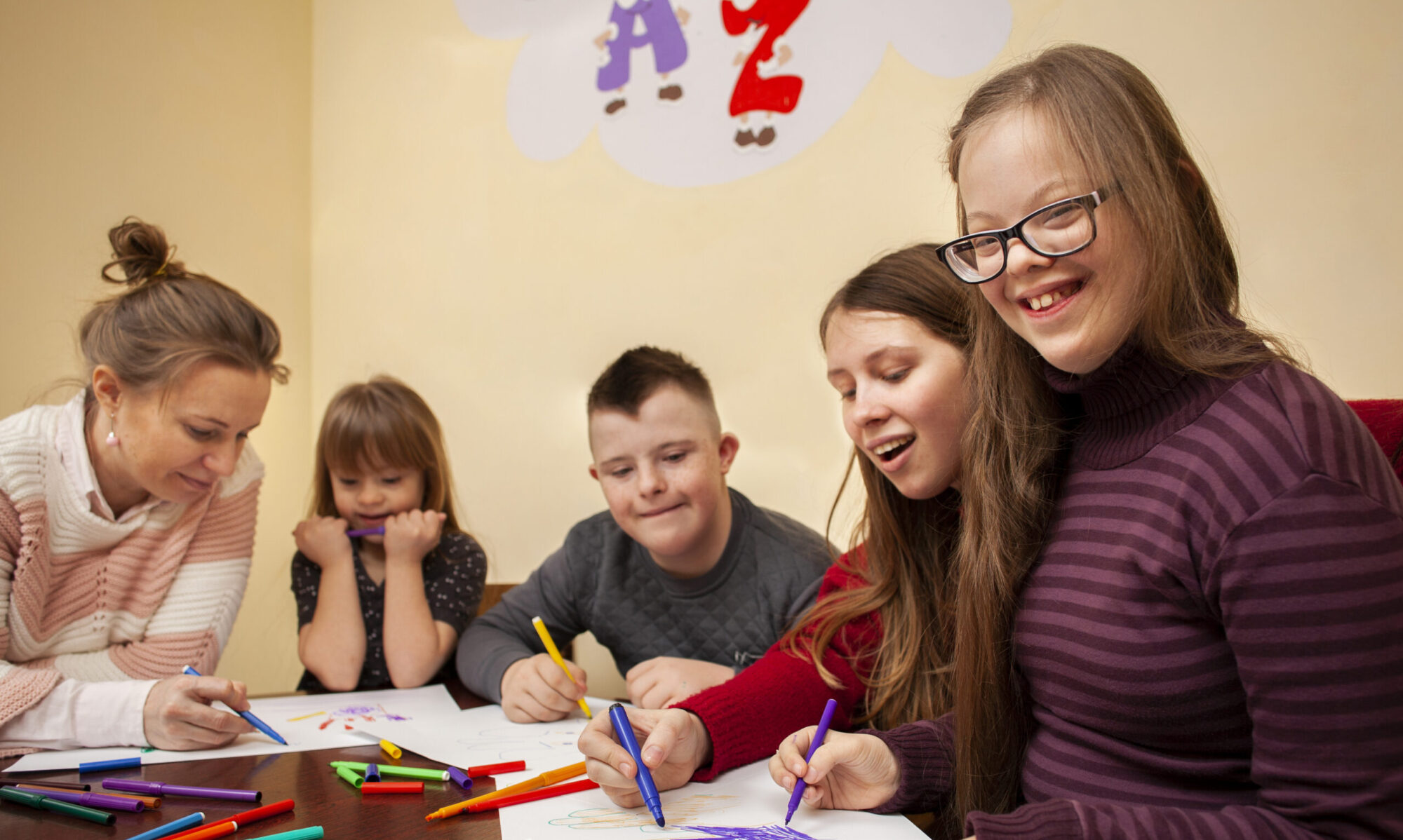
Music Therapy for Children with Down Syndrome

My 5-year-old son singing Twinkle Twinkle Little Star, while he plays the ukulele. It’s music to my ears! With a dual-diagnosis of Down syndrome and Childhood Apraxia of Speech Troy struggles to speak intelligibly, but somehow he speaks much more clearly while singing.

Speech therapy twice a week, and total speech immersion in an inclusive preschool class has helped Troy make great gains in speech intelligibility. But it’s his love of music and singing that has continued to show me where we should place our efforts.

Music therapy can seem frivolous, but research supports connections between speech and singing, rhythm and motor behavior, memory for song and memory for academic material. Music is processed by a different area of the brain than speech and languages, so a child may be able to more easily absorb information and skills presented with music.

“Music organizes the brain. The child strums the instrument with his right hand, which stimulates the left side of the brain. The left side of the brain is the center of language and speech, which is one reason Troy can speak more clearly,” explains my son’s Music Therapist, Kendra Carson. Kendra has been a certified practicing Music Therapist for 16 years, and has worked with all ages.

Read related post here: Teaching Your Child with Down Syndrome to Read

Kendra says music therapy isn’t about music production. “Music is just the tool I use as a therapist to see what Troy’s non-musical needs are and facilitate non-musical goals,” Kendra says. She incorporates Troy’s speech goals into each session, and many songs like “Old McDonald” incorporate sounds and words that Troy struggles with as a child diagnosed with Childhood Apraxia of Speech.

The American Music Therapy Association defines music therapy as “an established health profession in which music is used within a therapeutic relationship to address physical, emotional, cognitive, and social needs of individuals. After assessing the strengths and needs of each client, the qualified music therapist provides the indicated treatment including creating, singing, moving to, and/or listening to music.”

Even if you don’t have the time or money for private music therapy, you can incorporate music into your daily life to benefit your loved one with Down syndrome. Kendra taught me how to put familiar books to music. For example, Troy has memorized the book Brown Bear, Brown Bear. When we sing the words in the book to the tune of Twinkle, Twinkle, Little Start he can read the book more fluidly. I’ve also helped my children learn my phone number and our address by putting them two easy tunes.

Read Related Post Here: Travels of a Posterior Walker

This doting sister shown below shows off her natural music therapy skills in a social media video that’s gone viral. She shares the joy of music to help her toddler brother with Down syndrome learn to speak his first words. Check it out!

As a parent of child with Down syndrome, I understand that fitting one more therapy in can seem impossible. But many music therapists will come to you, and many local Down syndrome affiliates or county developmental disability boards offer scholarships to families for therapies and other activities.

You can find out more about Music Therapy and find a certified therapist in your area HERE. Does your loved one with Down syndrome love music? How have you facilitated this love of music to help him or her in other areas of life? Share your story with me below.


Communication is Key to Self-Advocates’ Pursuit of Goals

This summer I started a “Self-Advocate Communications Workshop” in my local area, and I’ve been blown away by the progress of the teens and adults with Down syndrome.

Honestly, I didn’t have many expectations for the workshop. I just wanted our local self-advocates to better represent themselves and the organization that supports them (MVDSA).

But watching our group of self-advocates rehearse for their role at our 15th Annual Buddy Walk literally brought happy tears to my eyes. I know it sounds cheesy, but they are really starting to act like self-advocates by communicating their wants and needs to people outside their family. 

Our mantra for the workshop is “I Can!”

Many of our self-advocates started the workshop apprehensive to speak in front of strangers, to look someone in the eye, and tell others who they are and what they stand for. The “I Can!” mantra helped them put into words their goals for the Buddy Walk and life in general.

In our last workshop before the Buddy Walk our Theater Educator, Stephanie Radford (heavy on the “RAD”), brought in strangers to test the self-advocates’ new communications skills.

They’ve been working on:

  • conversational skills
  • non-verbal communication skills like eye contact and body language
  • improv skills
  • speech skills

The self-advocates have warmed up to us over the last three months, but we wondered how they would perform in front of complete strangers. We set up a practice advocacy table with games and brochures, like they’ll have at the real Buddy Walk.

Practice with strangers to prep for the Buddy Walk

The first interaction was a bit forced, but as the strangers started asking the self-advocates questions about their life everyone started smiling and having a good time. The self-advocates used what they’ve learned about eye contact and reciprocal conversations to engage these strangers they’ve never met. I was impressed! They know that people may have a harder time understanding them, but still they advocated for themselves and got the job done.

I can’t wait to see how they do September 16th at our Buddy Walk!

They’ll be the ambassadors of the Miami Valley Down Syndrome Association; running our advocacy table and introducing national, state, and local politicians to Buddy Walk attendees.

Self-Advocates with our volunteer actors

Evie’s Sleep Story

The Following is Evie’s Sleep Treatment Story as Told By Her Mom, Jen Alge: 

Read about new research that links sleep issues with cognitive, memory, language, and behavior issues HERE.

I could write a book about this. Evie’s had 7 sleep studies. Her first was at 11 months, because they were trying to rule out pulmonary pressure issues before doing heart surgery. She had mild apnea then.

We did another sleep study before her first set of tubes and they found she had severe sleep apnea. They put tubes in and took the adenoids out. She still had severe apnea. They then did the tonsils along with a tear duct probe and another set of tubes. Then her apnea was moderate so the tonsils helped a bit.

Then we did a simi MRI to get a better read on her airway. That helped the docs a ton. I highly recommend that procedure. But that showed us just how obstructed her airway is so that’s when we started the CPAP (Central Positive Air Pressure). Due to her tiny facial structure and age (she started this when she was 4) it took a while to find the right mask and pressure that she would tolerate.

Doing a sleep study to titrate the machine was the most challenging sleep study- keeping a canula in with a CPAP is rough. So they gave her ambien to get that result. Then after several months of her only wearing the CPAP for 2 hours we did another sleep study and this time with a time-released melatonin. That did the trick.

So Evie takes a pill like a champ every night along with her nasal steroid and allergy meds to open her airway. After we got her pressure where it works best and a full face mask, she wears her CPAP an average of 7 hours a night. Now, she’s on a pressure of 11, and the full face mask isn’t the best option because when she moves the seal breaks pretty easy. So we’re not at the finish line yet. But the docs are happy with her use and they want to kick us out of the upper airway clinic.

I’m holding on because, yes, she does wear it on average 7 hours a night, but that’s only because I’m in her room 5-8 times a night at least putting the mask back on. She lets me put it back on, but man is this lack of sleep going to get old someday soon. And I’ve definitely considered other options like orthodontic pieces and the surgeries they really wanted to do when she wasn’t wearing her CPAP more than 2 hours.

Those surgeries are 3 in total: 1. Cutting the back of her tongue and pulling out some tissue. 2. Cutting away her lingual tonsils at the back of her throat (this is a risky procedure with a long recovery due to the risk of her throat swelling and closing up- lots of steroids) 3. The insertion of a screw under her chin with a string tied to her tongue to keep it forward. Evie’s problem is not the tongue, the throat or the width or length of her mouth- it is all three. So only all three procedures would solve it. Oh and all three procedures only have a 60% success rate so she’ll likely still need a CPAP. 🙂

I’ve notice no behavior changes since the treatment. Evie’s always been a smarty pants and she talks all day long so I can’t credit the CPAP for any changes there. I will say she is getting more air and isn’t gasping for breath or snoring with the cpap on so that’s a relief. The behavior changes might be more long term given her age.

Using Improv Theater to Build Confidence in Self-Advocates

What a better reflection of the uncertainty of life than Improv Theater. Improvisation is a type of theater in which the plot, characters, and dialogue are made up in the moment. Like life, you will never see the same improv show twice. 

This month, I got a chance to take some of my favorite adult self-advocates with Down syndrome out to a local Improv Theater. We got to see our very own Communications Workshop Educator, Stephanie Radford (heavy on the “RAD”), perform and boy did she steal the show. It’s a great precursor to this month’s workshop that focuses on improv skills. Read more about our past workshops here.

My family and some of my favorite self-advocates get a chance to see Stephanie Radford (bottom left) perform Improv

Although improv can be down right scary, with no sense as to what’s coming next, it’s also been shown to build confidence and decrease anxiety.

This seems oxymoronic, but it’s true. The lack of planning and structure requires role players to depend on each other.

Stephanie Radford (right) performing Improv

Psychology Professor, Gordon Bertmant, explains “if all play authentically to each other, fear of failure loses its sting—a net of support is constructed from the openness, trust, and acceptance.”

For individuals with Down syndrome, who often struggle with small talk and conversational speech, improv may seem unattainable but the net of support makes it worth learning.

The goal of our monthly Communications Workshops is to prepare our self-advocates to lead our Buddy Walk. This will require thinking on their toes and good conversational skills. Improv adds another tool to our tool belt.

“When you think of Improv remember the ‘Yes, and….’ Rule,” explains Communications Workshop Educator, Stephanie Radford. “You want to agree with the person you’re talking to and add something to their line of thinking.”

Stephanie Radford directing some of our self-advocates through an improv scene

Radford had the self-advocates practice having a conversation with a peer who always said “NO!” This “denier” proved that a good conversation cannot thrive without the “Yes, and…” rule. The self-advocates practice this rule, and agreed that a conversation flows much better when you agree and add something to the conversation.

Sally courageously gets on stage and tells us about her road trip. Here’s a picture she shared of her trip.

This was perhaps our hardest workshop to date. At least one self-advocate was petrified to get on stage. Others had a hard time adding appropriate information to a conversation to keep it going. Still, by the end of the session self-advocates were doing a better job of understanding that all good conversations rely on the support of each person participating. Even our most scared self-advocate took the stage at the end and used her improv skills to tell us about her recent road trip to South Carolina.

We’re so impressed at the progress our self-advocates have made in four short workshop sessions. A positive net of support and a new toolbox full of communication skills have nudged our self-advocates to be more self-confident in their interactions with other people. I can’t wait to see them in action at the Buddy Walk this year!

Teaching Your Child with Down Syndrome to Read

Of all my children, I never would have guessed that the family book worm would be my child with Down syndrome. Troy has a special devotion to certain books. The sound of the words, the clues in each picture, the feel of the book, even the taste (LOL). He simply adores books and reading!

Troy reading his FAVORITE book

We all know that literacy opens doors to a life of learning and opportunities. Learning to read positively impacts learning in all subject areas, provides access to the curriculum, improves speech, and is essential to an independent life. But just a generation ago, it was believed children with Down syndrome could not learn to read. 

Now we know that even the very youngest children with Down syndrome can learn literacy skills and almost all can be taught to read at a level essential for independently living. So, where do we start?

I use a combination of reading for pleasure with all my children, and some more focused literacy building developed specifically for children with Down syndrome. By the way, I use these specially developed programs for my typical kids too.

Troy really enjoys Orange County’s Online Learning Program, and it’s completely free with a guest login. You print off books that your child might enjoy. Watch Troy read his favorite LP book, “Sports.”

Like most early literacy programs, this approach focuses on acquiring high interest and common sight words. Children with Down syndrome excel at the visual memory skills needed for reading sight words. 

Obviously, Troy just memorized this book, but he also shows comprehension later with a matching game. Watch below.

The beauty of this approach is that you can start even before your child is verbal. They can match picture to picture, they can use sign language, or you can read and they can point to the words.

Sue Buckley’s Down Syndrome Education Online uses a similar approach. Both programs start with a whole word approach, build vocabulary through pictures, memorize sight words and use them in sentences, and eventually introduce phonics and sound blends.

It may seem intimidating to teach your child with Down syndrome to read, but really there’s only 5 simple steps: 

  1. Read: (a book from either LP Online or DSE Online)

  2. Match: either picture to picture or word to word, which I did with Troy from about 2 to 4-years-old

  3. Select: give you child a choice between 2 pictures or words and ask them to choose the right picture or word

  4. Name: hold flash cards of either pictures or words and have your child name or sign them

  5. Check: for comprehension by matching picture to word, draw a line from picture to word, or make generalizations in the real world (example: read the zoo book, then visit the zoo)

After doing the Easy Readers with Troy for the past three years, we’re now slowly moving on to building sentences. Troy has great sentence awareness. He can show me the front and back cover, and even say the author and illustrator of his favorite books.

Now I’m trying to get Troy interested in building sentences by creating his own book, which his typical twin brother already loves.

Buy some blank books at Target in the dollar section

I found these awesome blank books in the dollar section of Target. Then we print out pictures of a favorite topic like superheroes, Paw Patrol, or family members.

After gluing a picture on a page we come up with a simple sentence to correspond with the picture. I write the sentence on a strip of paper and cut each individual word. The boys glue on each word in the correct order and we add punctuation at the end. Then we read our books.

This is a hard skill for Troy, because he can’t verbalize a novel sentence by himself, or sit through the creation of an entire book. But we’re starting small by giving him a choice between 2 or 3 pictures in one sitting, and helping him come up with the sentence. The point is to keep him interested, while understanding the structure of a sentence.

My twin boys falling asleep to a good book each night

I love this approach and have used both program’s apps on our iPad. Troy loves them too. The apps include: VisualLearn, Special Words, and See and Learn.

If your child is past this stage check out my dear friend’s blog, Sassy Southern Gal, for advice on more advanced readers.

What works for you and your child, and what’s challenging when it comes to literacy? Let me know below.