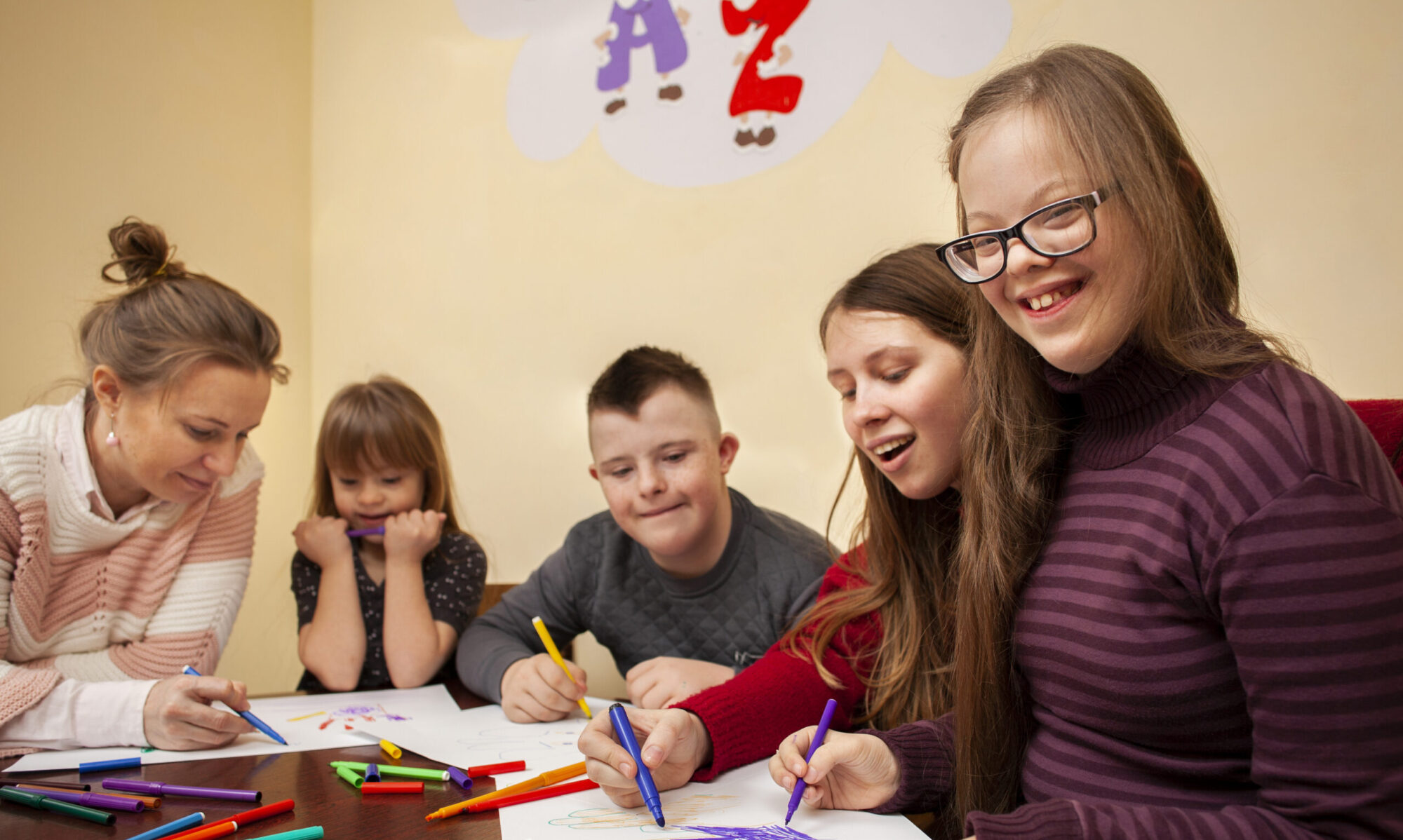
Finding Inclusion as a Military Child with a Disability

Tis the season to PCS! Your husband is on TDY, so it’s up to you and one power of attorney to secure the movers, sell the house, organize all 18,000 pounds of stuff you plan to move, and sell that couch that won’t fit in your new house in a new state. You can’t see out the minivan because 3 kids, 2 dogs, and all your personal items must make it across country to your moms for the next two months before you find permanent digs at your new duty station.

Military families are extremely resilient. We bloom where we’re planted. We often make fast friends, throw ourselves into new careers or hobbies, play tourist in our new town, while leaving it better than when we arrived.

Military life also presents real stressors and challenges, especially for families with children with disabilities. The Exceptional Family Member Program (EFMP), a.k.a. the PCS gatekeeper, throws in a whole new wrench into the works. Orders often center completely around the military child with a disability, rather than the active duty member. You can’t go to your dream duty station, Germany, because the services are supposedly inadequate for your child. You have to say goodbye to that excellent Speech Pathologist who did PROMPT, and the gap in service while moving could mean a real gap in your child’s communications skills. You heard from another military wife that the schools in the neighborhood you want to live in don’t even follow the law, much less do inclusion.

How can a military family advocate for full inclusion for their child with a significant disability when they’re dealing with so many other moving parts? How does a military child maintain a consistently inclusive educational career when they move every 2 to 4 years?

These are two very difficult questions that I’m not sure I can tackle in one post or even have a complete answer to. My hope is that I can post a few tips that works for my son with Down syndrome, and other military families will chime in with what’s worked for them. I’d love to do a follow-up post with other family’s experiences. Here it goes!

3 Tips to Finding Inclusion As a Military Child with a Disability:

  1. Secure a solid IEP before you PCS:
    • Use those military orders to your advantage. Dangling the orders in the face of your child’s current IEP team if needed. Tell them you’re moving so writing in a full time paraprofessional, daily communication with parents, and modified homework given to the student a week before it’s due into the accommodations section of the IEP should be no big deal. Sometimes this is all an IEP team needs to hear to make some real effective changes to the IEP.
    • The Individuals with Disabilities Education Act (IDEA) requires the new school district you move to to provide a comparable IEP for at least 30 days. This gives you time to make your case to keep the current IEP or improve upon it. The new IEP team must also give you a Prior Written Notice (PWN) explaining WHY they won’t follow the IEP from out of state. Many schools don’t want to make a denial of comparable services in writing, so make sure you ask for the PWN.
  2. Stalk Social Media Groups at your new duty station:
    • Social media opens up a whole new world for families of children with disabilities. There’s a closed group for everything, and could be a great starting point to find an inclusive school.
    • WARNING: some parents’ idea of inclusion may not be in line with your idea of inclusion. I had to learn this the hard way when my son started preschool at our duty station in Ohio. Although the public preschool included 50% of students without IEPs, starting in kindergarten kids were segregated. Luckily, we PCSed before I had to fight for inclusion.
    • Be specific on social media: ask what percentage of time their child spends in general education. You’re looking for at least 80% or more. Ask if proper supports are given, and if the school actually follows through with their child’s IEP.
  3. Get Serious with a Freedom of Information Request:
    • Did you know you can find out how many restraints or seclusion cases a district had in a year? Or how many due process cases a district had and the outcome? If the district had any Civil Rights Complaints made against them. All of this is public information, so once you’ve chosen one or two schools get down to business with a freedom of information request.
    • A request through the district or state office of education (special education office) can reveal so much about the school you’re hoping to choose. Anything from state complaints to individual employee complaints. Go to the state’s Parent Training and Information Center to find out how to make the request for public records in your new state.
    • Side note: this is completely different than looking at school rankings on line (think “Great Schools” and other such sites). Often the traditional rankings tell you nothing about how the district does special education. In fact, a very high rated school in Ohio was notorious for segregating kids with IEPs. So beware!

Lastly, reach out to a local special education advocate to get their take on districts that are following the law and including kids with disabilities in general education. The Council of Parent Attorneys and Advocates has a directory of advocates by state. Advocates often are filing state complaints and civil rights complaints all the time, so they will know which school districts to stay away from.

I called a local advocate before we planned to PCS to Washington state, and I’m still friends with her today. My son is also 93% included in general education with appropriate supports in a state that is ranked 3rd lowest in the nation for inclusion. Doing your homework pays off!

What tips do you have for military families PCSing with a child with a disability? How did you find an inclusive school? What do you wish you would have done differently?

7 NEW Research Studies to Help You Win the Fight for Inclusion

One of my most popular posts included 7 evidence-based research studies that prove the benefits of inclusion for students with and without disabilities. Still, I had a few readers comment that the research studies I cited were too old to be impactful. I was completely irked by these comments, because no one would ever say research from the 1990s showing the benefits of desegregation on black and white students is not still impactful and true today. Still, I have come across so many new studies that show the benefits of inclusion, that I thought I would update my original post. In fact, as you’ll read below there are absolutely NO research studies that show an academic advantage for students with intellectual disabilities in a segregated setting. I hope you’ll share these newer research studies with your child’s IEP team or other potential non-believers.

______________________________________________________________________________

“Almost 30 years of research and experience has demonstrated that the education of children with disabilities can be made more effective by having high expectations for such children and ensuring their access to the general education curriculum in the regular classroom, to the maximum extent possible.”

Most parents of students with with an Individualized Education Plan (IEP) have heard a variation of the quote above, especially if you’ve tried fighting for inclusion. I assumed this statement was just hyperbole. I figured there was some truth in it, but that there was probably just as much research showing self-contained classes were more beneficial than inclusion. At least that’s what most school districts and even many parents would have you believe.

Imagine my surprise then, when I read the EXACT quote above in the introduction to the Individuals with Disabilities Education Act (read it for yourself right here). The actual law, supported by both Democrats and Republicans, states that a regular classroom with proper supports is best for ALL students with disabilities. I was a bit taken back, and wanted to know more about this research the law touted.

Read Related Post Here: My Original Post with 7 Evidence Based Research Study that Prove Inclusion Works

What I found was even more surprising. Did you know there’s not one quantitative research study, since research began on the topic, that shows an academic advantage for students with intellectual disabilities in separate settings? None! Zip! Nada! Here’s the research study citation to prove it: Falvey, Mary A. (Spring 2004) Toward realization of the least restrictive educational environments for severely handicapped students. Research and Practice for Persons with Severe Disabilities. 29 (1), 9-10. 

Luckily, I’ve learned a lot more about the research that supports proper inclusion in the Least Restrictive Environment for students with even the most severe disabilities as part of the Council of Parent Attorneys and Advocates Special Education Training. It’s a year-long course I completed for my own son’s entry into public education, as well as to fulfill my goal to help other families advocate for inclusion for their child.

So, without further ado, below are 7 NEW quantitative research studies that show the benefits of including students with disabilities in a general education classroom:

  1. A 2013, quantitive study of more than 1,300 students between the ages of 6 and 9 years old within 180 school districts found that access matters. The study found a strong relationship between the amount of time spent in general education and achievement in math and reading for students with disabilities.
    • Citation: Cosier, M., Causton-Theoharis, J., & Theoharis, G. (2013). Does Access Matter? Time in General Education and Achievement for Students With Disabilities. Remedial and Special Education34(6), 323–332. https://doi.org/10.1177/0741932513485448

2. A 2010, synthesis of research studies shows the academic effects that peer tutoring has on students with disabilities (regardless of disability type). The literature overwhelmingly reveals that peer tutoring has a positive effect on the academic outcome of students with disabilities in grades 6 through 12.

  • Citation: Okilwa, Nathern S. A.; Shelby, Liz, (2010). The Effects of Peer Tutoring on Academic Performance of Students with Disabilities in Grades 6 through 12: A Synthesis of the Literature. Remedial and Special Education, v31 n6 p450-463 Nov-Dec 2010

Read Related Post Here: So you survived IEP season? 3 steps to get organized NOW for the next one

3. A 2012, comparative study followed 34 students with Intellectual Disabilities (ID) fully included in general education with supports with a control group of 34 students with ID in special schools. Included children made slightly more progress in literacy skills than children attending special schools. The researchers concluded that inclusive education is an appropriate educational placement for students with ID who require extensive supports in school.

4. A study looking at the outcome of 11,000 students with all types of disabilities found that more time in a general education classroom correlated to less absences from school, fewer referrals for misbehavior, and more post-secondary education and employment options.

  • Citation: Wagner, M., Newman, L., Cameto, R., and Levine, P. (2006). The Academic Achievement and Functional Performance of Youth with Disabilities: A Report from the National Longitudinal Transition Study-2 (NLTS2). (NCSER 2006-3000). Menlo Park, CA: SRI International

5. A 2017, study found that 41.7% of student with learning disabilities made progress in math in general education classes compared to 34% in traditional special education settings, without the presence of nondisabled peers.

  • Citation: Sharp, N. (2017). Inclusion in the early childhood classroom: What should this look like? (Master’s thesis, Northwestern College, Orange City, IA). Retrieved from http://nwcommons.nwciowa.edu/education_masters/32/

6. A 2011, study finds that there’s nothing “special” about the four walls of a special education classroom. The research suggest that the purported rationale for self-contained special education in the literature–issues of community, distraction-free environments, specialized curriculum/instruction, and behavioral supports–were not present in the six observed self-contained settings. Implications for school leaders are discussed and the rationales for the utilization of self-contained classrooms are strongly questioned.

  • Citation: Does Self-Contained Special Education Deliver on Its Promises? A Critical Inquiry into Research and Practice. Causton-Theoharis, Julie; Theoharis, George; Orsati, Fernanda; Cosier, MeghanJournal of Special Education Leadership, v24 n2 p61-78 Sep 2011.

7. Many schools and parents make the argument that typical peers may be negatively impacted by the presence of students with disabilities. Especially those students with behavior problems. But a 2013, study found that inclusion does NOT compromise a typical students academic or social outcome. No significant difference was found in the progress of the low-, average-, or high-achieving pupils from classrooms with or without inclusion.

So with all this proof, why are students with intellectual disabilities still only being included in general education 17% of their day on average? Tell me below why you think this is the reality for our loved ones. I’ll do a blog post giving my answer as well.

Students with Intellectual Disabilities Can Use Federal Funds for College Opportunities

With more than 260 College Programs available for students with Intellectual Disabilities (ID), it’s no longer a question of whether the new generation of students with ID can go to college but how to pay for it.

Vineet Narayan recently graduated from high school, and wanted to do dual enrollment at a community college as part of his transition to a 4-year university. Vineet’s transition program staff refused to support this path.

Vineet Narayan graduation from high school

Vineet’s mother, Nithya Narayan explains “The district’s transition program is supposed to support Vineet until age 21, but none of their programs work on academics. He could learned so much navigating a community college, but instead they have him working on functional goals. I fought hard, but the staff won’t change their mindset.”

College programs are expensive. Tuition is often as much or more than tuition for typical college students. This coupled with the fact that most families of children with ID have no savings for their adult child really creates a real barrier to these new college opportunities.

Now the Department of Education issues guidance that these students can use Vocational Rehabilitation (VR) and Individuals with Disabilities Education Act (IDEA) funds to pay for expenses related to dual enrollment, comprehensive transition programs, and other college programs.

Vineet should have been able to use IDEA funds to attend community college as a dually enrolled student, but Stephanie Lee Smith of the National Down Syndrome Congress (NDSC) says the guidance on IDEA funds is less clear. “This is a real step forward and the guidance on VR funds is clear, but we need further clarity on IDEA. The new guidance appears to say it’s allowable to use funds from IDEA, but there would need to be state guidance. The Department of Education states a Free and Appropriate Education (FAPE) is only guaranteed in primary and secondary schools, but I would argue that IDEA’s 2004 regulations leave this type of decision up to the IEP team. Advocating for guidance in all 50 states could be daunting.”

Vocational Rehabilitation (VR) programs are state run, federally funded programs who’s main goal is to give people with disabilities the support they need to get to work. With this goal in mind it seems fitting that VR funds should be used for postsecondary education. Think College reports that “Individuals receiving postsecondary education services from VR do show higher rates of competitive employment and improved employment outcomes including higher earnings and greater number of hours worked per week.” In fact, the employment rate upon completion of college programs for students with Intellectual Disabilities is 90%. That’s compared to an employment rate of less than 20% for people with ID at large.

Stephanie Lee Smith, who’s been busy advocating for this type of guidance since 2005, says the real challenge now is getting the word out. “One of the challenges is going to be how it will be adopted and used at the local level. How will this information get out to the regional offices. Some regional VR offices do a good job, others do not. Attitudinal barriers will need to be brought down so that VR counselors understand students with Intellectual Disabilities could benefit from post-secondary education.”

Vineet is still busy applying for entry into a 4-year university for the fall of 2020. Nithya says after hearing about this new guidance she contacted her local Vocational Rehabilitation program. “Our VR says they will give money towards educational supports with a goal of employment, but the programs funds have been frozen recently. We’ll see!”

Does your loved one with ID use their local Vocational Rehabilitation services? Do they have plans to go to college? What barriers do you face? Share you story below.


Busting the Myths Surrounding ABLE Accounts

Are you still skeptical about opening an ABLE account for your child with Down syndrome? Do you believe that your child’s SSI or Medicaid benefits would be at risk? Are you afraid the government will take the savings if your child passes?

Even though roughly 10 million Americans could benefit from an ABLE account, only 35,000 accounts have been opened since the first program started in 2016.

The viability of the program relies on more people opening accounts and saving, so it’s important to dispel myths surrounding ABLE accounts. So, why aren’t more people taking advantage of this tax-advantage savings accounts? “In a few words: lack of information and skepticism,” says Senior ABLE Advisor Heather Sachs.

When Troy was first born we opened a special needs trust for him, because of our worry the government would take away any savings left in his name. Before the Achieve a Better Life Experience (ABLE) passed, individuals with disabilities could only have $2000 in their name if they wanted to receive needed government supports.

The special needs trust cost us more than $500 dollars to open. Troy can only use the trust upon my husband and I’s death, because it costs so much to manage the account once in use.

In comparison, it cost us nothing to open and maintain an ABLE TN account, and we can use the money right now just a like a checking account. Special Needs Trusts and ABLE accounts are not mutually exclusive though. They have their own separate costs and benefits, but many people are incorrect in their understanding of ABLE accounts.

This month the ABLE National Resource Center is running an ABLE Awareness campaign to educate the public on the benefits of ABLE. Sign up for their weekly webinars here.

Let’s debunk some of the most common myths surrounding ABLE: 

1. Once the ABLE account exceeds $2,000 the account holder loses his or her SSI and Medicaid benefits.

Wrong! For the first time ever, individuals with disabilities can save like anyone else WITHOUT losing needed government supports. This is a civil rights issue, and one the ABLE law did a good job of remedying. I should be able to save for my son with Down syndrome, just like I save for my typical children. Money in an ABLE account is not a countable asset in determining SSI or Medicaid eligibility. ABLE accounts allow you to save up to $100,000 dollars without losing government disability assistance. Even when the account exceeds $100,000 the account holder’s SSI or Medicaid benefits are just suspended, not canceled. The account holder must spend down below the $100,000 threshold for benefits to kick in again. Also, if money in an ABLE account exceeds the $100,000 ceiling, the beneficiary can still receive Medicaid, SSDI, SNAP, Section 8, etc.

2. If the account holder dies, the government takes all the money in the ABLE account.

Not quite! This is the biggest concern of parents I talk to who are still skeptical about opening an ABLE account for their child with a disability. Here’s what you need to know. ALL outstanding disability expenses are paid first before Medicaid can make a claim. That means burial and medical expenses, outstanding loans, etc. must be paid first before the state can even look at the account. State Medicaid agencies MAY make a claim but are not required to do so. Also, many states like Pennsylvania and Oregon are passing legislation to prevented this “clawback” through legislation. Check you state for details, and start advocating to end the Medicaid clawback in your state.

4. Only the account holder can contribute money into the ABLE account: 

Wrong! Anyone can contribute money into the ABLE account. Family and friends can contribute up to $15,000 a year as a tax free gift. To control the account the person without a disability must have legal guardianship or financial power of attorney. 

3. ABLE Accounts are like 529 College Savings Accounts, but my child with Down syndrome isn’t planning on attending post-secondary school so he/she doesn’t need one.

Wrong! Although ABLE accounts are like 529 accounts in that they’re a tax-advantage type savings vehicle, the account holder can spend ABLE money on much more than just post-secondary costs. “The list of eligible expenses is defined very broadly,” explains Sachs. ABLE account money can be spent on anything that improves the life, independence and wellness of the account holder. This means Troy could use his ABLE account money for an iPad to play his favorite Starfall phonics game. An adult beneficiary could buy an iPhone (assistive technology) to call Uber (transportation) to get to ballroom dance lessons (wellness), and their ABLE account would pay for it all. “There’s no preapproval necessary for these purchases, but keep your receipts in case you’re ever audited,” Sachs says. Click here to learn more about how the ABLE account money can be spent.

4. We already opened a trust for our child with a disability, and you can’t have both a trust and ABLE account.

Wrong! An ABLE account is not in competition with a special needs trust. You can have both; we do. They’re just two tools in your toolbox. The biggest difference is a special needs trust is taxable, usually have higher costs to set up and maintain, and you must have a lawyer or trustee manage it. But the government cannot touch any money in a trust, whereas states MAY make a claim on ABLE money once the account holder passes (after all other disability and life-related expenses have been paid).

As you can see, there a lot of advantages to an ABLE account. There’s tax incentives, low cost to start and maintain, and a wide list of eligible expenses.

Yes, your state MAY make a claim on the account if your child passes suddenly, but this may be a reason to use the account differently than say a special needs trust. You may keep a smaller amount of money in the ABLE account, or use it for grandparents or family members to gift to your child.

For more information about ABLE and sign up for a the ABLE National Resource Center’s webinars click here.

Ninth Circuit Court Rules Student with Down Syndrome Can Be Moved to Life Skills Class at New School

The Ninth Circuit Court of Appeals ruled an Arizona school district can move an elementary student with Down syndrome to a public school outside his neighborhood. The student would receive an additional 20 minutes of Specially Designed Instruction (SDI) in an “academic SCILLS classroom” at this new school.

The Appeals Court decided that the district’s decision to move the student was a change of location, not a change of placement. The court quoted the recent Supreme Court Case, Endrew F., to argue that the student would make more meaningful progress in the special class at the new school.

Read Related Post: How School Districts Are Using a Supreme Court Case Against Students with Down Syndrome

The student’s parents argued against the additional 20 service minutes, stating that it would mean less time in the general education classroom. But the Ninth Circuit judges quoted Endrew F.: “even when the other factors weigh in favor of mainstreaming, the student’s academic needs ‘weigh most heavily against a mainstream environment.'”

You can read the decision for R.M. v. Gilbert Unified School District in it’s entirety here.

There is one piece of good news out of this decision: It’s NOT PRECEDENT! The 9th District did cite that their decision in R.M. v. Gilbert Unified School District is not precedent, except when relevant under the doctrine of law of the case itself. This is good news: other districts can’t use this case to argue for a similar move. The student’s family has yet to make a decision about appealing the case to the U.S. Supreme Court.

Still, the decision is detrimental to our community. After 40 years of research touting the benefits of inclusion on all children, society still believes children with intellectual disabilities should be educated separately. Not one evidence-based research study, since studies began on the topic, have shown more benefit for students in a special class. Still we fight the perception that “special” and “separate” will lead to more “meaningful benefit” for our children.

Read Related Post: 7 Research Studies You Can Use at Your Next IEP Meeting to Win the Fight for Inclusion

School districts should be focused on changing the general education environment to benefit all students through Universal Design for Learning (UDL) and diverse learner training for all teachers. Instead, districts are using the same old model of segregation that’s leads to a 50% graduation rate for all students on IEPs (much higher for students with significant disabilities), and an 80% unemployment rate for people with disabilities.

Read Related Post: Promoting Inclusion Through Universal Design for Learning

Check back for updates on this case and more.