From Awareness to Acceptance this #WDSD

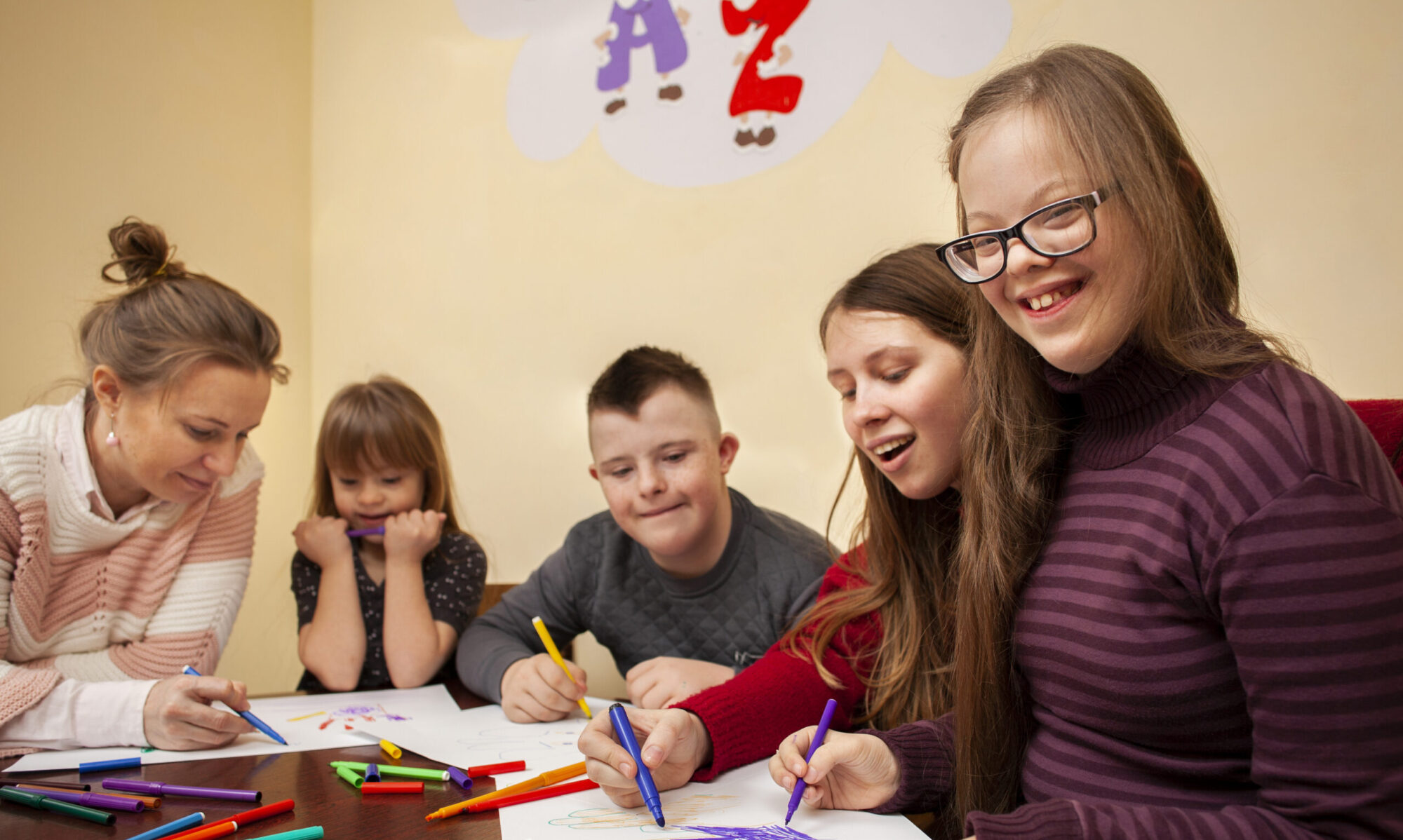
March is Developmental Disabilities Awareness Month, and March 21st is World Down Syndrome Day. As my journey with my own son with Down syndrome has evolved I realize that I want more than awareness. I’d love for our society to move from awareness to acceptance, recheck our ableist tendencies, and provide a more equitable world for our loved ones with disabilities.

I admit I once wore those “crazy socks” for World Down Syndrome Day, but now realize the campaign does little to persuade people to actually accept my son. The organizers of his trend even changed the name to “wacky socks,” because of the inherent ableism in it’s name: “crazy” socks. I think it’s important that we move past these awareness campaigns to something that persuades actual action. But how? How do we raise awareness and persuade people to truly accept people with disabilities for who they are?

Outside of the classroom, there’s many small, yet powerful actions you can take. Advocating for laws that end sub minimum wages, and promote community inclusion can be as easy as sending a letter to your representative or showing up to a rally. Another powerful step towards equity is working with people with disabilities to understand how they want to be respected and supported. Always question yourself and others. Do you or people around you still harbor ableist feeling like pity or inferiority of people with disabilities? Learning from these moments and moving forward is an important first step towards acceptance, and something I still practice and struggle with sometimes.

When and how should parents formally introduce their child in a classroom setting, and promote disability acceptance? 

First, let’s talk about what NOT to do. You might have come across the use of disability simulations: marshmallows in the mouth to simulate low tone and lack of intelligibility, hands in mittens to simulate poor fine motor skills, blindfolds to simulate–well, being blind. Do you notice what all these simulations highlight?

What a person can’t do, rather than how individuals with disabilities successfully adapt to their environment with the right modifications and supports.

Instead of promoting empathy and awareness, research studies show disability simulations actually promote fear, apprehension, and pity towards their classmate with a disability. Also, because the simulation is only for a short time, it’s hard for typical students to truly experience the classmate’s limitations in a meaningful way.

Awareness Activities in Grade School

Trying to promote acceptance will take more time and thought than awareness campaigns but they’re worth it. I invited a local self-advocate with a disability to come talk to our entire school body about acceptance. I hope that this will make a lasting impact.

Many teachers and parents like to take a more broad approach to awareness of differences in lower grades. For instance, in kindergarten through 2nd grade you may not even mention the term “Down syndrome” or “Autism.” Many parents decide the discussion shouldn’t single their child out, but foster acceptance of all students. Children’s books are a great way to foster acceptance of people for who they are. Here’s some examples:

“My Friend Isabelle” by Eliza Wilson: I love this book, because it starts with two friends that have so much in common, but also talks about differences. The reader only finds out that one character has Down syndrome by reading the jacket note at the end of the book. It also has a guide to help teachers and parents incorporate the book into a classroom lesson. Watch the YouTube click below for a video version of the book.

“The Day the Sheep Showed Up” by David McPhail: About farm animals who had never met a sheep before. The sheep teaches them that they are more alike than different. Great metaphor for accepting those that are different, and fabulous for new readers.

“King Louie and His Marshmallow Kingdom” by Louis Rotella: About a little king who rules over a kingdom where the sun always shines and every meal is a picnic. Louie explains to his friends that he loves to do kid-things, even though he’s different. This is one of my all-time favorites!

Awareness Activities with Older Students

Books can also be used with older students, and some may actually define a disability. But more hands-on or project-based activities are also fun at this age. Open discussions about what students already know about disabilities (or think they know) is imperative. Prior knowledge allows teachers and parents to assess where to start, as well as any preconceived notions students may have. Discussing inclusion is also important at this age. All kids want to be included.

The Governor’s Council for People with Disabilities did a fabulous disability awareness campaign in Indiana and posted all of their lessons here. Some of their ideas include:

  • Students create a class motto for inclusion
  • Anonymously write questions students have about disability and difference, and have those questions read and answered as a class (or in private)
  • Create a classroom mural that depicts what an inclusive class, school, and community looks like
  • Perform a simple skit showing appropriate and inappropriate ways to interact with classmates with disabilities: people’s first language, asking before you help someone, inviting classmates to special occasions, treat your classmate the way you want to be treated
  • Show a movie or show that depicts someone with a disability as the main character
  • Evaluate their school or local business to see if they accessible for people with disabilities. If they’re not, come up with a plan to change that.
  • Invite a sign language interpreter to teach students some simple signs.

What are you planning to foster acceptance in your child’s classroom? Add some ideas in the comments sections.

The following are some other books that may help you foster acceptance in the classroom:

Why Your Child Needs a “No Consent” Letter for Restraint and Seclusion

Two Ohio teachers caught on video dragging an Autistic boy will not be criminally charged. The disturbing video below shows the teachers restraining the boy. The teachers still face possible disciplinary action.

This type of incident of restraint and physical punishment of students with disabilities is more common than you might think.

Two Ohio teachers drag an Autistic boy

A study of 99% of public schools by the United States Office of Civil Rights found that students with disabilities are restrained and secluded at a much higher rate than their typical peers. The office found that although students served under IDEA make up only 12% of the U.S. public school population, they make up 67% of students who were restrained or secluded.

That’s 70,000 students with disabilities who were restrained or secluded in the 2013-14 school year, for which the last data was recorded. Let that sink in for a moment. And assuredly there’s a lot more incidents that are not reported.

A “No Consent” Letter for Restraint and Seclusion

The best way to prevent this type of incident from happening to your child is to find out if your school’s personnel are trained in non-violent crisis prevention and to add a “No Consent” letter for restraint or seclusion in your child’s official records. The Individuals with Disabilities Education Act (IDEA) is very clear about this issue. The law states that school districts MUST consider the use of positive behavioral supports and Functional Behavior Assessment (FBA) plans if a child’s behavior interferes with their education or the education of others, but most do not.

Read Related Post: Why Your Child’s Teacher Should Be Trained in Non-Violent Crisis Intervention

I could never imagine my son’s teachers using the techniques the teachers above used and my son doesn’t really have any violent behaviors. Still, I have a “No Consent” letter on file. The statistics are not in your child’s favor, no matter who your child’s teacher is. It’s prudent to add this type of letter to your child’s record whether you like their teachers or not. The letter need not be adversarial, but instead puts in writing your expectations for behavior supports.

What should be included in a “No Consent” Letter

A “No Consent” letter will make it clear that you do not approve or consent to any harmful or exclusionary techniques. Include the following in your letter:

  1. Name and contact information for your school district
  2. Date that you send the letter
  3. Name of your child, birthday, and school they attend
  4. Describe your child’s disability and any behavior concerns you have
  5. Clearly state that you do not consent to any negative behavior techniques including: restraint, seclusion, physical management, seclusionary time outs, forcible holding, dragging, use of ties and straps, slaps, deliberate humiliation, or deprivation of nutrition or exercise.
  6. Clearly state your opposition to these strategies: This letter is to make it clear that I have not authorized or given consent to any of the above strategies being used on my child
  7. Add family emergency contact information in case any situation arises where the school feels they cannot respond in a safe and non-threatening way.
  8. Make clear that IDEA states that only positive behavior supports like a formal behavior analysis should be used. Add that you would like to be part of any team that develops a FBA plan.
  9. Add any effective behavior techniques that have worked in the past for your child.
  10. Ask that an IEP meeting be held if problems arise or persist.
  11. Thank them and remind them that you will be holding them accountable if any restraint or seclusion technique without your permission.

The last time Congress took up the issue was in 2010, but the bill died because of language in the bill that would have allowed restraint and seclusion to be written into the students IEP. Now the federal government under the new Every Student Succeeds Act is requiring states to reduce these “adversive behavior interventions.” Sadly, parents must be proactive about the possibility of restraint and seclusion until school districts and the government takes a clear stand.

If you want to see a sample of a “No Consent” letter click here. Do you have a no consent letter on file for your child? Has your child ever experienced this type of negative behavior strategy? Tell me what you think below.


3 Tips to Survive Your Child’s Next IEP Meeting

IEP season is upon us! It’s like preparing for Christmas or Hanukkah without any of the joy. Still, the results of an IEP (good or bad) will have a much more lasting impact on your child’s life than any holiday gift they receive. It’s important to get the process right. Here’s some useful tips:

Other than your child, you are the most important person on your child’s IEP team. That’s because you know your child best. Likely, you’ve become an expert on your child’s strengths and weaknesses.

Read Related Post: 3 Words That Will Transform Your Next IEP Meeting

If you’re reading this, I know you’ve spent countless hours scouring the Internet for expert advice on inclusion and educational best practices.

Still, an IEP meeting can often feel like an episode of David and Goliath. You playing the part of David.

So, now is the time to get organized. Rally the troops, because this year’s IEP meeting is going to be EPIC…in a good way!

Here’s 3 tips to make your child’s IEP meeting run as smoothly as possible: 

  1. Never go alone to an IEP meeting!
    • An IEP team meeting can include countless school personnel, often with their own agenda.
    • If you can afford it, find an non-attorney special education advocate in your area by searching the Council of Attorney and Advocates directory here. A good advocate can cost you anywhere from $100-$1000, but it may be worth your weight in gold to have someone in your corner who knows the law. 
    • If you can’t afford an advocate, invite an friend, pastor, neighbor….anyone who is less emotionally invested than you are and who can take good notes. 
    • Many state Parent Training and Information Centers (PTIs) provide free non-attorney special education advocates. Click here to find your state’s PTI center.

2. Organize all those documents CHRONOLOGICALLY!

  • As a former teacher, I realize failure to document can come back to bite you in the “you know what.” Keep all of your child’s records – from evaluations to letters home to IEPs to that adorable little Mother’s Day painting he made you this year. But how?
  • First, go out and buy the BIGGEST 3-ring binder you can find.
  • MOST IMPORTANT: Organize your documents chronologically! I’ve tried creating categories for my son’s IEP folder, but I soon realized the categories are ENDLESS (IEP, ETR, Behavior, Communications, Resources, etc). Also, some of the documents could really be under more than one category (which category do you choose then?).
  • My best advice, create a table of contents with the following: date, author, type, significance. Number each document and place them in order of date. Then you can quickly look back at your table of contents to find your child’s “1st grade ETR”. 

Read Related Post: Using the Recent Endrew F. Supreme Court Case at Your Child’s Next IEP Meeting

3. Put EVERYTHING in WRITING!

  • Communication is EVERYTHING! Save it all: emails, letters home, even text messages.
    • Make all requests in WRITING! I have so many clients who complain that they asked for a 1:1 aide for their child and the school said “no.” If you ask for the aide in writing your child’s school has to provide Prior Written Notice explaining why they denied your request. Often school’s don’t want to official deny a request in writing. Read about Prior Written Notice here
    • At the end of each email I send to school personnel I always write: “please add this to Troy’s educational record.” Emails can often get lost in the ether, but they can be very powerful if you need to make a case for a change in your child’s IEP later. Make sure you make them a part of your child’s official record.
    • The easiest way to save emails if you don’t have a physical copy and don’t want to print it out, is through email files. Most emails (I use Gmail) allow you to create folders.
    • I have a folder for Troy in my email, and even have sub-folders (for behavior, IEP, and therapies). Any time I get an email I save it in the appropriate folder. I even email text messages to my email to save.
    • This is especially important if, for instance, you keep getting an email about your child’s behavior. Keeping a paper trail (or in this case, an email trail) will be crucial for getting your child the help they need. Most schools require evidence of a continued problem before they’ll shell out money for say a formal behavior assessment.
    • If you have a verbal conversation with school staff about your child, go home and document it. It can be as easy as starting a list of conversations with the date in the Notes app on your iPhone. If you document the conversation the day it happens it becomes part of your child’s official record.

Let me know what you think of these 3 tips below. And tell us how you make your child’s IEP meeting as magical and impactful as Christmas morning! Comment below.

Speak Your Fear, Be Fearless

I feel alone.

Are my hands sweating?

They’re never going to go for my request.

I wish I would have brought someone with me.

I want to vomit.

Let’s just get this over with!

This was me in some of my son’s first IEP meetings in preschool, but it really could be anyone. I have friends who text me before going into their child’s IEP meeting and the commentary is the same. Fear and loathing!

Read Related Post: 3 Words that Will Transform Your Next IEP Meeting

I’ve never been a very confrontational person. I want everyone to just get along. To this day I still sometimes shake my head “yes” to decisions made in my own son’s IEP meetings, while inside I’m thinking “This doesn’t sound right!” Then I get home and I realize “it’s not right!”…then I really freak out. My husband gets the brunt of this freak out session. Poor guy! I mean, I really go bonkers. Then I get angry.

I was sick of feeling this way, which is one reason I decided to complete the Council of Parent Attorneys and Advocates year-long Special Education Training. I knew I was supposed to be an equal member of the IEP team, but always felt like the school personnel had the upper hand. They’re in charge of the evaluations, the initial draft, and they ran the meeting.

The COPAA SEAT course gave me the legal expertise to know that it didn’t have to be this way. If I disagree with the school’s evaluation, I can request an independent educational evaluation (IEE) at school expense. I could offer my own “draft” of the IEP with my ideas for present levels, IEP goals, and accommodations. I could ask for a draft before the meeting. I could also provide my own agenda for the meeting. And the IEP document can ALWAYS be changed, even after the meeting.

All of this went a long way in quelling some of my fears, but that emotional charge of walking into your own child’s IEP meeting never quite goes away. That’s why I started speaking about my fears for my son.

You’ve probably heard of “speaking truth to power,” or a non-violent way of fighting back against corrupt governments. This is similar, even if the school is well-meaning and not corrupt. It may seem counterintuitive, but speaking your fears can actually expose what may be wrong or challenging about your child’s situation in a real and authentic way. Get it out and be done with those fears. What are your fears for your child? SAY THEM OUT LOUD! WRITE THEM DOWN!

Read Related Post: Advocate Like a Mother

I fear my son will be mistreated and I will never know, because he can’t tell me.

I fear my son will be separated from his twin brother and other peers, because he has a cognitive disability.

I fear that he will be left in a general education classroom without the supports he needs.

I fear that behaviors that are a manifestation of his disability will be used to segregate him.

I fear, I fear, I fear!

SAY IT OUT LOUD! WRITE IT DOWN!

Then, here’s the clincher…..

Say them to the IEP team. I know!!! It’s super scary, but it’s also revolutionary!!! If you’re like the old me you can also just write them down and present them in an agenda at the meeting. Speaking our fears is one of the most powerful ways to overcome them; to ensure our worst fears for our children never happen. Instead, solutions to your fears take center stage at the IEP table.

Most teachers and principals are in education for the right reasons. They really care about our kids. They want what’s best for them. If we speak our fears to them it really sets the stage for an open relationship that’s focused on what’s best for the child. Sometimes being vulnerable, speaking your fears, is the most powerful tactic you can take!

What helps you stay on-point at an IEP meeting? Tell me your fears below.

Top 5 Blog Posts of the Year

2018 was a year of change for our family. The military moved us across country, my twin boys (one with Down syndrome) started kindergarten, and I started a special education advocacy business. So, far all those ventures have been a success. We found a school in Washington state that believes in inclusion. My twins are in the same general education classroom; my son with Down syndrome is receiving supports inside the regular classroom. With my youngest child still at home, I’ve started slow with my special education advocacy business…but things are heating up with phone calls from around the nation and some special clients locally.

What hasn’t changed is my need to learn everything about special education law, inclusion, and the disability civil rights movement. And I still love sharing what I’ve learned on this blog. Judging from my top 5 read blog post, you are eager to learn more too.

My New Year’s Resolution is to help more families advocate for their child with a disability in school. To secure their child’s civil right to a Free and Appropriate Education in the Least Restrictive Environment. To share what I’ve learned from this venture with you here. Please let me know if you need help. Click on the “services” tab on the menu to learn more.

So without further ado, here are the Top 5 Blog Posts of 2018:

  1. Least Dangerous Assumption: This theory that explains the bigotry of low expectations we set for people with disabilities will blow your mind. It will change how you view every IEP meeting you attend. It’s a must know in the new year!
  2. Why Your Child Needs a “No Consent” Letter for Seclusion and Restraint: It’s the blog post that I wish wasn’t in the top 5, but has obviously hit a nerve. This post consistently ranks in the top 3 blog post on my blog on any given day. It’s disturbing, and speaks to the dark side of special education. There’s been too many instances of seclusion and restraint across the nation this year. Still, the post gives you some guidance on how to prevent seclusion and restraint tactics from happening to your child. I gave my son’s school a “No Consent” letter as soon as we moved here. The district already has a policy against these tactics, but I respectfully and politely pushed to have this in his file just in case. The IEP team completely understood my concerns.
  3. Teen with Down Syndrome Wins Inclusion Case in Federal Court: The Down syndrome community and all special education students had a huge victory in federal court this year in the case of Luka vs. Hamilton County School District in Tennessee. Luka and his Mom sacrificed a lot to ensure he received the education he deserved; and their bravery has a positive impact on us all.
  4. Using a Recent Federal Court Case at Your Next IEP Meeting: Luka’s mom specifically talks about how you can use her son’s case at your own child’s IEP meeting to fight for inclusion. Her words will stay with you…check it out!
  5. 7 Research Studies You Can Use At Your Child’s Next IEP Meeting to Win the Fight for Inclusion: This was one of the most shared blog post of the year. Did you know there’s not one research study since IDEA was signed into law more than 40 years ago that says a separate setting shows an academic benefit for students with intellectual disabilities. Find out what the research says about all the benefits of inclusion!

What blog post was your favorite? What do you want me to write about in the New Year? Let me know in the comments below. We’re wishing you an inclusive 2019!