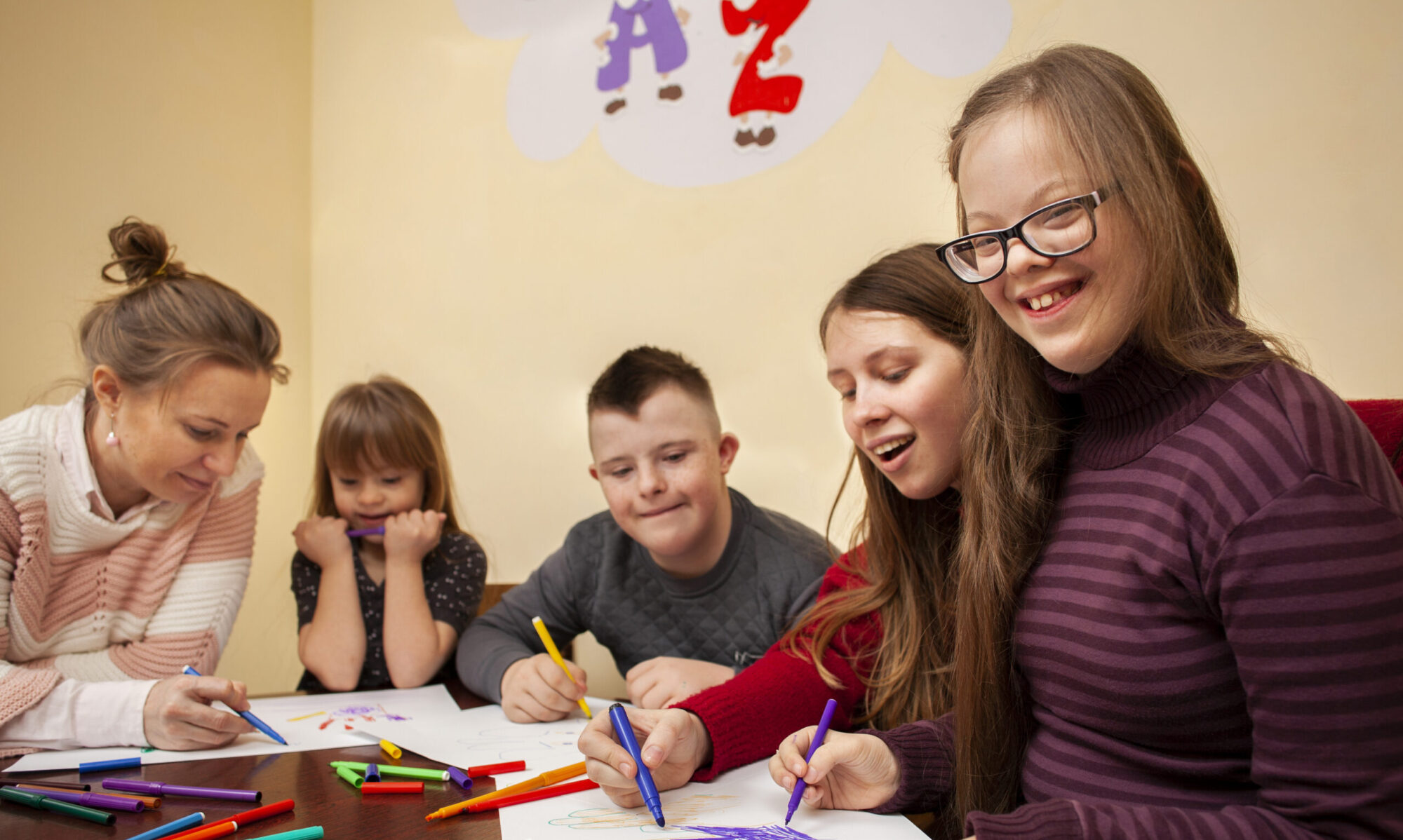
Fostering Acceptance in the Classroom

The first couple of weeks of school is what teachers like to call the “honeymoon phase”. When I taught, I remember students always being on their best behavior. But soon students will become more comfortable and a classroom hierarchy will develop. Students begin to notice those that may be different, and will start making comments or asking questions.

As a parent of child with Down syndrome, I’ve often wondered how I would formally introduce my son to his typical peers. My son, Troy, has had the same preschool teacher for the past two years, and his teacher and I have a decided not to do any formal explanation of Troy’s differences. He is more alike than different, after all. And the 3 and 4-year-olds aren’t concerned about labeling his difference.

When and how should parents formally introduce their child in a classroom setting, and promote disability awareness and acceptance? 

First, let’s talk about what NOT to do. You might have come across the use of disability simulations: marshmallows in the mouth to simulate low tone and lack of intelligibility, hands in mittens to simulate poor fine motor skills, blindfolds to simulate–well, being blind. Do you notice what all these simulations highlight?

What a person can’t do, rather than how individuals with disabilities successfully adapt to their environment with the right modifications and supports.

Instead of promoting empathy and awareness, research studies show disability simulations actually promote fear, apprehension, and pity towards their classmate with a disability. Also, because the simulation is only for a short time, it’s hard for typical students to truly experience the classmate’s limitations in a meaningful way.

Awareness Activities in Grade School

Many teachers and parents like to take a more broad approach to awareness of differences in lower grades. For instance, in kindergarten through 2nd grade you may not even mention the term “Down syndrome” or “Autism.” Many parents decide the discussion shouldn’t single their child out, but foster acceptance of all students. Children’s books are a great way to foster acceptance of people for who they are. Here’s some examples:

“My Friend Isabelle” by Eliza Wilson: I love this book, because it starts with two friends that have so much in common, but also talks about differences. The reader only finds out that one character has Down syndrome by reading the jacket note at the end of the book. It also has a guide to help teachers and parents incorporate the book into a classroom lesson. Watch the YouTube click below for a video version of the book.

“The Day the Sheep Showed Up” by David McPhail: About farm animals who had never met a sheep before. The sheep teaches them that they are more alike than different. Great metaphor for accepting those that are different, and fabulous for new readers.

“King Louie and His Marshmallow Kingdom” by Louis Rotella: About a little king who rules over a kingdom where the sun always shines and every meal is a picnic. Louie explains to his friends that he loves to do kid-things, even though he’s different. This is one of my all-time favorites!

Awareness Activities with Older Students

Books can also be used with older students, and some may actually define a disability. But more hands-on or project-based activities are also fun at this age. Open discussions about what students already know about disabilities (or think they know) is imperative. Prior knowledge allows teachers and parents to assess where to start, as well as any preconceived notions students may have. Discussing inclusion is also important at this age. All kids want to be included.

The Governor’s Council for People with Disabilities did a fabulous disability awareness campaign in Indiana and posted all of their lessons here. Some of their ideas include:

  • Students create a class motto for inclusion
  • Anonymously write questions students have about disability and difference, and have those questions read and answered as a class (or in private)
  • Create a classroom mural that depicts what an inclusive class, school, and community looks like
  • Perform a simple skit showing appropriate and inappropriate ways to interact with classmates with disabilities: people’s first language, asking before you help someone, inviting classmates to special occasions, treat your classmate the way you want to be treated
  • Show a movie or show that depicts someone with a disability as the main character
  • Evaluate their school or local business to see if they accessible for people with disabilities. If they’re not, come up with a plan to change that.
  • Invite a sign language interpreter to teach students some simple signs.

What are you planning to foster acceptance in your child’s classroom? Add some ideas in the comments sections.

The following are some other books that may help you foster acceptance in the classroom:

From Where We Stand: Perspectives on Fathering a Child with a Disability

Most parents of children with disabilities would agree that at some point along this journey they’ve felt alone, isolated, confused, and scared. Fathers are no different, and many say they share a unique set of concerns, different than mothers. Research shows that disability support services focuses primarily on the needs of mothers, and are predominately provided by women.

This Father’s Day it’s important to recognize the contributions and needs of all the dads that share in this unique journey.

Below are the perspectives of fathers of children with Down syndrome. Make sure you read to the end, to get tips and resources from dads to dads in similar situations.

Read Related Post: Mother’s Day Advice From Moms Who’ve Been There

Brian Herndon, Associate Professor of Elementary Education at John Brown University

“It is interesting being the dad of a child with Down Syndrome. The overwhelming majority of people that I interact with in the disability community are mothers. There seem to be very few, if any, fathers who are actively advocating for their child(ren) with disabilities. I am part of a couple of Facebook pages that are specifically for dads, but they are, honestly, pretty generic. There is one that is called Band of Brothers, and mostly dad’s just post cute pics of their child doing fun things. The Kansas City Down Syndrome Guild has a dad’s group, but I never got involved in it. I get posts and updates, but I don’t do anything with it.

I think I’m a bit of a different kind of dad though because I am also an elementary school educator. So, children are an area of expertise for me. I have never been one to shy away from being around children, even babies. I knew pretty early on that if I didn’t speak up for my child and become knowledgeable about the law that no one else would. My wife would speak up, but I knew that schools would shoot her down pretty quickly and she wouldn’t really know what to do from there. She’s a tough woman, and she would have figured it out for sure. But, she is very comfortable with me being the one to be the strong voice when it comes to schooling and inclusion.”

Erik Weiner, Disability Advocate who’s worked on key disability rights legislation in his state

“Being a father to a child with a disablilty can sometimes be a lonely journey. Not from the aspect of being alone from your spouse but sometimes from the special needs community itself. I remember when we first found out that Devan was born with Down syndrome. Being the type of person that I am I started to reach out to as many groups as I could. As the days and weeks went on I found that many times the groups were mainly run by women and a lot of times when I would ask questions or tried to participate in an online discussion my questions and statements went unanswered. I felt like being a man/father my concerns for my child weren’t “good” enough that it was up to the mom to ask those questions. I will say that there were a few moms that reached out to me and because of that I have formed some great resource/friend relationships. As I moved on in the journey I did find support groups from men but never fully pursued active participation with them for some reason.

All my life I have been in one way or another involved with individuals with all types of disabilities. Whether it was through school, coaching, or personal experiences. So the idea of disability or an individual with a disability was not a new concept. What WAS a new concept was now I WAS that parent with a child with a disability. From the moment we were able to take Devan out on family outings I immediately went into “on guard” mode. Meaning I constantly was looking for someone to give her a second glance, to make a face, laugh at her, to have some say “looked at that retard”. I was on edge and looking for that fight. Not that I was ashamed of her or who are family was, but because I knew there were not so nice people out there. People that don’t see her the way I do. Slowly and I mean very slowly I have been able to push that “feeling” down. Because I truly don’t feel it will ever go away; just stored away in an “in-case of emergency break glass” kinda of thing.”

Mitchel Rothholz, Disability Advocate who brings over 34 years of association management experience to the Down syndrome community

“Fathers sometimes feel isolated because they are trying to figure out their role.  I encourage dads to connect with each other so they have someone going through similar challenges who they can talk to. Attend meetings of your local interest groups, attend the National Down Syndrome Congress (NDSC) convention, volunteer to be a parent-to-parent counselor or work on a committee, visit legislators. Once you engage you will get the bug and realize you are not alone. My wife, Julie, and I complement each other and play off of each of our strengths.  Julie and I have been group facilitators for the sharing sessions at NDSC, and it is interesting to compare notes of what each group discussed. Both are trying to figure out the foreign language they have been thrust into and trying to do what’s right for their kids. Navigating all of the issues can be daunting.

There will always be ups and downs in raising any child, but in raising a child with an intellectual disability the challenges can be amplified.  This is why this is a team sport with each parent supporting each other.  Identify your strengths and take on responsibility for key aspects regarding the needs of your child.  Kids with Down syndrome are no different than other kids – they will find your weak points and exploit those.  Stay strong, consistent, coordinated and support each other.”

Resources For Dads:

https://www.dadsnational.org: D.A.D.S or Dads Appreciation Down syndrome assists and supports fathers of individuals with Down syndrome

National Down Syndrome Congress Convention’s Dad’s Sharing Session. Every summer, during the NDSC’s annual convention, Dad’s breakout by age group to discuss issues common to us all.

Check out your local Down syndrome organization for a local dad’s group. Many are active in their local community.

The Arc also provides Father’s groups in many cities throughout the nation.


The Link Between Sleep and Learning

It wasn’t long ago that dad’s snoring was a family joke. New research is now showing that sleep problems can lead to serious issues, especially for our loved ones with Down syndrome.

Evie is only 5-years-old, and already she’s underwent 7 sleep study.

Evie

“Her first was at 11 months because they were trying to rule out pulmonary pressure issues before doing heart surgery. She had mild apnea then,” says Evie’s mom Jen Alge. This amazing preschooler, who happens to rock an extra chromosome, was found to develop severe obstructive sleep apnea (OSA) in a follow-up sleep study.

Surgery to remove her adenoids and tonsils brought down Evie’s OSA levels to a more moderate range. “A simi MRI (which I highly recommend) showed how obstructed her airway is, so we started Evie on a CPAP (Continuous Positive Airway Pressure),” describes Alge. Evie’s mom is a disability advocate friend of mine, so I’ve heard her talk about their countless sleepless nights. “She does wear it on average 7 hours a night, but that’s only because I’m in her room 5-8 times a night at least putting the mask back on.”

Research out of the University of Arizona links Obstructive Sleep Apnea to cognitive problems. 

“Addressing sleep disruptions may be an overlooked way to improve cognitive outcomes in the Down syndrome population,” says Dr. Jamie Edgin, lead researcher and professor of Psychology and Cognitive Science. The study found that individuals with Down syndrome with OSA had cognitive, memory, language, and behavioral issues.

Edgin’s study of school aged kids found those with untreated OSA had a poor ability to learn new rules, and a 9-point difference in verbal IQ scores compared to their peers with Down syndrome without OSA. “A more recent study of preschoolers with Down syndrome found that those with OSA had fewer words and may limit how well they learn to communicate,” explains Edgin.

It’s estimated that 50-100% of individuals with Down syndrome have Obstructive Sleep Apnea (OSA), and most parents can’t predict whether or not their child has it.

Troy during his sleep study

This is true in our case. I had no suspicion that my son, Troy, had OSA, but took him in for a sleep study at 2-years-old anyway after reading Edgin’s research.

The American Academy of Pediatrics recently lowered their recommended age for completing a sleep study for children with Down syndrome from 8-years-old to 4-years-old. “The earlier we detect the sleep problems the better. There’s a push in the medical community to decide how early and I argue it should be earlier than 4-years-old,” explains Edgin. “A study out of Indiana found that babies as young as 6-months-old showed divergent sleep patterns.”

I’m glad I didn’t wait to take Troy in for a sleep study. At 2-years-old he had moderate sleep apnea. Troy got his adenoids and tonsils removed, which was enough to resolve his sleep apnea. At almost 5-years-old he’s speech has taken off despite his Apraxia diagnosis, although I’ll never know if that’s because we were so proactive in treating his OSA.

Parents should continue monitoring sleep issues even into adulthood. 

“One age group that’s not being studied is adults,” says Edgin. “OSA and other sleep issues has been shown to lead Alzheimers and cognitive declined in typical adults. The same is likely true for adults with Down syndrome. Although they may suffer these declines earlier than their typical peers.”

Edgin recommends that individuals with Down syndrome repeat sleep studies periodically throughout their lifespan. “As people age and put on more weight it can reoccur. Parents need to stay vigilante as they age,” explains Edgin.

Talk to your child’s doctor and decide on a course of treatment that’s best. Not every treatment is meant for every child. 

Goodnight kiss from brother

For our family, surgical removal of aenoids and tonsils was enough to resolve Troy’s OSA for now. Evie’s mom, Jen, says she hasn’t seen any difference in her daughter’s language and behavioral outcomes after using the CPAP, but she still thinks the treatment has been worth it.

“Evie’s always been a smarty pants and she talks all day long so I can’t credit the CPAP for any changes there. I will say she is getting more air and isn’t gasping for breath or snoring with the CPAP on so that’s a relief. The behavior changes might be more long term given her age,” explains Jen Alge.

Remember sleep is likely just one piece of the puzzle when it comes to cognitive, language and behavioral issues.

“Sleep issues alone do not fully explain the extent of language disruption in individuals with Down syndrome. We found that the good sleep group with DS was also impaired in these areas in relation to their typical peers,” explains Edgin.

“It’s important to understand the link between sleep and learning problems, but it’s not the only thing people need to keep in mind. In the end, language interventions may be more beneficial if done in conjunction with sleep interventions,” argues Edgin.

Interested in learning more about 5-year-old Evie’s OSA treatment? Read here.  


Mother’s Day Advice From Moms Who’ve Been There

This mother’s day I hope that you take some time for yourself, and realize that you’re doing the best you can for your child. Drink the wine, eat the chocolate. Kick back, and know you and your child will be ok. For proof of this, I asked some mothers, who are further along on their parenting journey, to give some sage advice to newer moms. I asked all of these rockstar advocate moms the following questions:

  1. What advocacy advice do you have for moms just starting this journey?
  2. What advice do you have for new moms to prevent burnout? 

I got so much good advice from moms, that I made this a 2-part series. Click HERE for the first part!

If you haven’t listened in on Charmaine Thaner’s Facebook Live posts, you’re missing out. Every week, Charmaine hosts an advocacy guru or gives timely advice on IEPs. Check it out here. Her son, 29-year-old Dylan, rents his own house with a roommate, attended the University of Colorado Springs, currently works at Red Robin restaurant. Charmaine credits all of this to full inclusion in K-12.

Charmaine’s advocacy tip for new moms is to focus on your child’s strengths. “At the beginning of an IEP meeting ask each person sitting around the table to share a couple strengths your child has. It creates a positive tone and helps everyone see your child as a person with gifts to share,” Charmaine says.

To prevent advocacy burnout she recommends to build relationships. “The 3 Rs of Advocacy are Relationships, Relationships, Relationships. Get to know the staff as people, what they’re interested in, about their family, what you have in common with them. Help teachers build positive relationships with your child. When a teacher knows your child on a personal level they will go the extra mile for him/her.”

Stephanie Smith Lee and her late daughter, Laura, are the pioneer advocates for inclusive higher education. When Laura asked her mom back in 2000, why she couldn’t go to college like all her friends, Stephanie said “Why not!” That started an amazing journey that has help lead to more than 260 inclusive college programs for people with disabilities. Laura went on to graduate from George Mason University’s LIFE program, work at the World Bank, volunteering at a food bank, and becoming a nationally recognized self-advocate giving speeches nationwide with her mother by her side.

Stephanie’s advice to new moms: “Understand that you really can make a difference, and that there are many of us who have been working on advocacy for decades years who will help and support you.”

Stephanie says to “do the best you can with the time and resources you have available. Don’t feel guilty when you need to take time for yourself, your family, and your work. Come back at it refreshed and ready to make a difference!”

Laura and Stephanie doing what they do best: Advocating!

Senior Education Policy Advisor for the National Down Syndrome Congress, Ricki Sabia, has also been at the forefront of political advocacy and disability rights. She was instrumental in securing educational rights for students with disabilities in the new Every Student Succeeds Act (ESSA). Her son, 25-year-old Steve Sabia, lives independently with a roommate, attended Montgomery College, and works at Holy Cross Hospital.

Ricki’s top advocacy tip for new moms: “The ability to collaborate and see issues from other perspectives is as important as knowing your rights under the law.”

Ricki reminds parents to “pick their battles, join forces with others, pay attention to your health and well-being, and don’t forget to take time to simply enjoy your child.”

Ricki and Steve

Amy Allison may not have a child with a disability by birth, but she has served hundreds through advocacy. As the Chief Operating Officer of the Down Syndrome Guild of Greater Kansas City, Amy has visited over 800 families receiving a diagnosis for Down syndrome, and currently serves 1500 people with Down syndrome. Attending the KCDSG’s annual, winter conference is a must. I learned how to potty train my own kiddo with Down syndrome, and will never forget the fabulous siblings workshop. Click here for more on that.

Amy says parents should “trust their gut and instincts. If something feels off about one of your children follow that voice in your head and keep pushing for answers regardless of what the “experts” may say to you. Allow your child space and grace to try, fail and make mistakes even though you can see the pain and heartache coming. If you overprotect your child and shelter them from the consequences of their actions, you set them up to fail as adults.”

As for preventing advocacy burnout, Amy says “be sure to surround yourself with a good group of friends and family members who will go to the mat for you or your kids. And DO NOT be afraid to ask for help or admit you are tired. Advocacy is a marathon not a sprint. Pacing yourself and choosing your battles will take you help you cross the finish line!”

Amy with her 3 kids

I met Carolyn and her son, Walter May, of Ohio from a Self-Advocacy Communications Workshop I co-taught for adults with Down syndrome in our area. Carolyn says things have changed drastically since her son was born 45 years ago. Walter told me how he was bullied and taunted in school. Still, this mother-son duo thrived despite the prejudices they faced. He’s an extremely well-spoke self-advocate who works locally for the famous “Homies with Extra Chromies” t-shirt company, as well as a local tennis club. He spouts off sports trivia like no one’s business, and loves to joke around.

Carolyn and Walter

Carolyn’s advice is simple, yet true: “Never give up!” and “Always take time for yourself.” Thanks Carolyn and Walter for showing me what I have to look forward to. I’ll miss you guys!

Happy Mother’s Day to all you brave, wonderful mothers! Celebrate you today! 


Advice from Moms Who Have Been There

With Mother’s Day just days away, I thought it would would be fun to share advice from mothers further along on the journey of advocating for a child with a disability. Mothering any child requires patience, endurance, and commitment. We advocate for all our children, both typical and differently abled. None come with an instruction manual, and everyone’s situation is different. Still, it’s comforting and enlightening to receive advice from others who have walked a similar path.

Read Related Post: Advocate Like Mother

This mother’s day I hope that you take some time for yourself, and realize that you’re doing the best you can for your child. Drink the wine, eat the chocolate. Kick back, and know you and your child will be ok. The following moms are proof of this. I asked all of these rockstar advocate moms the following questions:

  1. What advocacy advice do you have for moms just starting this journey?
  2. What advice do you have for new moms to prevent burnout? 

Denise Gehringer of Nebraska has a 22-year-old son with Down syndrome. Jacob was named National Down Syndrome Society’s Champion of Change in 2017, and just started taking continuing education classes after working as a teacher’s aide. 

Denise and her son, Jacob

Denise wants new moms to remember they’re the expert of their child. “You know them best, have spent the most time with them and have experienced what has worked and what hasn’t for them. Know that YOU are the most important member of the IEP team, the most important resource at a doctor’s visit, and have the lived experience to share with your legislators,” Denise says.

Denise says she has yet to master the burnout prevention, but she says “taking breaks from what seems like a never-ending need to advocate on behalf of your child is necessary to keep up the energy and wherewithal needed to be an effective advocate . Scheduling an activity that has nothing to do with “disability world”, a dance class, art class, cooking class, book club, etc. where you allow yourself to focus on something you enjoy, even for a short time, helps tremendously.”

Read Related Post: A Mother’s Day Wish

Beth Foraker of California is the founder of the National Catholic Board on Full Inclusion. Her son, Patrick, is headed across country to attend George Mason University’s LIFE program. 

Beth and the new high school grad, Patrick

Beth encourages new moms to develop a Circle of Support for your child beginning in 3rd grade (a strategy she learned from another rockstar advocate, Janice Fialka-Feldman. Click here for more). “What this means is a group that includes typical friends, special adults in the child’s life and a friend that has a disability. These people meet once every 4-6 weeks to talk about how things are going and brainstorming any trouble spots or ideas the person wants to work through. I wish I had known about this for Patrick. I think it would be awesome! And very cool to continue in young adulthood,” Beth explains.

“Believe it or not, your child will grow up and need you less and less. The goal is independence but who really knows…my goal is actually interdependence for Patrick…so, work to nourish your marriage and your friendships…those will sustain you when your child needs less and less of your attention,” Beth explains.

Amy Van Bergen of Florida recently retired as Down Syndrome Association of Central Florida’s Executive Director, and now helps raise money for the Global Down Syndrome Foundation’s special projects. Her 27-year-old son, Wils, works as an office assistant at a law firm, and is an ambassador for the Best Buddies Citizens program in Orlando.

Amy and Wils (center) with their family

Amy says advocacy is “all about playing the long game, meaning approach all of your efforts with your long-term goals in mind. And one of the best advocacy tips related to that is this: always reach out to the losers after an election. Thank them for their willingness to run for public office, for running a campaign with integrity, etc. I can almost guarantee that today’s losers will run again or get appointed to leadership positions in the future and they will remember the folks who connected with them when they were down.”

“As for burnout, moms and dads always need to take care of themselves first. If you are new to advocacy and overwhelmed by trying to figure out legalese and policy doublespeak, identify a few advocate mentors. Look to them for guidance as you grow and learn. They will help you identify what’s truly action-alert worthy,” Amy says.

I got so much good advice from moms, that I’ve decided to divide this post into two parts. I’ll post on Mother’s Day, so be sure to check back!