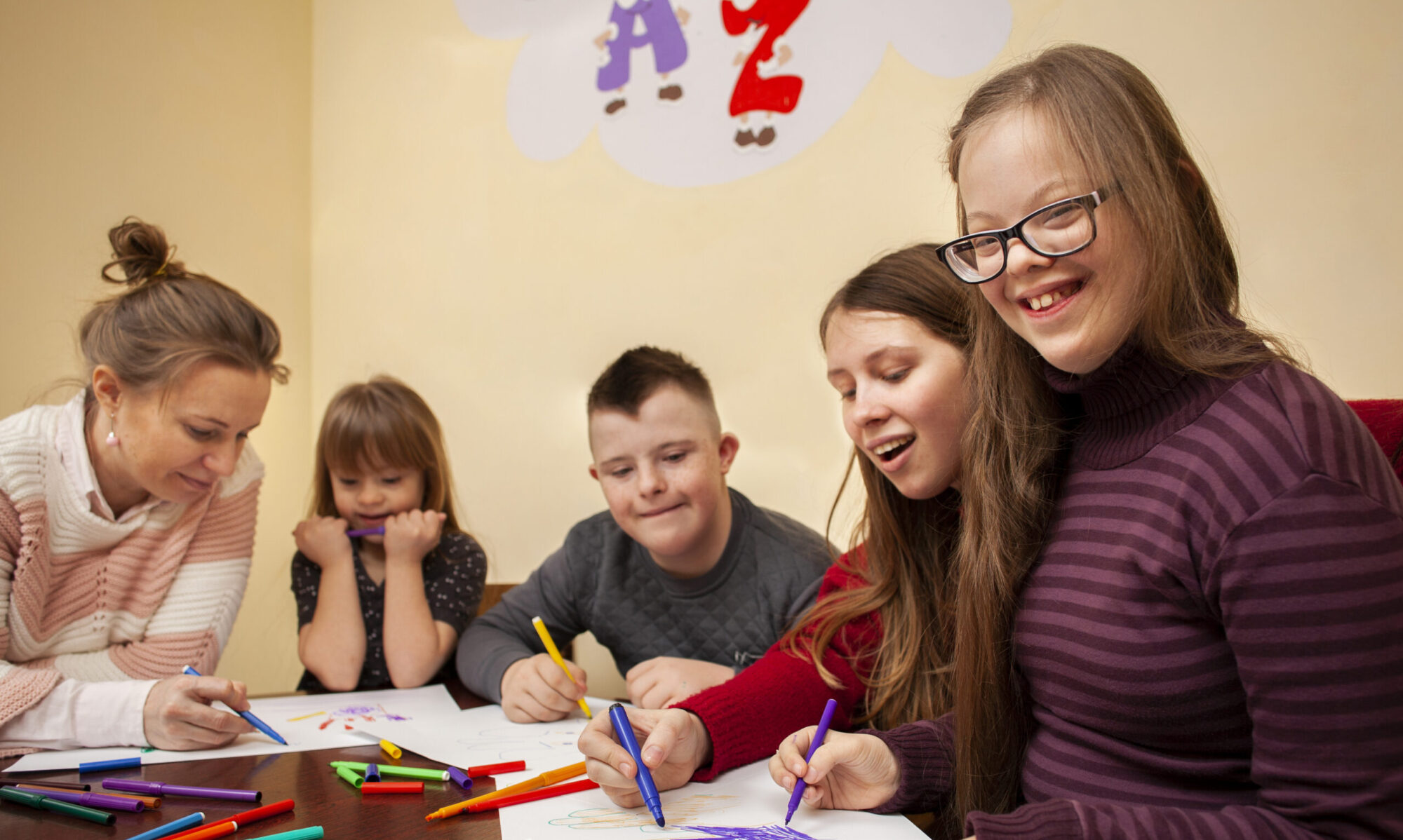

Many people agree, college is some of the best years of life.
It’s the first time we live independently. We make decisions that will shape our life forever. It’s a place were lasting relationships are made.


This experience is no different for Josh, a recent graduate of Syracuse University.
He cheers for the Giant Orange in the Otto’s Army section of the SU football stadium. He hangs out with his friends at the UU and interned at SubCat, a professional recording studio off campus.
“SubCat was my favorite internship. I could find out information about getting a job and how to work with the people involved in the job, like the boss or co-workers,” Josh says.
All of these experiences are extraordinary compared to your typical college student, because Josh has Down syndrome.
There are currently more than 260 college programs available to students with intellectual disabilities. The cream of the crop is Syracuse University’s InclusiveU program in New York state.
Related: Yes, My Son with Down Syndrome Can Go to College

I got the privilege to hear InclusiveU executive director, Beth Myers, speak at the first annual NDSS #DSWorks conference in Washington, D.C. I learned how the program fully integrates students with intellectual disabilities into the fabric of campus life.
InclusiveU is one of only a few college programs that practices full equitable inclusion.
This means students with intellectual disabilities declare a major, enroll as an audit student for certificate (which is open to all students), take the same classes as their typical peers, and live with them in the dormitory.
 Josh recall’s his favorite professor: “My favorite memory was working on the lights with David Bowman, one of my teachers. He was a really fun guy to be with. Doing the lights for the stage is one of my goals for the future and part of my major.”
A peer-to-peer program helps to facilitate this inclusion.
Josh says, “I got to go to classes, I would study with my peer partners, Cindy and Lindsay. My favorite classes were the classes at Syracuse Stage and stage techniques, were really fun. I graduated with a certificate in Visual and Performing Arts.”
Modifications and adapted coursework allows students to experience a wide-range of courses on campus.
 Students have full access to the course catalog, but they can’t take Writing 400 unless they’ve passed the prerequisite courses.
InclusiveU uses Project Search to help students with independence skills. “I love it. The reason why I loved Project SEARCH was because I could explore all the job opportunities I liked,” Josh explains.
The 42 students currently in the program are expected to complete three employment internships on or off campus. They also take seminars in communication skills, professional dress, employment, and self-advocacy.
Entry into the program includes a written application and in-person interview. The student doesn’t need a high school diploma, and the program doesn’t look at GPA or SAT scores. InclusiveU accepts students who are non-verbal, non-readers, and who have low mobility.
Related: Inclusion for Students with Down Syndrome is Just a Click Away
During the #DSWorks seminar I learned that the biggest barrier to more higher education opportunities like InclusiveU is money (isn’t it always?).
Tuition for InclusiveU can run upwards of $23,000 a year. Medicaid waivers, pell grants, scholarships, and federal financial aid are now available to students with an intellectual disability. Still, the cost can be prohibitive. And starting a program like this takes a lot of advocacy and a lot more money.
For Josh, the experience was priceless!
He learned to live independently and hopes to use the skills he learned in his eventual career: “I want to work at pop concerts (Lady Gaga, Ke$ha) working on live audio, lights and special effects. I would like to also work on a TV show specifically a reunion show (Brady Brunch, Full House) being an assistant.”
“I will miss the people at Syracuse University and InclusiveU when I move to Florida.”
Congratulations Josh! You’re an inspiration. Inclusion Evolution and the Down syndrome community wishes you the best of luck!


 Here’s the other problem:
 The OSE is responsible for funding other inclusive programs like