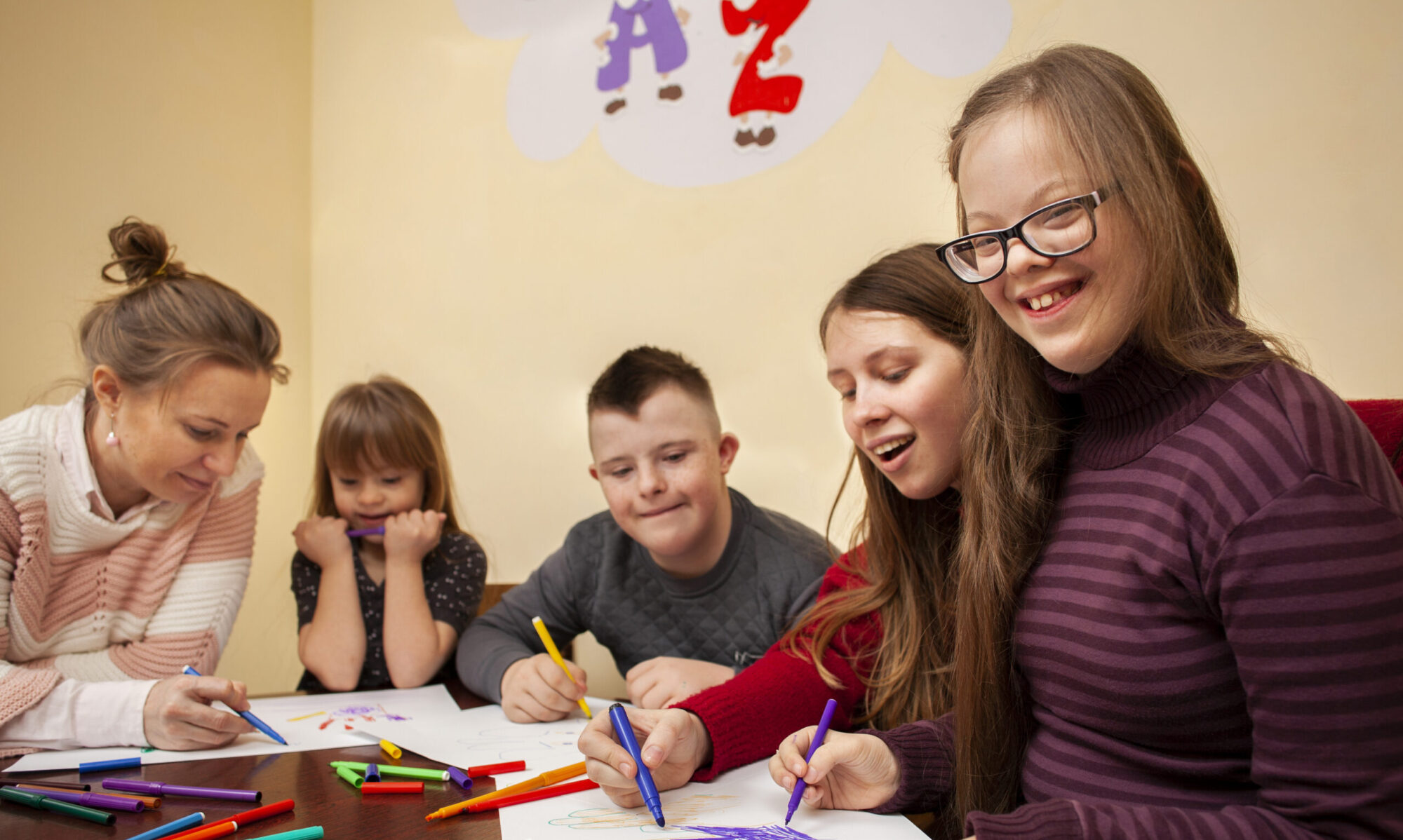
Worth More Than a Test Score

Want to really make a parent of a student with Down syndrome cringe? Bring up assessments, especially IQ testing. Sitting around a table, outnumbered by school professionals, describing in detail how your child doesn’t measure up. I’ve been through it (albeit, not IQ scores) and Troy is only in preschool!

Why is this being done and what can be done about it?

It’s understandable that schools must use some sort of assessment to decide eligibility for special education services. The key word here is “services.” Special education is not a place, but a service!

I repeat, federal law does not define disability services as a special education classroom, but instead a “free and appropriate education” in the “least restrictive environment.”

But many school district use IQ testing and other assessments to systematically segregate students.

The school district I taught in called it “tracking.” Supporters of tracking or ability-grouping say it allows students to learn at their own level, and prevents teachers from having to teach many different abilities in one classroom. I argue that the costs to students in the low-level, or special education classroom, negates the benefits to the students in the advanced classes.

Instead, why not follow federal law and court precedent that calls for inclusion with needed supports in the general education classroom? Why not execute a true “Individualized” Education Plan (IEP), instead of systematically creating “places” for groups of students to be served. If a student is best served in a separate room so be it, BUT it should not be an assumed, systematic practice solely based on the student’s test score or disability.

New Approaches to Assessing the Strengths and Weaknesses of Students with Down Syndrome:

“It’s misleading to take that one score and portray the entirety of that child. May be that child functions well when you do non-verbal skills. Parents should make it clear during the testing that the teacher should sit down and understand both your child’s strengths and weaknesses,” says Dr. Jamie Edgin of the University of Arizona.

For the past decade, Professor Edgin has been researching better ways to assess students with Down syndrome. Her team is currently working on two types of cognitive test batteries. The Arizona Cognitive Test Battery is for students 7-years-old and older, and a newer iPad assessments for preschoolers (some of whom are completely non-verbal) called the Arizona Memory Assessment for Preschoolers. Unlike IQ tests, that are a global assessment with a cut off score, Edgin’s set of tests assesses multiple domains of strengths and weaknesses.

UC David MIND Institute is testing adults with Down syndrome

Another method being developed at the UC Davis MIND Institute breaks down scores below the IQ cutoff (the most common IQ tests are not able to measure cognitive ability below a certain level).  “A child placed in a new special education classroom may be given the Stanford-Binet IQ test and obtain a floored score showing no variation in performance, which would give the impression that he is simply low functioning and has no real cognitive strengths or weaknesses,” says David Hessl, UC Davis professor of psychiatry and behavioral sciences and the study’s senior author. “But if our scoring method is used, you are likely to find that particular verbal skills are relatively better, or there are unique visual spatial strengths, and that might help you to better serve his needs.”

The problem is neither of these new methods to test students with Down syndrome are widely available in school districts across the country. “You have to function within the way the school system works. These batteries haven’t been around long enough, and tested enough students to be widely accepted,” Dr. Edgin argues.

So, what do we as parents do when our child’s school wants to use a traditional IQ test?

3 Alternatives to Traditional IQ Testing of Students with Down Syndrome:

  1. Refuse: IQ Testing is NOT required for Special Education services, so many parents refuse the test.  Even when a school district argues that a designation of “intellectual disability” cannot be used without an IQ score, parents have gotten around the pesky assessment. Usually by using the “Other Health Impairment” designation instead. Both ID and OHI should be measured by a wide range of assessments and observations, not necessarily IQ scores. Before your child turns 18-years-old, find out what your state requires for eligibility to adult services. Some states require an IQ score to receive these services.
  2. Request a Better Test: Professor Edgin says it’s worth asking for a Differential Abilities Scale, which gives a wide range of scores with strengths and weakness. If your school refuses, and you have the financial ability, an outside assessment may be worth your child’s time.
  3. Advocate: Ask what test is being given and how the scores will be used. It’s your right to know which assessment your child will be given, and what impact it will have on their education. Never sign an IEP or assessment form without understanding the implications of test results. Another good tip: ask for the test results before the IEP meeting. That way you can leave your emotional response to the test results at home, and better advocate for your child at the meeting. Also, ensure that strengths and areas for improvement are a focus of any conversation.

Know that your child is worth more than one test score. Know your child’s rights, and don’t be afraid to advocate!


College Scholarships for Students with Down Syndrome Is The Pot at the End of the Rainbow

College acceptance for students with Down syndrome is a real possibility, as you learned in my very first blog post. But once you’re accepted, how do you pay for college tuition? 

Ruby’s Rainbow, that’s how!

Ruby’s Rainbow is an amazing non-profit that grants post-secondary scholarships to students with Down syndrome. The scholarship recipients can use the money for a university, community college, or vocational program.

Ruby’s Rainbow creator and Executive Director, Liz Plachta says the non-profit gives over 40 scholarships every summer, each worth from $3,000 to $5,000 dollars.

This year, the organization raised a record $137,500 for 47 Rockin’ Recipients. Check out the winners here.

Ruby’s Rainbow is such an important organization, because college tuition for students with Down syndrome can sometimes costs more than typical college tuition.

At Syracuse University’s InclusiveU program, tuition can increase by $10,000 dollars to $24,000 a year if a student needs addition supports. That’s enough to make college out of reach for this group of students.

“Parents weren’t expecting to pay for college for their child who was born with Down syndrome a generation or two ago,” Plachta says. If a student with Down syndrome decides to go to a community college, Ruby’s Rainbow scholarships could cover the whole cost.

Also, the Higher Education Opportunity Act allows college students with cognitive disabilities to apply for pell grants or work study funds, but they still can’t get a student loan.

Ruby, center, with her dad and mom

The inspiration for Ruby’s Rainbow is Plachta’s daughter, Ruby, who is now 7-years-old and rocks an extra chromosome.

“I knew I wanted Ruby to have the same opportunities as her older sister. I didn’t even know if people with Down syndrome went to college when Ruby was born. But I started researching and found college programs for student with cognitive disabilities…

…At that point, I was full force ahead. I wanted to raise expectations!” says Liz Plachta, Ruby’s Rainbow creator.

And raise expectations is just what she did!

“The non-profit’s growth has blown me away!” Plachta says. This year Ruby’s Rainbow almost doubled their applicants and recipients. Since 2012, the organization has provided more than $400,000 in scholarship money to over 150 students with Down syndrome.

“When we first started, my goal was to raise $2,000 dollars and give one scholarship. That first year we raised $20,000 and gave 10 scholarships!” explains Plachta. 

One of the first scholarship recipients, Alex Bender, just graduated from University of Cincinnati’s 4-year Transition and Access Program (TAP).

Alex Bender, Ruby’s Rainbow Scholarship Recipient

“I love my college, University of Cincinnati, a ton! Now that I graduated my plans are to get a Job at University of Cincinnati Bearcats Athletics Department,” Bender explains.

Bender plans to live in a house or apartment near the University of Cincinnati with friends. She says Ruby’s Rainbow helped make all this possible.

Plachta says her next goal is to raise scholarship amounts. “Right now our scholarships make a small dent in college tuition. I want to make our impact even bigger,” Plachta says.

Of course, all of these scholarships are made possible through generous donations.

“I see a piece of my daughter, Ruby, in every single applicant we review. I hate to turn anyone away, but right now we don’t have the funds to give every applicant a scholarship,” Plachta explains.

Ruby’s Rainbow’s biggest fundraiser is on March 21st or World Down Syndrome Day. They ask donors for 3 ways to help:

  1. Donate $21 (representing the 21st chromosome–people with Down syndrome have 3 copies of this chromosome)
  2. Make a pledge to be kind to people of all abilities
  3. And ask 3 friends to do the same

Plachta expects to announce this year’s winners in August sometime.

To find out how you can donate, apply, or find out about this year’s recipients visit Ruby’s Rainbow at www.rubysrainbow.org 


Teaching Your Child with Down Syndrome to Read

Of all my children, I never would have guessed that the family book worm would be my child with Down syndrome. Troy has a special devotion to certain books. The sound of the words, the clues in each picture, the feel of the book, even the taste (LOL). He simply adores books and reading!

Troy reading his FAVORITE book

We all know that literacy opens doors to a life of learning and opportunities. Learning to read positively impacts learning in all subject areas, provides access to the curriculum, improves speech, and is essential to an independent life. But just a generation ago, it was believed children with Down syndrome could not learn to read. 

Now we know that even the very youngest children with Down syndrome can learn literacy skills and almost all can be taught to read at a level essential for independently living. So, where do we start?

I use a combination of reading for pleasure with all my children, and some more focused literacy building developed specifically for children with Down syndrome. By the way, I use these specially developed programs for my typical kids too.

Troy really enjoys Orange County’s Online Learning Program, and it’s completely free with a guest login. You print off books that your child might enjoy. Watch Troy read his favorite LP book, “Sports.”

Like most early literacy programs, this approach focuses on acquiring high interest and common sight words. Children with Down syndrome excel at the visual memory skills needed for reading sight words. 

Obviously, Troy just memorized this book, but he also shows comprehension later with a matching game. Watch below.

The beauty of this approach is that you can start even before your child is verbal. They can match picture to picture, they can use sign language, or you can read and they can point to the words.

Sue Buckley’s Down Syndrome Education Online uses a similar approach. Both programs start with a whole word approach, build vocabulary through pictures, memorize sight words and use them in sentences, and eventually introduce phonics and sound blends.

It may seem intimidating to teach your child with Down syndrome to read, but really there’s only 5 simple steps: 

  1. Read: (a book from either LP Online or DSE Online)

  2. Match: either picture to picture or word to word, which I did with Troy from about 2 to 4-years-old

  3. Select: give you child a choice between 2 pictures or words and ask them to choose the right picture or word

  4. Name: hold flash cards of either pictures or words and have your child name or sign them

  5. Check: for comprehension by matching picture to word, draw a line from picture to word, or make generalizations in the real world (example: read the zoo book, then visit the zoo)

After doing the Easy Readers with Troy for the past three years, we’re now slowly moving on to building sentences. Troy has great sentence awareness. He can show me the front and back cover, and even say the author and illustrator of his favorite books.

Now I’m trying to get Troy interested in building sentences by creating his own book, which his typical twin brother already loves.

Buy some blank books at Target in the dollar section

I found these awesome blank books in the dollar section of Target. Then we print out pictures of a favorite topic like superheroes, Paw Patrol, or family members.

After gluing a picture on a page we come up with a simple sentence to correspond with the picture. I write the sentence on a strip of paper and cut each individual word. The boys glue on each word in the correct order and we add punctuation at the end. Then we read our books.

This is a hard skill for Troy, because he can’t verbalize a novel sentence by himself, or sit through the creation of an entire book. But we’re starting small by giving him a choice between 2 or 3 pictures in one sitting, and helping him come up with the sentence. The point is to keep him interested, while understanding the structure of a sentence.

My twin boys falling asleep to a good book each night

I love this approach and have used both program’s apps on our iPad. Troy loves them too. The apps include: VisualLearn, Special Words, and See and Learn.

If your child is past this stage check out my dear friend’s blog, Sassy Southern Gal, for advice on more advanced readers.

What works for you and your child, and what’s challenging when it comes to literacy? Let me know below.


NDSC Convention Advocates Fight to Save Medicaid

The 45th Annual National Down Syndrome Congress Convention was amazing. Advocates from all over the country and world came together for the biggest, happiest family reunion of the year.

This year in particular advocates were mobilized to fight to #SaveMedicaid. Dozens of advocates, including myself, shared our story in this short video clip. Please share widely!

https://vimeo.com/226929916

U.S. Senators on Tuesday voted on a motion to proceed to debate the healthcare bill. There’s still no clear understanding of what the bill would include.

“Senate Republicans narrowly prevailed on a key procedural vote on Obamacare repeal legislation, a big win for President Donald Trump and GOP leaders after their repeal effort was all but left for dead last week.

Vice President Mike Pence was expected to break a tie. Republicans will now start work on legislation, with a series of votes expected in the coming days and the outcome uncertain.”–Politico

Inclusion is the Canary in the Coal Mine

We all want our child with Down Syndrome included with their typically developing peers in school and work. Federal law requires inclusion. The past 40 years of research proves inclusion is best practices. So why are people with cognitive disabilities still segregated?

Lack of full inclusion of people with cognitive disabilities is the canary in the coal mine! 

I recently read a fascinating parable by venture capitalist, Adam Quinton, describing why more women weren’t working in tech industries. The comparison can be used for inclusion of our community too.

Canaries were taken down mines as early detection of danger. The small, caged birds would die of dangerous gases before the miners, allowing them to get out before the gases effected them.

“But what happens when the little canaries died?” Quinton asked. “Did the miners blame the canaries for not being tough or well-trained enough? Or did the miners decide that really what they needed was more canaries?”

Quinton argues, they neither blamed the canaries or solved the problem by getting more of these birds. “Rather they reflected on the underlying problem facing the canaries. When they thought about it, this wasn’t the canaries themselves. They didn’t need “fixing,” rather it was the atmosphere,” he argues.

Students with cognitive disabilities aren’t the problem. They don’t need to be just like their typical peers to enjoy meaningful inclusion. Placing all the students with cognitive disabilities together in a separate room doesn’t fix the problem either.

I agree with Quinton when he argued that we must “Look at the context they operate in and work out what is wrong with your organisational culture and ask how you can make it more inclusive.”

Only when the “I” in Individual Education Plan (IEP) is focused on will students with disabilities get what they need, whether that’s in a full inclusion setting or some variation of inclusion. Only then will students with cognitive disabilities feel more valued and supported, as well as the teachers and typical peers that support these students.