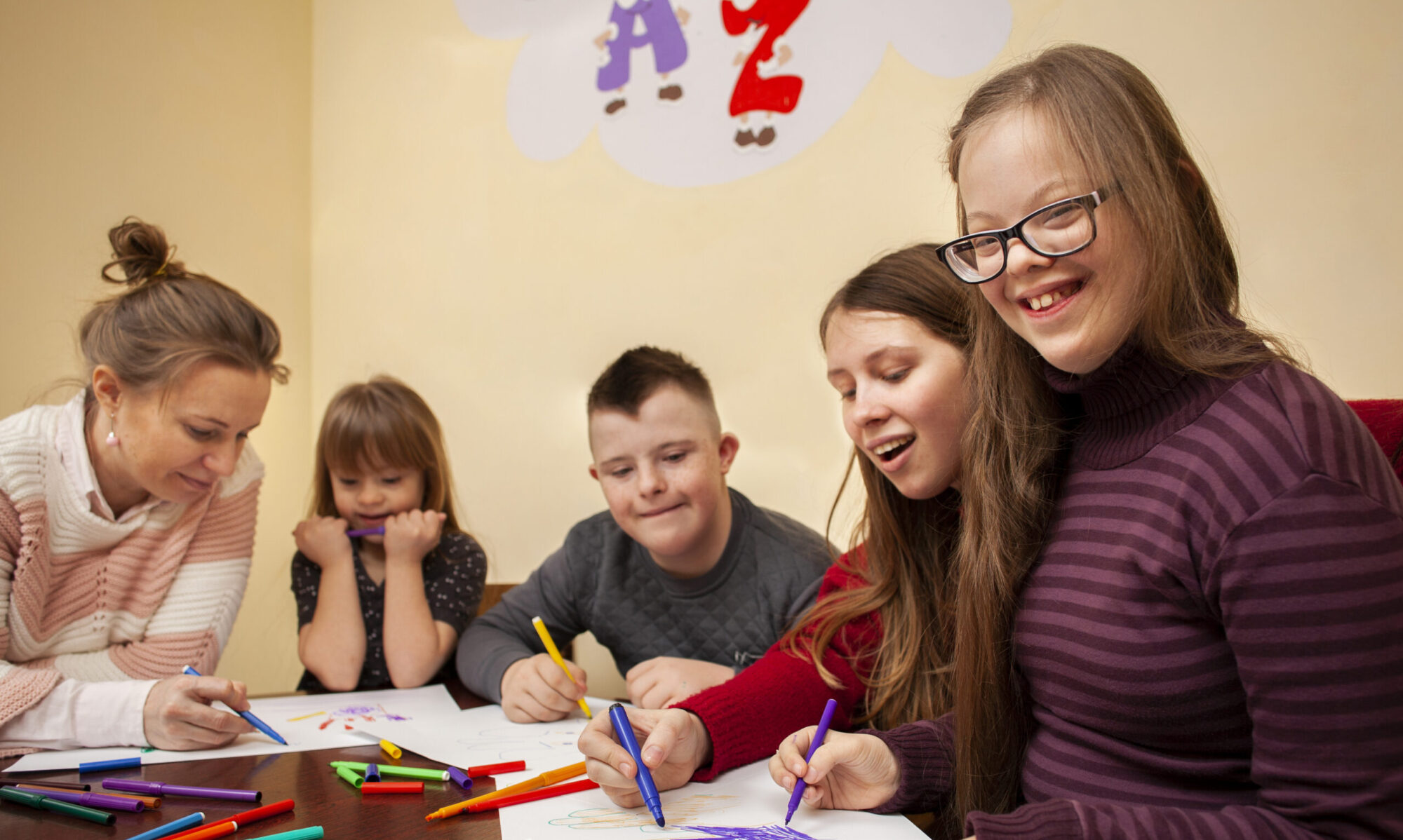
321 Let’s Count!

I just need to be up front: I’M NOT A HUGE FAN OF MATH! Add to this the fact that students with Down syndrome often struggle with the abstract idea of numbers, and we’ve got a tough problem to solve. 

But one of my recent posts “Teaching Your Child with Down Syndrome to Read,” was so popular that I thought I should share a similar approach to teaching early math concepts. All of this information is from two programs that I learned about at the National Down Syndrome Congress Convention and other conferences I’ve attended. Most of the material is free, so in the end it’s just about finding the time to incorporate this into your child’s day.

Related: Teaching Your Child with Down Syndrome to Read

Here’s what we know about math and students with Down syndrome. There’s less research regarding this topic compared to literacy and students with T21. We do know that you can teach these students math in the same way you teach it to typical students, but it needs to include “smaller steps, more repetition, more guided practice and lots of visuals.” That’s according to Orange County Learning Program Director, Dana L. Halle.

Math sense equals INDEPENDENCE!

Just like literacy, math can open doors for individuals with Down syndrome. But unlike my typical children, who seem to just figure out how to do simple counting and patterns on their own, Troy has needed a lot more guided practice. You will likely have to consciously teach concepts like “more than” and “less than.”

There’s a benefit to starting early and often. “This doesn’t mean 3 times a day everyday. It just means often enough that it becomes part of what they expect. So they don’t forget what you’re teaching and you have to start over again,” says Halle.

So, where do you we start?

With Troy I use Sue Buckley‘s one-to-one correspondence method, which includes keeping the objects the same. This means you want to throw out those counting visuals that has 1 elephant, 2 balls, 3 flowers, etc. Buckley argues the changing objects are too confusing for beginning counters.

Related: 4 Tips to Help Teachers Include Students with Down Syndrome in the General Education Classroom

We literally started one-to-one correspondence with Troy using black dots–simple, unmistakeable. Now Troy is using Buckley’s method with his favorite food. YES, food is imperative in teaching counting in our house (LOL)!

Like Halle encourages, we try to incorporate simple math sense into our every day routine. Troy counts the stair steps, the buttons on his shirt, the number of plates at the table, while we clap to music, etc. Troy is starting to understand that counting isn’t just memorizing the words 1 through ten, but instead that each number represents a specific amount of objects. It took us 2 years of counting and lots of one-to-one correspondence practice to get to this point.

What comes next? 

Patterns worksheet from LP Online

Other early math skills include shapes and patterning. Troy has mastered shapes names and sorting through continuous repetition, but patterns are much more difficult. Understanding what comes next is a very abstract thought. We’re starting simple. You can download free pattern worksheets like these from LP Online with a guest login.

I always forget to print new pattern sheets out, so again FOOD works better for us. Check out Troy below doing a simple ABAB pattern with his favorites: blueberries and Cheerios a.k.a O’s (disclaimer: let me apologize in advance for my 2-year-old crying in the background…REAL LIFE here people! LOL!)

With all this conscious practice, Troy will be prepared for math lessons in kindergarten. He’s still behind his typical twin brother, but he has a basic understanding of the earliest math skills. Luckily, we have one more year to continue to practice.

If your child is ready to move on to the next stage of math sense, I would start with Down Syndrome Education USA’s “Number Skills for Children with Down Syndrome (5-11 years)“. Also, I bought a Numicon system for Troy, but have yet to start this skill. It’s a great visual way to make numbers real. Check it out below and here.

How do you teach math sense to your child with Down syndrome? Tell me about your triumphs and challenges below!


Dear IEP Team

The following letter is a pre-planned posthumous letter to my son, Troy’s IEP team. The context of the letter can be explained by reading The Immortal Mom: Why I Can Never Die.

Dear IEP Team,

Thank you for your tireless efforts to ensure Troy receives the best educational career. One that prepares him for college or a career and independent living. I wish that I could be there to advocate for my son. To watch as he meets his ambitious IEP goals, fret over stalled progress, marvel at him making new friends and learning grade-level content, and nervously laugh as he gets into a bit of mischief.

Unfortunately, God had other plans. So, I am writing to you in hopes that my educational goals for Troy are carried out in his Individualized Education Plan. When I wrote this I had no idea when or how I might pass, but I knew then that I am my son’s best advocate. If I was there my plans would be much more detailed, but as it stands I hope these broad goals are used as guidance to create an ambitious, supportive, and fluid plan for Troy.

  1. Troy should be present at every IEP meeting, and should start advocating for himself in Middle School.
  2. Always Presume Troy is Competent! It’s the least dangerous assumption.
  3. A COPAA trained advocate should be present at every IEP meeting, and should have full access to Troy’s records.
  4. Troy’s teachers should receive the support they need through set planning time and professional inclusion training courses.
  5. Troy should have a one-on-one aide or his classes should be co-taught. The one-one-one aid or co-teacher should get the same training as his general education teacher.
  6. Troy should learn to read  and understand what he reads using proven methods like Orton-Gillingham.
  7. Troy should learn functional math using proven methods.
  8. Troy should get Speech and OT pushed into his general education classroom throughout his elementary school years; if not, beyond.
  9. Evaluations and assessments should never be used for placement. General education is the least restrictive environment.
  10. Troy should access grade-level content at his own level using appropriate modifications.
  11. Troy should get the behavior supports he needs if behavior problems are preventing him from learning.
  12. Troy should stay in a general education setting at his neighborhood school 70 to 80% of each day.
  13. Troy should stay with his typical twin throughout his educational career.
  14. Troy should not do any cleaning or functional life skills type tasks, unless his typical peers are also doing the tasks.
  15. Troy should work towards a general diploma.
  16. When in doubt, ask yourselves the following question: “How is this specific IEP goal helping Troy be ready for college, career, and independence?”

Thank you for taking my posthumous wishes into consideration. Troy’s future depends on you carrying it out with fidelity. I appreciate all of you!

Sincerely,

Courtney

Troy’s Mom

Down Syndrome Policy Expert Chosen as Parent Advisor for New National Center to Include Students with Intellectual Disabilities

Research shows that full inclusion for students with the most significant intellectual disabilities is the best path forward. Federal law requires it. But reality is much different! Talk to any parent of a student with Down syndrome, and they will tell you: “the struggle is real!” In fact, statistics show only 16% of students with intellectual disability spend the majority of their time in a general education classroom with their typical peers.

Now, the University of Minnesota’s National Center on Educational Outcomes (NCEO) plans to put more of these students in general education classes with the support they need. NCEO was recently awarded $10 million dollars from the U.S. Department of Education to create the TIES Center: Increasing Time, Instructional Effectiveness, Engagement, and State Support for Inclusive Practices for Students with Significant Cognitive Disabilities.

Read Related Post Here: $10 Million To be Awarded To Agency that Delivers Inclusive Results for Students with Down Syndrome

“We’re so excited to get this center up and running. The grant begins October 1st, and we’re thrilled to have this opportunity,” says principal investigator for NCEO, Sheryl Lazarus. The center is charged with a monumental task: to support systematic changes in the way most school districts are teaching our loved ones with intellectual disabilities (ID).

“We believe in full inclusion for these students, and now we want to make that happen for them,” explains Lazarus. The goal of the TIES Center is to get students with ID fully engaged in in the same instructional activities and curriculum as their typical peers, while meeting their individual learning needs.

Students with Down syndrome would be a target group for this program. In fact, National Down Syndrome Congress Education Policy Advisor, Ricki Sabia, was chosen to be the parent advisor and liaison for the TIES Center.

“In spite of the strong least restrictive environment language in IDEA, the vast majority of these students are still segregated from their peers. Studies show that students in separate classes have less access to the grade level curriculum and content trained teachers. NDSC is looking forward to the impact that the TIES Center will make to improve the quality of instruction for students with significant cognitive disabilities in inclusive environments,” Ricki Sabia says.

Read Related Post Here: Promoting Inclusion Through Universal Design for Learning

Lazarus says the TIES Center hopes to accomplish the following goals:

  1. Develop professional learning communities in partner state and local education agencies
  2. Develop coaching models for implementation of resources, inclusive practices and communicative competence.
  3. Improve the efficiency and effectiveness of existing resources.
  4. Support parents to become partners in the practice of inclusion for students with significant cognitive disabilities.
  5. Support systems change within the leadership of state and local education agencies for implementation of inclusive practices.

Research on better inclusion won’t be limited to the University of Minnesota. Lazarus says they will have subcontractors at the University of North Carolina Charlotte, University of North Carolina Greensboro, University of Cincinnati, CAST, University of Kentucky and the Arizona Department of Education. There will also be parent liaison’s working with the TIES Center to help parents better advocate for their child.

Read Related Post Here: How Homeschooling is One Path to Inclusion for Students with Down Syndrome

Lazarus says they plan to work backwards to find solutions to the barriers keeping students with ID out of general education classrooms. “We plan to work with schools to find out what’s working and what’s not to create better outcomes for these students. Hopefully that will translate into materials for teachers and parents. We don’t pretend to have all the answers, but we’re going to work hard to find the best path forward,” says Lazarus.

To learn more visit https://nceo.info. I’ll be posting more information on this grant project as new policies or practices are introduced.

What barriers do you see to full inclusion for students with Down syndrome? Comment below and share your experiences and thoughts.


$10 Million Dollar Grant Awarded to Support Inclusion for Students with the Most Significant Disabilities

Research shows that full inclusion for students with the most significant intellectual disabilities is the best path forward. Federal law requires it. But reality is much different! Talk to any parent of a student with Down syndrome, and they will tell you: “the struggle is real!” In fact, statistics show only 16% of students with intellectual disability spend the majority of their time in a general education classroom with their typical peers.

Now, the University of Minnesota’s National Center on Educational Outcomes (NCEO) plans to put more of these students in general education classes with the support they need. NCEO was recently awarded $10 million dollars from the U.S. Department of Education to create the TIES Center: Increasing Time, Instructional Effectiveness, Engagement, and State Support for Inclusive Practices for Students with Significant Cognitive Disabilities.

Read Related Post Here: $10 Million To be Awarded To Agency that Delivers Inclusive Results for Students with Down Syndrome

“We’re so excited to get this center up and running. The grant begins October 1st, and we’re thrilled to have this opportunity,” says principal investigator for NCEO, Sheryl Lazarus. The center is charged with a monumental task: to support systematic changes in the way most school districts are teaching our loved ones with intellectual disabilities (ID).

“We believe in full inclusion for these students, and now we want to make that happen for them,” explains Lazarus. The goal of the TIES Center is to get students with ID fully engaged in in the same instructional activities and curriculum as their typical peers, while meeting their individual learning needs.

Read Related Post Here: Promoting Inclusion Through Universal Design for Learning

Lazarus says the TIES Center hopes to accomplish the following goals:

  1. Develop professional learning communities in partner state and local education agencies
  2. Develop coaching models for implementation of resources, inclusive practices and communicative competence.
  3. Improve the efficiency and effectiveness of existing resources.
  4. Support parents to become partners in the practice of inclusion for students with significant cognitive disabilities.
  5. Support systems change within the leadership of state and local education agencies for implementation of inclusive practices.

Research on better inclusion won’t be limited to the University of Minnesota. Lazarus says they will have subcontractors at the University of North Carolina Charlotte, University of North Carolina Greensboro, University of Cincinnati, CAST, University of Kentucky and the Arizona Department of Education. There will also be parent liaison’s working with the TIES Center to help parents better advocate for their child.

Read Related Post Here: How Homeschooling is One Path to Inclusion for Students with Down Syndrome

Lazarus says they plan to work backwards to find solutions to the barriers keeping students with ID out of general education classrooms. “We plan to work with schools to find out what’s working and what’s not to create better outcomes for these students. Hopefully that will translate into materials for teachers and parents. We don’t pretend to have all the answers, but we’re going to work hard to find the best path forward,” says Lazarus.

To learn more visit https://nceo.info. I’ll be posting more information on this grant project as new policies or practices are introduced.

What barriers do you see to full inclusion for students with Down syndrome? Comment below and share your experiences and thoughts. 


Stop Giving Only Kids with Disabilities Janitorial Jobs at School

Imagine your black child is asked to clean up trash throughout his school with all the other black students in an effort to learn life skills. White students are busy learning math, reading, writing, and socializing in the halls. They watch the black students clean up after them.

This smacks of demeaning and stigmatizing discrimination. It’s unbelievable in 2017! Except for the fact that if you replace black student with disabled student it’s a very real scenario in many schools throughout America today.

Troy loves a good dance party when we clean up at home

So, I’m about to go on a rant. Like a knock out, throw down tirade. Because this is something I feel VERY, VERY passionately about. My son with Down syndrome will NOT; I repeat, WILL NOT be cleaning his school while his typical twin brother is learning to read, write, and do math.

Having children with disabilities cleaning while their typical peers are learning is the anti-thesis of inclusion. It’s the very definition of discrimination.

This problem is very real at my 4-year-old son’s own school and too many of my friends’ children’s schools too. A dear friend of mine’s daughter with Down syndrome attends the same school as Troy. Her daughter and other students with disabilities learn to vacuum and wipe the cafeteria tables in kindergarten. KINDERGARTEN, people!!! The students that need more help and time in academics are being singled out to instead learn how to vacuum at age six.

I flinched when my friend told me this. Troy is only two years behind her daughter. Our experience in preschool at the school has been good, but I cannot envision Hunter watching his brother cleaning his table at school. Asking me after school: “Why isn’t Troy in class with me anymore? Why is he cleaning tables at lunch, instead of eating with me?” It literally rips my heart out to think about it. What will I do?

Read Related Post Here: Class of 2031, Yes My Son with Down Syndrome Can Go to College

Here’s the thing: I’m all for life skills. I think EVERY student can learn a thing or two about life by cleaning their school. I am in full support of bringing home-economics and shop class back. In Japan there are no janitors, because the students clean their school EVERY DAY. This is admirable! In fact, I would be proud if any one of my children chooses a profession in the janitorial, waste management, fast food industry, etc. My mother and step-father had jobs in both. NO job is beneath ANY of my children, disability or not. Getting a job and keeping it is what makes me proud.

The fact of the matter is my son and students like him are being singled out, and pigeon-holed into a stereotypical path for employment and life. Were they even asked what interests them; what they want to be when they grow up? Their typical peers are watching this cleaning scene unfold on a daily basis and here’s where their minds begin to be molded: disability is different, disability is separate, disability is dirty, disability is shameful.

Read Related Post Here: Why You Should Hire Someone with Down Syndrome

This mindset follows them throughout their educational career and into adulthood. Educators who support these programs argue they’re teaching these special students activities that “instill soft skills such as how to follow rules, adhere to a schedule, complete tasks and accept criticism.”

As students with disabilities enter high school it gets worse. Many are shuffled into a life skills path that supposedly prepares them for employment in the real world. Wanna know how that’s going? Only 24% of individuals with intellectual disabilities are competitively employed. News flash: the life skills path isn’t working!

Parents and Teachers Need to Demand Equitable Treatment of Students with Disabilities. 

Christopher on his way to school

One Oklahoma mom is doing just that after her son with Down syndrome reacted with anger at being given a job of cleaning up after teachers and students at his school. Jordan Shuffield says her son, Christopher, “isn’t as verbal as some of the kids in his class but he does have feelings about it.”

Christopher lashed out in frustration on at least one occasion: “He had cleaned a table and a group of teachers sat at the table he cleaned. In his frustration he threw his bucket on the ground, and then had to mop up his mess,” Shuffield describes.

Now Shuffield has a meeting scheduled with the school this Friday to advocate for change. “We feel that having his class do this work at school isn’t inclusive,” Shuffield explains. “My son has lost skills, such as money denomination and simple addition and subtraction skills that he used to know.” The family believes if more time was spent on academics than cleaning, Christopher would be making better progress.

Read a Related Post Here: Realizing the Promise of the Endrew Supreme Court Case

Federal law and a recent U.S. Supreme Court ruling demands that Christopher and other students with disabilities make “meaningful progress.” Shuffield has every right to demand a change in how her son is being educated. We’ll check back in on their story as it unfolds.

Has your child or loved one experienced this type of discrimination in school? Comment with your stories below.Â