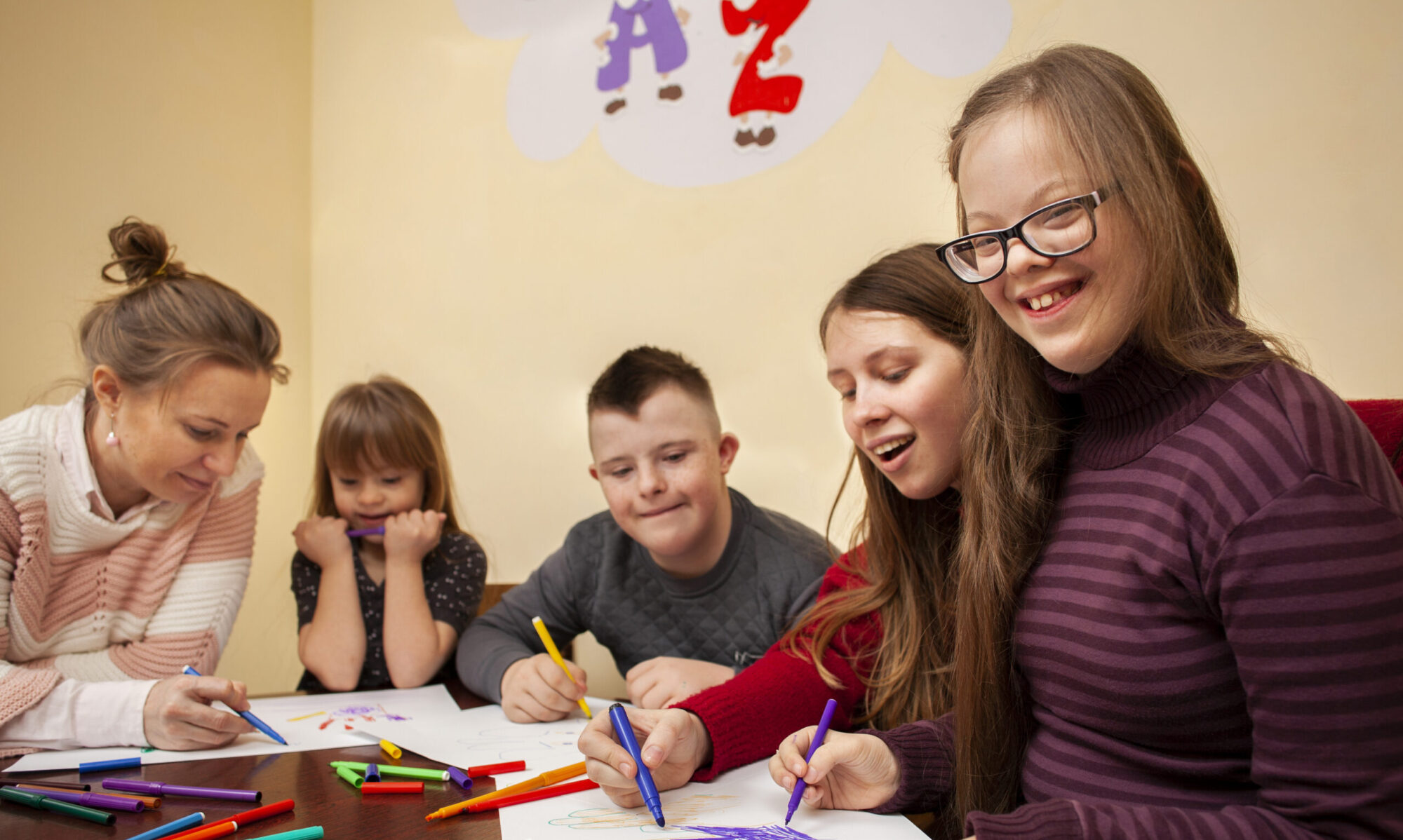
Teaching Your Child with Down Syndrome to Read

Of all my children, I never would have guessed that the family book worm would be my child with Down syndrome. Troy has a special devotion to certain books. The sound of the words, the clues in each picture, the feel of the book, even the taste (LOL). He simply adores books and reading!

Troy reading his FAVORITE book

We all know that literacy opens doors to a life of learning and opportunities. Learning to read positively impacts learning in all subject areas, provides access to the curriculum, improves speech, and is essential to an independent life. But just a generation ago, it was believed children with Down syndrome could not learn to read. 

Now we know that even the very youngest children with Down syndrome can learn literacy skills and almost all can be taught to read at a level essential for independently living. So, where do we start?

I use a combination of reading for pleasure with all my children, and some more focused literacy building developed specifically for children with Down syndrome. By the way, I use these specially developed programs for my typical kids too.

Troy really enjoys Orange County’s Online Learning Program, and it’s completely free with a guest login. You print off books that your child might enjoy. Watch Troy read his favorite LP book, “Sports.”

Like most early literacy programs, this approach focuses on acquiring high interest and common sight words. Children with Down syndrome excel at the visual memory skills needed for reading sight words. 

Obviously, Troy just memorized this book, but he also shows comprehension later with a matching game. Watch below.

The beauty of this approach is that you can start even before your child is verbal. They can match picture to picture, they can use sign language, or you can read and they can point to the words.

Sue Buckley’s Down Syndrome Education Online uses a similar approach. Both programs start with a whole word approach, build vocabulary through pictures, memorize sight words and use them in sentences, and eventually introduce phonics and sound blends.

It may seem intimidating to teach your child with Down syndrome to read, but really there’s only 5 simple steps: 

  1. Read: (a book from either LP Online or DSE Online)

  2. Match: either picture to picture or word to word, which I did with Troy from about 2 to 4-years-old

  3. Select: give you child a choice between 2 pictures or words and ask them to choose the right picture or word

  4. Name: hold flash cards of either pictures or words and have your child name or sign them

  5. Check: for comprehension by matching picture to word, draw a line from picture to word, or make generalizations in the real world (example: read the zoo book, then visit the zoo)

After doing the Easy Readers with Troy for the past three years, we’re now slowly moving on to building sentences. Troy has great sentence awareness. He can show me the front and back cover, and even say the author and illustrator of his favorite books.

Now I’m trying to get Troy interested in building sentences by creating his own book, which his typical twin brother already loves.

Buy some blank books at Target in the dollar section

I found these awesome blank books in the dollar section of Target. Then we print out pictures of a favorite topic like superheroes, Paw Patrol, or family members.

After gluing a picture on a page we come up with a simple sentence to correspond with the picture. I write the sentence on a strip of paper and cut each individual word. The boys glue on each word in the correct order and we add punctuation at the end. Then we read our books.

This is a hard skill for Troy, because he can’t verbalize a novel sentence by himself, or sit through the creation of an entire book. But we’re starting small by giving him a choice between 2 or 3 pictures in one sitting, and helping him come up with the sentence. The point is to keep him interested, while understanding the structure of a sentence.

My twin boys falling asleep to a good book each night

I love this approach and have used both program’s apps on our iPad. Troy loves them too. The apps include: VisualLearn, Special Words, and See and Learn.

If your child is past this stage check out my dear friend’s blog, Sassy Southern Gal, for advice on more advanced readers.

What works for you and your child, and what’s challenging when it comes to literacy? Let me know below.


Why Your Child with Down Syndrome Needs an ABLE account

Some of the best advice I received when Troy was born was to live in the present; to treat my son like any other baby. Looking too far into the future can be a daunting task for parents with children with disabilities.

What do you mean you haven’t opened that college savings fund yet? Troy (right) with his typical twin (Hunter) at 5 months old.

Will my son live independently? Will he have a job, and be a contributing member of society? Will he have friends and be happy? It may seem easier to ignore these thoughts, but thinking constructively about your child’s future has its rewards.

The Achieve a Better Life Act (ABLE) is one way to control your child’s future success today. ABLE accounts are tax-advantage savings accounts, similar to a 529 college savings account but you can save for so much more than just college.

“ABLE accounts give people with disabilities the potential to significantly increase their independence and quality of life, without jeopardizing benefits such as Medicaid and Supplemental Security Income (SSI),” explains Heather Sachs, Senior ABLE Advisor at the ABLE National Resource Center.

Before ABLE passed, individuals who received disability benefits could only have $2,000 to their name. “This was just so wrong. People with disabilities were forced into a life of poverty and dependence on government,” Sachs said recently at a workshop on ABLE at the National Down Syndrome Congress Conference in Sacramento.

Now, with an ABLE account people with disabilities can save up to $100,000 dollars total without losing their SSI or Medicaid benefits. We opened Troy’s ABLE account this past spring. You can read about it here. I soon realized this is not just a college savings account, and with looming threats to cut Medicaid it may end up supplementing needed government supports.

Troy and other ABLE account holders can use their savings at any age on ANYTHING that will improve their independence, health and wellness. This includes private therapies, medical equipment, assistive technology, school expenses, employment related costs, transportation, and housing just to name a few. 

“The list of eligible expenses is defined very broadly,” explains Sachs. This means Troy could use his ABLE account for an iPad to play his favorite Starfall phonics game. An adult beneficiary could buy an iPhone (assistive technology) to call Uber (transportation) to get to ballroom dance lessons (wellness), and their ABLE account would pay for it all. “There’s no preapproval necessary for these purchases, but keep your receipts in case you’re ever audited,” Sachs says.

ABLE Accounts have a $14,000 a year contribution limit, and 48 states already have ABLE plans. You can compare state plans here. Shop around for the best plan, because most states allow non-residents to sign up.

We went with Tennessee’s ABLE plan (even though we have no connection to the state), because their is no initial or annual cost.

Even though roughly 10 million Americans could benefit from an ABLE account, only 10,000 accounts have been opened since the first program started in 2016. So, why aren’t more people taking advantage of this tax-advantage savings accounts? “In a few words: lack of information and skepticism,” says Sachs.

Now the ABLE National Resource Center (ANRC) wants to change that with an awareness campaign starting the month of August. You can sign up for weekly ABLE informational webinars (every Wednesday in August) here.

Check back next week, when we bust the myths surrounding ABLE accounts.


NDSC Convention Advocates Fight to Save Medicaid

The 45th Annual National Down Syndrome Congress Convention was amazing. Advocates from all over the country and world came together for the biggest, happiest family reunion of the year.

This year in particular advocates were mobilized to fight to #SaveMedicaid. Dozens of advocates, including myself, shared our story in this short video clip. Please share widely!

https://vimeo.com/226929916

U.S. Senators on Tuesday voted on a motion to proceed to debate the healthcare bill. There’s still no clear understanding of what the bill would include.

“Senate Republicans narrowly prevailed on a key procedural vote on Obamacare repeal legislation, a big win for President Donald Trump and GOP leaders after their repeal effort was all but left for dead last week.

Vice President Mike Pence was expected to break a tie. Republicans will now start work on legislation, with a series of votes expected in the coming days and the outcome uncertain.”–Politico

Inclusion is the Canary in the Coal Mine

We all want our child with Down Syndrome included with their typically developing peers in school and work. Federal law requires inclusion. The past 40 years of research proves inclusion is best practices. So why are people with cognitive disabilities still segregated?

Lack of full inclusion of people with cognitive disabilities is the canary in the coal mine! 

I recently read a fascinating parable by venture capitalist, Adam Quinton, describing why more women weren’t working in tech industries. The comparison can be used for inclusion of our community too.

Canaries were taken down mines as early detection of danger. The small, caged birds would die of dangerous gases before the miners, allowing them to get out before the gases effected them.

“But what happens when the little canaries died?” Quinton asked. “Did the miners blame the canaries for not being tough or well-trained enough? Or did the miners decide that really what they needed was more canaries?”

Quinton argues, they neither blamed the canaries or solved the problem by getting more of these birds. “Rather they reflected on the underlying problem facing the canaries. When they thought about it, this wasn’t the canaries themselves. They didn’t need “fixing,” rather it was the atmosphere,” he argues.

Students with cognitive disabilities aren’t the problem. They don’t need to be just like their typical peers to enjoy meaningful inclusion. Placing all the students with cognitive disabilities together in a separate room doesn’t fix the problem either.

I agree with Quinton when he argued that we must “Look at the context they operate in and work out what is wrong with your organisational culture and ask how you can make it more inclusive.”

Only when the “I” in Individual Education Plan (IEP) is focused on will students with disabilities get what they need, whether that’s in a full inclusion setting or some variation of inclusion. Only then will students with cognitive disabilities feel more valued and supported, as well as the teachers and typical peers that support these students.


Improving Post Secondary Opportunities for Individuals with Down Syndrome

When Laura Lee graduated from high school in 2001, there were no college programs in her state for students with intellectual disabilities (ID). 

“Far too often, what is typically available for these students are ‘transition programs’ in high school that are isolated and a pipeline to living a life of poverty and either languishing at home or working in segregated sheltered workshops receiving below-minimum wage,” says Stephanie Smith Lee, Laura’s mother and Interim Policy Director for the National Down Syndrome Congress.

The Lee’s believed Laura and all students with Down syndrome deserved better. So, they petitioned George Mason University to start a pilot program and advocated nationally for more inclusive post-secondary programs. Laura became one of the first graduates of Mason LIFE Program, and today there are more than 260 college programs in 47 states for students with intellectual disabilities (ID). 

Laura Lee’s resume was impressive, even for someone without a disability. It included her graduation from George Mason University, her work at the World Bank, volunteering at a food bank, and becoming a nationally recognized self-advocate giving speeches nationwide.

In March 2016, Laura Lee passed away in her sleep. For thousands of people nationwide who mourned Laura’s passing, she had become a symbol of what can be accomplished when high expectations and advocacy meet. And Laura’s mother did not stop advocating upon her death. 

Laura and Stephanie Lee presenting together

“She’s the inspiration for my continued work,” Stephanie Smith Lee says.

As Interim Policy Director for the National Down Syndrome Congress, Lee is now in support of a newly released U.S. House of Representatives bill that will improve upon the Higher Education Act. Lee was instrumental in helping push through improvements in 2008, when the law was reauthorized. At that time, legislation was included to allow students with ID to apply for financial aid for the very first time, as well as the funding of model post-secondary programs for students with ID.

The new House bill released last week would increase inclusive post-secondary opportunities for students with ID. “One big change that will create a more inclusive environment is that model post-secondary programs that receive federal funding to educate students with ID must now offer inclusive housing on campus,” Lee explains. The bill would also change language in the law to require model programs to focus not just on academics, but career development as well.

The House bill would be attached to the reauthorization of the Higher Education Act expected this year, and would include the following amendments: 

  1. Using competitive grants to train faculty to deliver accessible instruction.
  2. Establish an Office of Accessibility at every Institute of Higher Education.
  3. A new grant program to implement Universal Design for Learning (UDL) .
  4. A new commission to increase accessible materials and technologies.
  5. Updates to data collection activities.
  6. Updates to the program that funds Institutes of Higher Education that educates and integrates students with intellectual disabilities.
Rep. Mark DeSaulnier (D)

U.S. Representative, Mark DeSaulnier (D-California), who sponsors the bill says: “This first of its kind legislation takes a comprehensive approach to providing students and institutions with improved training, greater resources, and expanded services—bringing us one step closer to ensuring that all Americans have the opportunity to earn a degree, find a job, and achieve the American Dream.”

The National Down Syndrome Congress fully supports the improvements. “Students with intellectual disabililities want the opportunity to go to college like their siblings and friends, to learn, to experience independence, and become employed after graduation. Postsecondary opportunities for students with intellectual disabilities offer a new path to academic access, social inclusion, and working and living as independently as possible in the community,” says Lee.

Laura Lee with her mother, Stephanie Smith Lee in 1992

The 2008 reauthorization of the Higher Education Act had very strong bipartisan support. So far, the current bill only has Democrats sponsoring the bill. Still, Lee hopes that there will be continued bipartisan support for further improvements for post secondary inclusion.

“I’m so exciting to see how far we’ve advanced since Laura and I started advocating so many years ago. So many more students have opportunities, and have gotten jobs and live in their communities. They have friends in the community and are contributing members of society. But we’re still not where we should be. The current bill will help pave a better path forward,” says Lee.