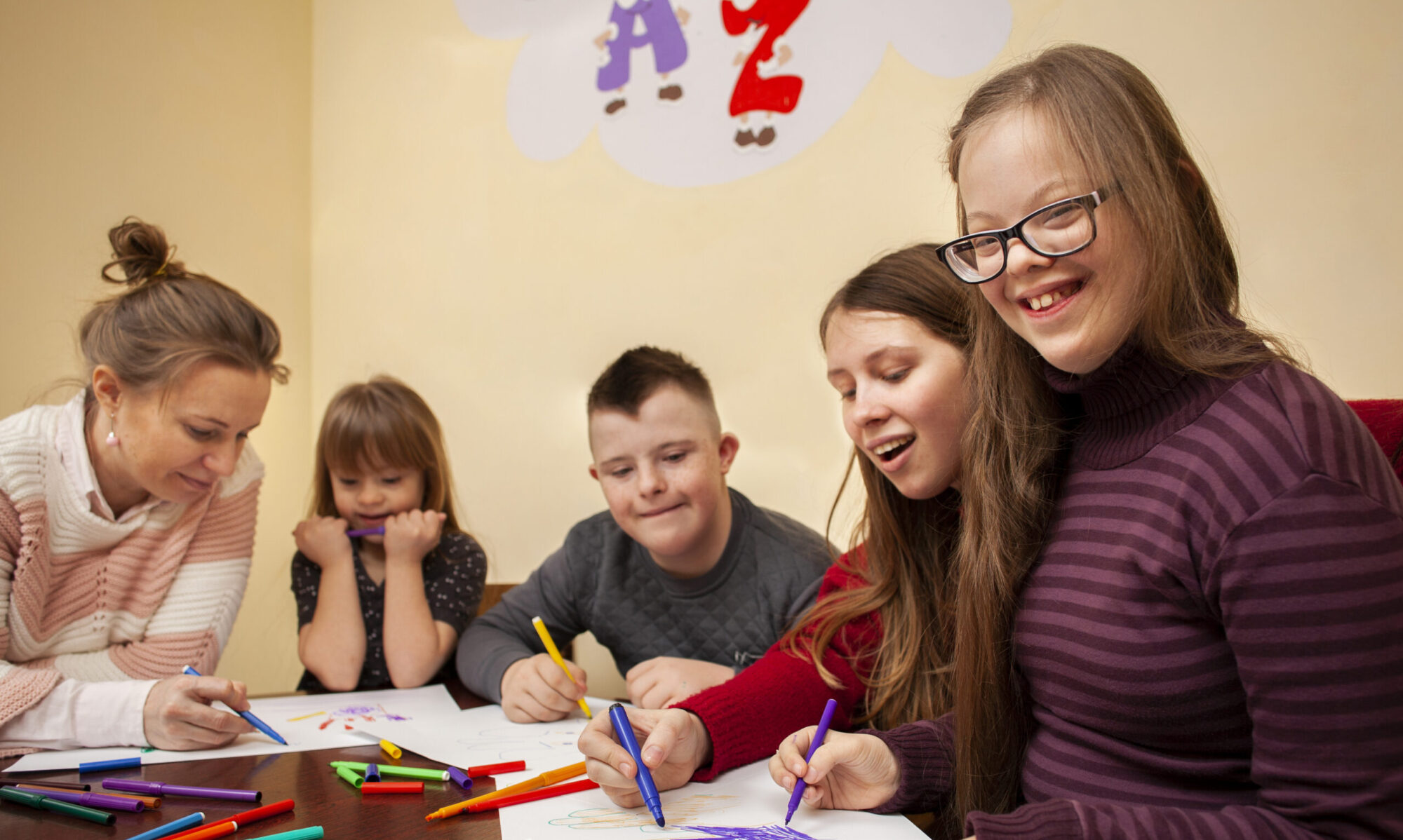
This blog started as a research project into how to include my son in kindergarten and beyond. In seven short months I’ve learned so much, and I hope you have too. I appreciate your readership, and as I look back on the top posts of this past half year I realize what’s important to you.
Inclusion in school tops the list, which is good because that’s where I want my focus to be in 2018. As part of the Special Education Advocacy Training course I’m taking through the Council of Parent Attorneys and Advocates, I hope to document what I learn and in turn help my readers on their journey to inclusion too.
Thank you so much for following along on our journey! I appreciate all of you!
Recently I wrote a blog post lamenting my mortality as it relates to my son with Down syndrome. Parents are often a child with a disability’s first and most important advocate. While the post started off with me whining that no one can replace me, it ended on a more realistic, less narcissistic note. I will probably die before my son, and he will be just fine without me. How, you ask?
He will do just fine, because he will have a “Circle of Support” that will allow him to lead a successful life of interdependence. You read that right: not independence, “interdependence.”
This idea is not mine. Many parents of children with disabilities facilitate this idea of interdependence every day, and one in particular has coined the phrase “Circle of Support.”
National recognized speaker, author and advocate, Janice Fialka, shared her son’s journey to interdependence with me via phone the other day. You may recognize her 30-year-old son, Micah, from the upcoming documentary “Intelligent Lives.”
Micah lives exactly 471 miles from home (I had to smile over the phone, because of course his mom knew the exact mileage), and has worked for the University of Syracuse as a teacher’s assistant for the past 5 1/2 years. He also has an IQ well below what most people would consider functional for a life of independence and “success.” Micah’s mom, Janice, says Micah’s success is 30 years in the making and includes help from dozens of friends.
“My advice to families is to seek out support. At first I felt awkward, uncomfortable, angry or too shy to ask for help. I soon realized Micah needs more than just me,” says Janice.
Micah (center) with his most inner circle–his family.
Fialka says families need to drop their love affair with independence. We all need a circle of support to be successful. “It’s important to learn the value of interdependence. Learn to ask for help and let people in. We had to be intentional about this with Micah,” explains Janice. Micah’s family became intentional about interdependence in elementary school by creating a “circle of friends.” First they invited friends in his class to hang out with Micah at lunch time, recess, and at home.
“Micah is poised now, but he could be very annoying when he was younger. He just didn’t know how to interact with people. I can remember crying because we invited friends over and Micah would be standing in the corner not playing with his guests,” Janice describes. The “Circle of Friends” got more complicated in middle school, but Janice was able to build relationships with eight families who continued to interact with Micah. By the end of high school, Micah had a group of friends rally, petition, and eventually help Micah sue a local university to allow him to live on campus and attend college courses there.
“When you ask Micah now, he will tell you he’s always had lots of friends. But he spent countless weekends at home alone. He’d call five friends and no one could meet up,” remembers Janice. Still, the family continue with the intentional interaction, and it really paid off. “When Micah was offered a job seven hours from home, he was the one that came to us an said ‘I’m going to need to create a circle in Syracuse if I’m going to live on my own.’ We knew then what an impact the idea had on Micah’s life,” Janice says.
Janice wants parents to know it’s “not about letting go, but holding on differently.”
What an impactful message from a mom who’s been there and gets it. You can order Janice and Micah’s new book, “What Matters: Reflections on Disability, Community, and Love,” here. Listen to an interview Janice gave to NPR here.
Tell me what you think about the idea of a “Circle of Support” for your loved one with Down syndrome below. How have you already begun this journey? What challenges and successes have you found in helping your loved one seek a successful life of interdependence?
College may not be for everyone, but for students with intellectual disabilities (ID) post-secondary programs have historically been completely out of reach. Since 2008 the federal government has given incentives to higher education programs who open their doors to students with Down syndrome and other intellectual disabilities.
Since the reauthorization of the Higher Education Act a decade ago, more than 260 college programs have been created for students with ID. But only the minority of these programs include a 4-year, all inclusive program for students with ID. The College of Charleston’s REACH program is one of them.
“I love it here. I am treated like a person, not like a disability. My classes are hard but I get all the help I need. I have lots of friends who don’t care about my disability, we don’t really talk about it,” explains a students with Down syndrome attending the REACH program.
The REACH program models a typical college experience. Students take regular classes and live on campus. The 4-year program started in 2009 with a grant from the College Transition Connection program, and has four areas of focus: academics, social, independent living, and career development.
Program Executive Director, Edie Cusack, says student success in the program often requires training parents and professors to change their mindset. “There’s an acceptance process for parents too. We’re really looking for them to let go. We often get parents at orientation who say ‘maybe that student can do it, but my child cannot.’ By the end of the program they’re proven wrong.”
“We also conduct specific inclusion training with professors, who often have no background in teaching techniques for students with intellectual disabilities. We promote UDL, scaffolding instruction, and stress high expectations that academic learning will take place,” explains Cusack.
REACH boasts a 93% post-program employment rate, and a 75% independent living rate. Cusack says students spend the last six months of the program finding employment and independent living supports. Students must also complete an internship in a career field of their choice.
“I believe in the dignity of risk. Stopping people with disabilities from taking risks and making mistakes is stopping them from living a full life. A cool side effect of the program is the idea of disability is shifting. No one turns and looks and stares when our students with Down syndrome goes into cafeteria. In fact we have a student with Down syndrome currently who has been entered into the lottery to dorm with typical students because she’s on-par for living skills,” Cusack says.
There are no national standards or accreditation process that post-secondary programs must follow to serve students with ID. Think College works as a clearing house for more than 260 college programs, and is working with the federal government to develop standards. You can learn about other college programs here.
A bill was just released to the House of Representatives to reauthorize the 2008 Higher Education Act last week. Some worry that gains that have been made under the 2008 version, could be lost in the current bill that calls for deregulation. You can read the bill here.
You can find out about the College of Charleston’s REACH program here. Is your loved one with Down syndrome going to college? What other post-secondary programs have you learned about that serve students with ID? Share what you know below.
If your home is anything like ours, the last thing your child needs is another plastic toy. That’s not to say that some of those type of gifts won’t make it under the tree, but I’m always on the look out for thoughtful gifts that teach empathy, confidence, and cooperation.
I’m leery of gift lists that are only for children with Down syndrome. My son, Troy, plays with everything his typical twin brother plays with, but there are some things he really gravitates towards. I wanted to share an all inclusive gift list. So, I gathered up all of Troy’s favorites, but these are also toys that his 2-year-old sister and 5-year-old typical twin play with often. I tried to choose gifts that teach an important skill like empowerment, empathy, cooperation, STEM, fine motor skills, gross motor skills, etc.
Without further ado, a list of my favorite gifts sure to empower any preschooler in your life:
The affiliate links in this post help you easily locate the products I mention, but don’t cost you to use them. When you use the affiliate links you help to support the efforts of this blog.
Does your child with a little something extra love music? Mine is obsessed. We’ve run the gamut of speech related music CDs, and some are better than others. Troy’s favorite is “Kids’ Express: Imitation Station.” He knows every word to this CD. You can find it here. My favorite is “Kids in Action,” because it gets all my kids up and moving.
There’s also Apraxia specific CDs like “Time to Sing,” which slows down all the well-known nursery rhymes and children’s songs so Troy can sing them along with the beat. It’s amazing how clear Troy can talk when he sings. Has anyone else found this to be true? I really think music is the key to better speech for Troy. We even make up our own songs to get dressed, wash our hands, brush our teeth, or learn our address and my phone number. Message me if you want any other music CD recommendations. We have a ton!
STEM, as well as sensory activities are all the rage these days and this “Marble Genius Marble Run” combines both in a perfect toy (albeit plastic). All three of my kids LOVE this toy, and use it EVERY day.
My neuro-typical 5-year-old has impressed me countless times as he’s created a unique and challenging new marble run. Troy hasn’t mastered the mechanics of how to put the marble run together, but he loves helping Hunter physically put the pieces together (great fine motor task). All three kids are almost in a zen-like state as they watch the marbles run down the maze of tubes. This is definitely my favorite toy, because I don’t have to feel guilty about taking a mini-mental break from the kids while they play with it.
Troy’s teacher is always commenting on how well he takes turns and waits during game time at school. I credit this in part to his love of board games at home. Stack Up! board game is just one example of a game that really teaches it all: balance, counting, fine-motor skills, hand eye coordination, cooperation, and patience.
Playing Stack Up! Check out the tongue–lots of concentration!
It’s not easy or fun to always sit down with your kids and play these type of board games, but it really does pay off. What I like about Stack Up! is that all three of my kids (age 2 to 5, typical and not) can enjoy the game because it scaffolds the directions to reach each age player. Troy and his siblings sat with me a few times to play, and now they enjoy playing without me.
Books are always a timeless gift. There are so many great children’s books to choose from. Troy especially loves any book that rhymes or can be sung like the “Pete the Cat” series or anything by Dr. Seuss. When we read the book, “What Are Your Superpowers?” by Marget Wincent together they were eager to name their own superpowers.
Troy could relate to the book’s character whose superpower is dancing alone when no one is looking. Hunter, my typical twin son, was a bit more skeptical. He couldn’t understand how every day actions could count as superpowers, which led to a great discussion on importance of valuing everyone’s gifts, big or small.
If you’re looking for something a little more high-tech, Osmo is a fantastic interactive learning game preschoolers can use on any iPad. Troy is obsessed with Osmo Monster, Mo, who asks the kids to draw objects that he then pulls into the iPad screen and uses in hilarious ways. All three kids are laughing nonstop with this game.
Other Osmo games my kids enjoy are Tangram an interactive wooden puzzle, Numbers where the kids can practice one-to-one correspondence and counting, and Words where they use letters to build sight words.
What would the holidays be without one fantastic gross motor gift. This year Troy is getting “Radio Flyer My 1st Scooter.” His typical twin is getting a Razor scooter, but Troy struggles with balance and coordination so I’m hoping this wider-based scooter helps.
Right now Troy uses a specially fitted Amtryke bike that he’s close to mastering. You can learn more here. I’d really like to get him on a “Strider Bike,” which he already has but doesn’t like because it takes a lot of core strength and balance. The Strider bike company is always at the National Down Syndrome Congress Convention, and I think it is a great beginning bike for our loved ones with an extra chromosome.
What do you plan to get your loved one with Down syndrome this holiday season? Share your ideas with me below.
Will my son, Troy, always live with us? Will he have a fulfilling career? What will happen to my son when my husband and I pass away? These are questions every special needs parent must face.
A new trend includes places like “Promise of Brevard,” in my hometown. These type of communities include employment within the community, and supported living. Parents are often the brainchild of these communities. Supporters point to low employment rates for people with developmental disabilities, and how issues with transportation often hinder any employment. The idea is that everything is on-site. Opponents of this new trend argue that it leads to further segregation of people with disabilities.
Promise of Brevard is a 39 acre community especially for individuals with disabilities. It will have independent housing with support for over 120 residents with disabilities, as well as vocational training and employment at one of its 9 businesses on campus.
Betsy Farmer breaking ground at Promise with her adult son, Luke.
The community is the realization of a promise Betsy Farmer made to her son, Luke, when he graduated from high school. Luke wanted to live independently and work like his typical brother, Josh.
“Promise is a place where young adults with special needs can live a life full of opportunities and freedom never thought possible,” founder Betsy Farmer explains.
Promise Thrift Shop
Over 270 individuals applied to live on Promise, but so far there’s only room for a little over 120.
Promise’s first business, a thrift shop, has been open for about a year and in its first month they had over 1500 customers. Six “Promisers” with disabilities are working at the Promise Thrift Shop.
The property will be more like a walkable community with a cafe and bakery, doggy daycare, Field of Dreams accessible sports complex, skate park, splash pad, festival area, bed and breakfast, accessible playground, and equestrian riding center.
Construction overlook of the residents area
More than 200 community supporters, and continuous fundraising events made the community possible.
Promise Cafe and Bakery will employ people with disabilities
All of Promise’s businesses will provide vocational training and employment for its residents with disabilities.
Ten college students from area universities will serve as housing assistants, so that residents get the support they need to live independently. There are also typical adults that rent apartments within the community. Opponents argue that this is not enough. That a truly inclusive community would have people without disabilities living beside those with disabilities.
Tell me about communities in your area below. How do you feel about this new trend? Do you feel like it’s new at all, or just another form of segregation for people with disabilities?
If you’re interested in learning more about Promise of Brevard, or would like to donate head here.