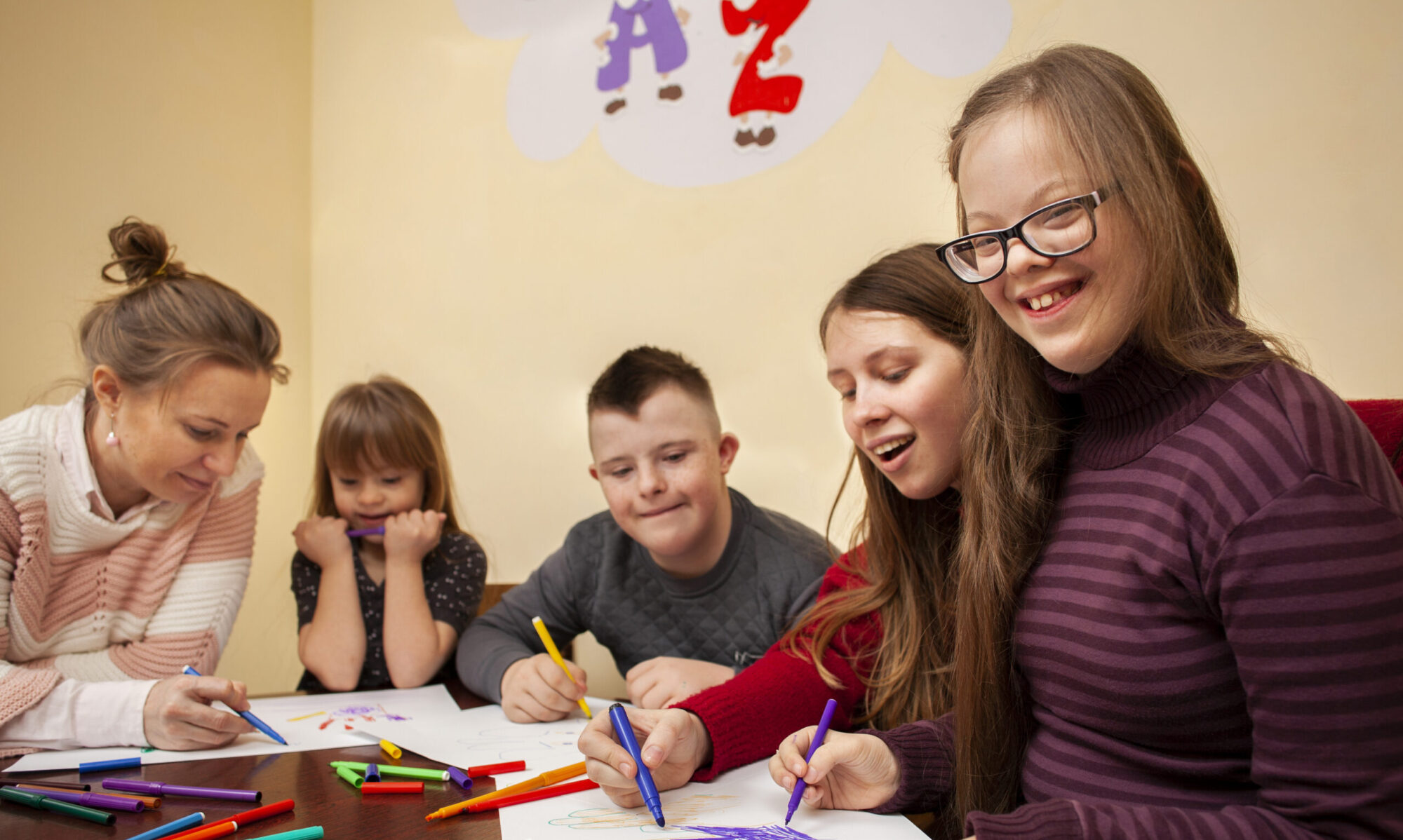
Inclusive Theater for Self-Advocates with Down Syndrome

When you are born different, it’s easy to stand out. Some of our local self-advocates with Down syndrome have embraced this role. They work hard to adapt to the neuro-typical way of life, and they want to be front stage.

If the world’s a stage, these self-advocates want a starring role!

So, we gave them the opportunity to do just that. It was an idea born out of a communications workshop I advocated for last summer. Why not include our self-advocates with Down syndrome in local theater? Local theater educator, Stephanie Radford, and I already knew from our communications workshop that the self-advocates have a natural flair for acting.

Read Related Post: Using Improv Theater to Build Confidence in Self-Advocates

We invited local self-advocates to a 6-week theater 101 workshop, followed by a try-out for our local theatre’s final performance: Madagascar. Each week in January and February, self-advocates learned how to be in a musical. They had to memorize a monologue and song, and perform both in front of their peers. Stephanie also taught them common dance moves found in most musicals to prepare them for tryouts and rehearsals.

To say our self-advocates were nervous is an understatement. When Stephanie asked them to read their monologue the first week after receiving one, some literally had no words. Communication skills are difficult for most people with Down syndrome, and memorizing a monologue and then performing it seemed near impossible. We have self-advocates that are completely non-verbal, and use an assistive technology device to perform their monologue. Week after week, I sat amazed as each self-advocate spoke in front of their peers; some through verbal words and others through emotion and sign.

“I recorded mine. Is that ok?” asked 21-year-old Kyle. Stephanie gave him a pass, but said he also should also try reading it in front of us. After two weeks Kyle eventually started reading off his script. You could tell that he loved to act. Still, the phone was a distraction, and I assumed he would never put it down. As usual, I was wrong in my assumptions. By the last workshop Kyle performed his complete monologue, with action and enthusiasm, from memory; no phone in sight. When I told him I was so proud of him he said “I am too!” Andy, who uses an assistive technology device, went from shaking his head and smiling at the beginning of our workshop, to adding humor to his computer voice and body language that would have any audience giving a standing ovation.

Read Related Post: Communication is Key to Self-Advocates’ Pursuit of Goals

Self-advocates received call backs for specific roles in Madagascar. This week they’ll be placed with a typical teen actor with experience. These peers will assist self-advocates on their acting journey. This is inclusion in action!

Thulani trying out for Madagascar. He’s looking forward to playing the part of the penguin or lemur in the musical. Stay tuned to find out what role he gets.

Our local theatre has never made a conscious effort to include people with disabilities in performances. With a little trial and error we’re hoping that this is just the beginning of an amazing inclusive experience. Stay tuned!

Does your child with Down syndrome participate in inclusive activities outside of school and work? Tell me how you make it work below.


My Love-Hate Relationship with the “I” in IEP

Federal law and evidence-based research supports full inclusion with individualized support for students with Down syndrome. Still, a recent study by the federal government found that less than half of students labeled as Intellectually Disabled are included with their typical peers for most of their school day (read the report here).

Many blame the lack of federal funding to implement the Individuals with Disabilities Education Act (IDEA) for the failure to include our children properly. The feds promised they would fund 40% of the IDEA budget, but they’ve only ever funded up to 17%. Others place blame on a culture of segregation in schools. Still others blame some teachers, administrators, and even parents for not holding high expectations for our children. To some degree, it’s true that all of these factors are part of the problem.

But another surprising roadblock to full inclusion is the “I” in IEP.

The bedrock of the Individuals with Disabilities Education Act (IDEA) is the “Individualized” Education Plan (IEP). Your child’s IEP should be a roadmap to inclusion in the general education classroom with their typical peers. It’s a detailed plan that should be reasonably calculated to plan for your child’s potential growth, and ensure they have access to the general education curriculum with needed supports.

Read Related Post: 7 Essential Research Studies to Win the Fight for Inclusion

In most ways, the “I” in IEP is a good thing. All children learn differently, even those within the Down syndrome community. All our children deserve to be individually served and supported. The “I” in IEP can also be used against our children too. How many of you have heard school personnel tell us that our child with Down syndrome would receive a more “individualized” education in a segregated setting? Many parents either want this path for their child or don’t question the legitimacy of it.

Our schools are imperfect systems. Most do the best they can to serve our children, but many are using unproven programs for students with intellectual disabilities. They’re doing what’s always been done, even if the outcomes continue to be no high school diploma and little chance of meaningful employment. Click on the “7 Essential Research Studies to Win the Fight for Inclusion” above and you will find that all the research collected since IDEA passed in 1975, shows inclusion is the best path for students with even the most significant disabilities. Even though we must work in the broken system we have, doesn’t mean we should stop advocating for evidence-based improvements to education for students with Down syndrome.

Many parents have fought long and hard to pave the way for inclusion for our generation of children. But inclusion in general education with proper supports is still not a reality for too many students with Down syndrome. Often the reason is the “I” in IEP. It’s ironic that many parents want to use the “I” in IEP to get their child into general education with supports, while many schools are using it to segregate children. Which is the correct course? I believe we have to follow the law, which states that the continuum of placement begins in the general education classroom with proper supports. It’s understandable if after exhausting all individualized supports in the general classroom, a child may need more supports pulled out of the classroom. But we need to follow the law first and foremost.

Read Related Post: 4 Resources to Help Teachers Include Students with Down Syndrome in the General Education Classroom

I believe our children are not the problem. They have proven they can surpass society’s pathetically low expectations, and they want more. They deserve “individualized” education with their typical peers. We can’t continue to go along with a failed way of educating our children. The stakes are too high. People with Down syndrome are living much longer, healthier lives. Still, for most, their prospects after high school are grim.

How will children with Down syndrome ever be fully included when each school and parent’s definition of “individualized education” is different? If the “I” in IEP is used to divide and conquer us, we’ll never win the fight for inclusion. We must follow the law and research, and ensure that our child is receiving individualized supports in the least restrictive environment.

What do you think? What’s the biggest barrier to full inclusion with proper supports for students with Intellectual Disabilities? Comment below.


Legislation Could Continue to Increase College Opportunities for Students with Intellectual Disabilities

Like many soon-to-be high school graduates, college is on Patrick Foraker’s mind. Just this week he interviews at Clemson and George Mason.

Patrick is just one of 3.3 million students applying to college in the U.S. this year, but just the fact that Patrick gets to go to college is an extraordinarily novel idea. “When he was born, these programs did not exist,” says Beth Foraker, Patrick’s mom and disability advocate.

Inclusive post-secondary educational opportunities for students with Intellectual Disabilities (ID) really started taking off after the reauthorization of the Higher Education Opportunity Act (HEOA) in 2008. At the time, the HEOA began allowing students with ID to qualify for Pell Grants, Supplemental Educational Opportunity Grants, and the Federal Work Study Program for the first time. It also established a new grant program that funds the development of programs tailored specifically to college students with intellectual disabilities across the country.

Read Related Post: College Scholarships for Students with Down Syndrome

Now, disability advocates are fighting to keep those, and other, important provisions in the current reauthorization, which recently moved to the U.S. Senate. “Parents and students need to reach out to their Senators soon. Even if your child with Down syndrome is only a baby you can start planning, but we need your help to advocate,” says Stephanie Lee, National Down Syndrome Congress’ Senior Policy Advisor.

Stephanie says when her daughter, Laura, with Down syndrome graduated from high school in 2001, she dreamt of going to college. “But at the time there was only about 15 college programs for students with intellectual disabilities nationwide,” Stephanie says. From that point, Stephanie knew she would make her daughter’s dream of college come true, and she became instrumental in getting the provisions to include students with ID in the HEOA.

Stephanie says it’s not guaranteed that these important provisions will continue to be authorized, so we have to remind our Senators of the improvements made thus far. According to Think College, there are now more than 260 college programs for students with ID, and 61% of the students that graduate from these programs are competitively employed. That’s compared to an 85% unemployment rate for the rest of the ID community.

Read Related Post: What College Should Look Like for Students with Intellectual Disabilities  

Stephanie is asking local, state, and national disability rights organizations to sign onto a letter to the Senate HELP committee, letting Congress know our community’s priorities for the bill. So far, 13 local and national organizations have signed onto the letter released last Friday.

Signatures to this letter to Congress need to be submitted by end of business on Thursday, February 22nd. To read and sign onto the letter click here.

Going forward, Stephanie says small improvements related to funding guidance should be made in the HEOA or at the Department of Education, and are detailed in the letter above. She says parents and community members can also improve these students’ odds. “It can be a challenge to start these post-secondary programs. I’ve been a part of starting several, and obviously start-up funding is the biggest challenge. But sometimes even a lack of understanding of why we need post-secondary options for students with ID can be an issue. Community colleges and universities need to know that inclusive programs have far reaching benefits for even typical students,” Stephanie says.

Stephanie Lee (right) with her daughter, Laura (left)

Although Stephanie’s daughter passed away a couple of years ago, she says her daughter Laura was able to see and speak about the benefits of the 2008 reauthorization of HEOA. “It’s very exciting when I read on Facebook parents are taking their child to visit college programs. Still, there are many places in our country with no post-secondary options,” Stephanie explains. She hopes new families with college in their sights will step up and advocate for the HEOA reauthorization.

Beth and Patrick Foraker plan to do just that. “There’s a reason they call life after high school for people with intellectual disabilities: Falling Off A Cliff. 85% of adults with ID are unemployed. The Higher Education Act needs to be reauthorized and it is not guaranteed that the TPSID funding will continue. These programs provide real options and a real chance at tackling that terrible statistic,” Beth explains.

To Learn more about the Higher Education Opportunity Act Reauthorization click here. Does your child with Down syndrome plan to go to college? How do you plan to make that happen? Tell me your story below.

Advocate like a Mother

Tis the season for chocolate and wine and tears. While most mothers take this to mean a cheesy Valentines day celebration with their sweetheart, mothers (and fathers) of children with Down syndrome know what it really means….

It’s IEP season.

That means chocolate and wine is needed to hold back the tears. In the past week I’ve read at least 3 social media posts that started something like this: “My goal for today is to not cry at my child’s IEP meeting…” To you, mama, I say: let the tears flow. Eat the chocolate; pour an extra glass of wine.

“There is no more powerful advocate for children than a parent armed with information and options.” –Rod Paige

We are our child’s best advocate, which is why we cry. Because we actually get it! We understand our child’s true worth, and what’s at stake. And the numbers are abysmal. In the year 2017, ALL but one state reported more than 60% of students with Intellectual Disabilities (ID) spent 50% or less of their day in general education classrooms. Check out the report here (the numbers for inclusion in general education start at page 49). The end result is 80% unemployment for people with ID.

Read Related Post Here: The Immortal Mom: Why I Can Never Die

Yes, you need to arm yourself with information at the IEP table and advocate in a professional manner, but you also need to inject emotion and heart into a meeting that too many schools turn into a check-the-box, fast food version of education. They need to understand that your child is not just another box to be checked; that your child deserves to “Have It Your Way!”

So, what can you do to advocate for your child at their next IEP meeting, while keeping heart?

  1. Bring an advocate: Never, never, never go alone to an Individual Education Plan (IEP) meeting. Bringing someone, anyone with you, gives you the freedom to cry and share why your child deserves more. The advocate provides an objective view of the meeting, and an important counter to school personnel. This person can take notes for you, ask questions that you planned to ask before you started crying, and rehash what happened over a glass of wine post-meeting. Find a COPAA trained advocate here. Your advocate could be a neighbor or good friend too.
  2. Demand more than the fast-food version of the IEP process: My favorite quote of 2017 comes from Chief Justice John Roberts in the Endrew F.  decision: “The IEP is not a form.” Simply put, the IEP is actually a living document. You have the right to change it and ask for more than what your state form requires. Ask a lot of “but why?” questions. Demand answers in writing. Keep reminding your child’s IEP team of the “I” in IEP.
  3. Write it down: Especially if you think you’ll be emotional at an IEP meeting, it’s imperative to have the meeting recorded via video or note form. An advocate can write notes for you. Remember, if your concerns are NOT put on the record, they don’t exist. A verbal concern is lost forever in the IEP abyss. Make sure everything is on record and in your child’s IEP. You can add attachments to your child’s IEP at any time. Often an IEP overwhelmingly becomes the perspective of the school personnel. Interject your concerns in an official way, and leave the tears at the IEP table. Those recorded concerns will make a lasting impact, and creates a paper trail.

What are your concerns going into your child’s next IEP meeting? How do you prepare? Tell me about it below.

5 Tips for a Better Transition Plan for Life After High School

Students with Down syndrome face many barriers to success after school. Too many fall off “the cliff” when they leave high school, with no village to catch them. With courts continuing to hold a low bar for school districts implementing transition services, it’s no wonder that unemployment for people with intellectual disabilities (ID) sits at 80%. Still, there are steps you can take to ensure your loved one gets the services and supports he needs to be successful in the real world.

Transition services start when your child turns 16-years-old. The IEP transition goals must be updated annually and include measurable goals. The Individuals with Disabilities Education Act (IDEA) defines these services as an outcome-oriented process that “promotes movement from school to post-school activities” like college, vocational training, integrated employment, independent living, and community participation. IDEA says transition services must be based on each student’s needs, and consider their preferences and interests.

Read Related Post: What College Should Look Like for Students with Down Syndrome

The problem is most of the case law surrounding transition services have created low expectations. I recently learned about this case law during a Council of Parent Attorneys and Advocates webinar on transition services. Overall, Circuit Courts have established three barriers to IEP transition services for student with disabilities:

  1. Courts have ruled the IEP transition process is procedural vs. substantive. This means if a parent brings a transition violation to court, most have ruled that it was just a procedural mistake and not a denial of a free and appropriate education (FAPE). There are few consequences for the violating school (Klein Independent School District v. Hovem, 5th Circuit 2012).
  2. Judges historically have looked at the IEP as a whole, instead of transition services specifically. If the judge believes the IEP overall has provided some benefit, then there’s no violation of FAPE if the transition services were not fully met (Lessard v. Wilton Lyndeborough Coop. Sch. Dist. 1st Circuit 2008).
  3. Courts have also diminished the value of transition service requirements, especially for students interested in college. Some cases have even inadvertently punished parents who advocate for college, by ruling that other services like vocational options and practical living skills don’t then have to be fulfilled in the transition plan (Coleman v. Pottstown Sch. Dist. ED.Pa 2013) (Sinan L. v. School District of Philadelphia, 3rd Cir. 2008).

Sometimes we have to evaluate how bad things are to understand how to make them better. Even though the case law surrounding transition is grim, there’s still a lot we can do to help prepare our loved ones for life after high school.

Tips for a Better Transition Plan for Students with Disabilities:

  1. Get a thorough transition assessment: The only place where case law seems bright is in the area of assessments. When courts looked at cases where there was either no transition assessment or a poor one, parents prevailed (Carrie I. ex re. Greg I. v. Dep’t of Educ, Hawaii 2012) (Gibson v. Forest Hills Sch. Dist. Bd. of Educ. 2013) (Dracut Sch. Comm. v. Bureau of Special Educ. 2010). Push your school district to complete a thorough transition assessment. It’s the only way to come up with meaningful, measurable IEP transition goals.
  2. Use the general education curriculum as a guide: IDEA requires, from its very first paragraph, that students with disabilities access general education curriculum. The Common Core has a lot of standards that are important to all students post-high school. The Free and Appropriate Education (FAPE) clause also requires an education that relates to state learning standards. Almost all states require standards that include career and college preparation (i.e. personal finance, time management, developing and action plan, diet and nutrition, home safety, etc). Look at these standards for all students in your state, and request that your student with ID also work on these important goals.
  3. Use Section 504: This civil rights law allows all students with disabilities to access the same activities as typical students. School clubs and after-school activities all provide direct experience for future careers, social interaction, self-advocacy, and leadership. Students with disabilities are often not selected for these clubs and extracurricular activities. You should work with your child’s IEP team to get them accommodations and modifications to participate in these clubs. It’s their right to participate, and it will provide an invaluable experience.
  4. Use the Every Student Succeeds Act (ESSA): According to this new federal education law, students with disabilities can still work towards a regular diploma, even if they are taking alternate assessments. Disability advocates worked tirelessly to get this provision in the law, because it’s so important to our loved ones’ futures. Let’s face it, most employers won’t even look at a candidate if they don’t have a high school diploma. It’s important that students with Down syndrome strive for a regular diploma, even if we’re unsure if they can obtain it. We never know unless they try, and it can help push expectations higher on transition goals.
  5. Use Endrew F. Supreme Court Case: It will be interesting to see new cases about transition violations moving forward in light of the Endrew F. Supreme Court Case. The justices in Endrew F. unanimously ruled that students with disabilities deserve a more meaningful benefit. It seems this new ruling could change how courts look at progress on transition goals. I also love Chief Justice Roberts quote during the hearing: “the IEP is not a form.” Parents can now ague that transition goals and services should be meaningful and progress should be checked often.

Click here and here for examples of good transition goals.  

Read Related Post: Realizing the Promise of the Endrew Supreme Court Case

Understanding the roadblocks at IEP transition meetings will help you prepare to break them down. Demand that your child’s IEP transition goals be concrete and have detailed data collection. There’s no way to know if goals and services are working without data collection and progress monitoring.

Research shows that students transitioning from school need IEP transition goals that look ahead. Experts say you should get rid of any goals a student has failed to accomplish in the last decade (i.e. identifying letters), and instead focus on specific goals that will help them adapt to the real world. Still, students don’t have to choose between academic and life skills. Push outside agencies to do life skills while still working on academics in school. After all you can’t understand how to navigate in the real world, unless you have experience out in it.

What does your child’s IEP Transition plan look like? What roadblocks have you faced to post-secondary success? Share your story below.