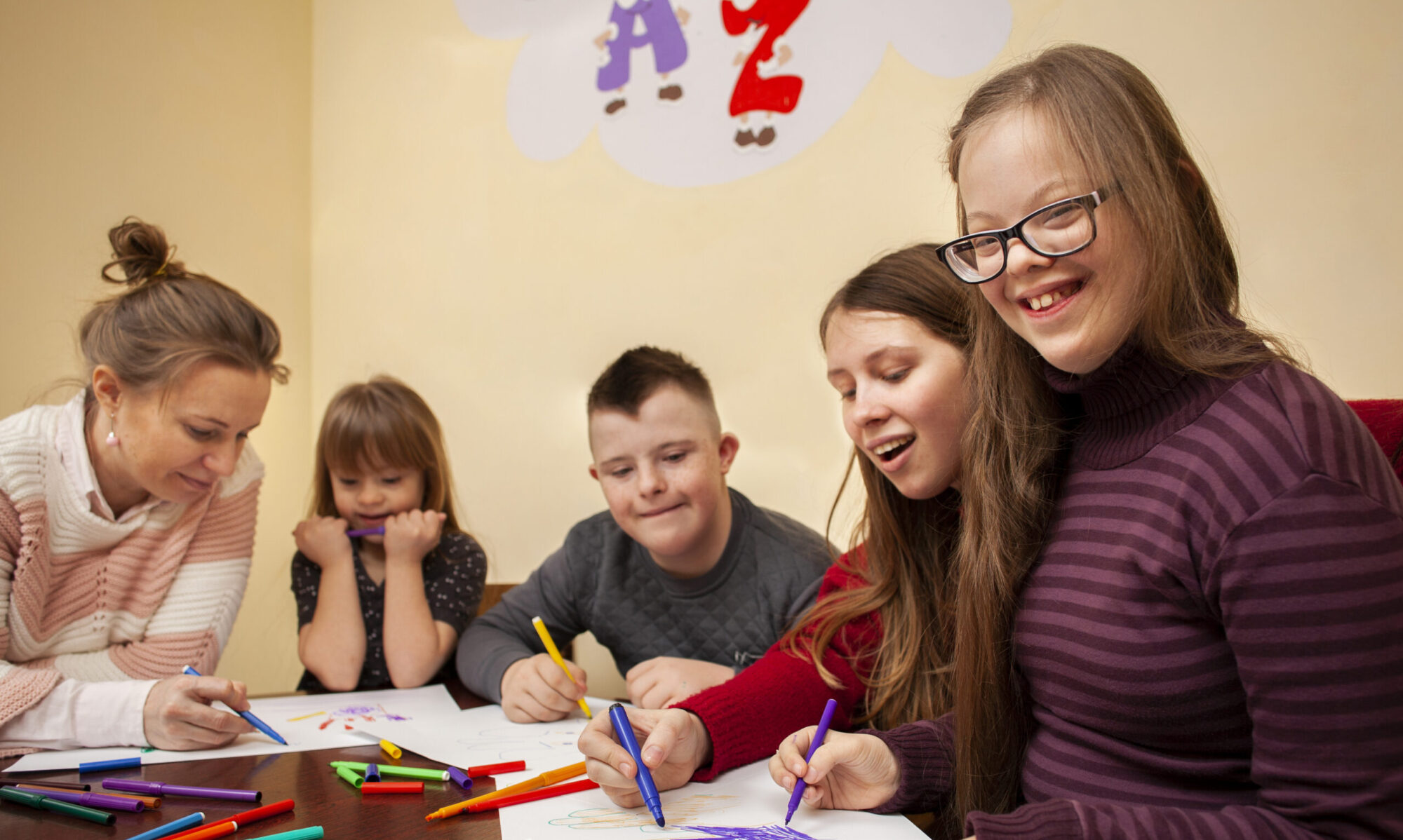
We all want our child with Down Syndrome included with their typically developing peers in school and work. Federal law requires inclusion. The past 40 years of research proves inclusion is best practices. So why are people with cognitive disabilities still segregated?
Lack of full inclusion of people with cognitive disabilities is the canary in the coal mine!
I recently read a fascinating parable by venture capitalist, Adam Quinton, describing why more women weren’t working in tech industries. The comparison can be used for inclusion of our community too.
Canaries were taken down mines as early detection of danger. The small, caged birds would die of dangerous gases before the miners, allowing them to get out before the gases effected them.
“But what happens when the little canaries died?” Quinton asked. “Did the miners blame the canaries for not being tough or well-trained enough? Or did the miners decide that really what they needed was more canaries?”
Quinton argues, they neither blamed the canaries or solved the problem by getting more of these birds. “Rather they reflected on the underlying problem facing the canaries. When they thought about it, this wasn’t the canaries themselves. They didn’t need “fixing,” rather it was the atmosphere,” he argues.
Students with cognitive disabilities aren’t the problem. They don’t need to be just like their typical peers to enjoy meaningful inclusion. Placing all the students with cognitive disabilities together in a separate room doesn’t fix the problem either.
I agree with Quinton when he argued that we must “Look at the context they operate in and work out what is wrong with your organisational culture and ask how you can make it more inclusive.”
Only when the “I” in Individual Education Plan (IEP) is focused on will students with disabilities get what they need, whether that’s in a full inclusion setting or some variation of inclusion. Only then will students with cognitive disabilities feel more valued and supported, as well as the teachers and typical peers that support these students.
When Laura Lee graduated from high school in 2001, there were no college programs in her state for students with intellectual disabilities (ID).
“Far too often, what is typically available for these students are ‘transition programs’ in high school that are isolated and a pipeline to living a life of poverty and either languishing at home or working in segregated sheltered workshops receiving below-minimum wage,” says Stephanie Smith Lee, Laura’s mother and Interim Policy Director for the National Down Syndrome Congress.
The Lee’s believed Laura and all students with Down syndrome deserved better. So, they petitioned George Mason University to start a pilot program and advocated nationally for more inclusive post-secondary programs. Laura became one of the first graduates of Mason LIFE Program, and today there are more than 260 college programs in 47 states for students with intellectual disabilities (ID).
Laura Lee’s resume was impressive, even for someone without a disability. It included her graduation from George Mason University, her work at the World Bank, volunteering at a food bank, and becoming a nationally recognized self-advocate giving speeches nationwide.
In March 2016, Laura Lee passed away in her sleep. For thousands of people nationwide who mourned Laura’s passing, she had become a symbol of what can be accomplished when high expectations and advocacy meet. And Laura’s mother did not stop advocating upon her death.
Laura and Stephanie Lee presenting together
“She’s the inspiration for my continued work,” Stephanie Smith Lee says.
As Interim Policy Director for the National Down Syndrome Congress, Lee is now in support of a newly released U.S. House of Representatives bill that will improve upon the Higher Education Act. Lee was instrumental in helping push through improvements in 2008, when the law was reauthorized. At that time, legislation was included to allow students with ID to apply for financial aid for the very first time, as well as the funding of model post-secondary programs for students with ID.
The new House bill released last week would increase inclusive post-secondary opportunities for students with ID. “One big change that will create a more inclusive environment is that model post-secondary programs that receive federal funding to educate students with ID must now offer inclusive housing on campus,” Lee explains. The bill would also change language in the law to require model programs to focus not just on academics, but career development as well.
The House bill would be attached to the reauthorization of the Higher Education Act expected this year, and would include the following amendments:
Using competitive grants to train faculty to deliver accessible instruction.
Establish an Office of Accessibility at every Institute of Higher Education.
A new grant program to implement Universal Design for Learning (UDL) .
A new commission to increase accessible materials and technologies.
Updates to data collection activities.
Updates to the program that funds Institutes of Higher Education that educates and integrates students with intellectual disabilities.
Rep. Mark DeSaulnier (D)
U.S. Representative, Mark DeSaulnier (D-California), who sponsors the bill says: “This first of its kind legislation takes a comprehensive approach to providing students and institutions with improved training, greater resources, and expanded services—bringing us one step closer to ensuring that all Americans have the opportunity to earn a degree, find a job, and achieve the American Dream.”
The National Down Syndrome Congress fully supports the improvements. “Students with intellectual disabililities want the opportunity to go to college like their siblings and friends, to learn, to experience independence, and become employed after graduation. Postsecondary opportunities for students with intellectual disabilities offer a new path to academic access, social inclusion, and working and living as independently as possible in the community,” says Lee.
Laura Lee with her mother, Stephanie Smith Lee in 1992
The 2008 reauthorization of the Higher Education Act had very strong bipartisan support. So far, the current bill only has Democrats sponsoring the bill. Still, Lee hopes that there will be continued bipartisan support for further improvements for post secondary inclusion.
“I’m so exciting to see how far we’ve advanced since Laura and I started advocating so many years ago. So many more students have opportunities, and have gotten jobs and live in their communities. They have friends in the community and are contributing members of society. But we’re still not where we should be. The current bill will help pave a better path forward,” says Lee.
The name alone brings instant sadness to the minds of special needs parents everywhere. A life taken too soon. A senseless death.
The 26-year-old man with Down syndrome died after police restrained him in a movie theater that he refused to leave. Ethan stayed for a second viewing of a movie, without having paid for it. The aide that was with him at the time begged the off-duty police to not aggravate Ethan; that his mom would soon arrive and make him leave. The death was ruled a homicide as a result of asphyxia, and the off-duty police officers involved are now being tried in a civil law suit.
21-year law enforcement veteran, Travis Atkins, says the Ethan Saylor death was a travesty that should have never happened. Now he’s started a non-profit to help change perceptions of people with intellectual disabilities within the law enforcement community.
Growth Through Opportunity (GTO Cadets) is a program designed to provide adults of all ages with Autism Spectrum Disorder, Down Syndrome, Cerebral Palsy, and other unique challenges an opportunity to gain valuable job skills and social experience.
GTO Cadet with a First Responder
“First responders and GTO Cadets grow immensely in their respective levels of understanding by being partnered together over a 16-week period. This drastically decreases negative encounters during future, real-life situations,” Officer Atkins explains.
I got a chance to hear Officer Atkins talk at the 1st Annual NDSS #DSWorks conference. He brought along one of GTO’s first cadet graduates, Tyler Caldwell, who happens to have Down syndrome.
“I got to wear a uniform just like all the other officers. When I was at State Special Olympic Games, I got to wear it and march in the torch lighting ceremonies with officers from other cities. People would recognize me when I was out as one of the GTO Cadets. That really made me happy. All my friends wanted to be in the program, too. Police officers are really nice people and are my friends,” Caldwell describes.
After spending 16 weeks as a volunteer cadet, Caldwell got a job at Kroger. “People recognized me from Police Department,” Caldwell says. And Officer Atkins says that’s the end goal. “Our goal is to enhance confidence, employability, and quality of life for participants. From a law enforcement officer’s perspective, there’s no better way to learn than by first-hand experiences in a controlled environment,” Atkins explains.
With the assistance of a first responder, cadets are taught specific tasks inside the department, as well as in the community.
“They assist our police department with crime prevention presentations, role playing at the police academy (which helps mold the minds of young recruits), and playing the role of the National Crime Prevention Council’s McGruff the Crime Dog®,” Atkins says. The City of Roanoke even has a sheriff’s vehicle and ambulance with the GTO logo, which helps break down barriers within the community.
Atkins says it’s community inclusion that will help prevent another tragedy like the death of Ethan Saylor. “GTO challenges other agencies across the nation to be pioneers and trend setters in the field. Be creative. Be innovative. Consider incorporating these fine individuals into your agency.”
To learn more about Growth Through Opportunity check out their website here or their FB page here.
My son, Troy, is almost 5-years-old. When he was born I knew no one and nothing about Down syndrome.
Troy at 6 months
I was hungry for any information I could find about Down syndrome. I spent the first month of his life on Google (bad idea, by the way). I quickly graduated to national conventions, advocacy groups, and now specialized training in special education law.
Secret Facebook groups and specialized books taught me all I need to know…Or so I thought.
Nothing can replace trial by fire. Living life with someone who rocks an extra chromosome gives you a front row seat to the docudrama that is Trisomy 21. Troy has taught me so much about how outdated stereotypes and low expectations can warp your perception of disability.
But living with a preschooler with Down syndrome often reminds me of the saying “It’s hard to see the forest for the trees.”
Self-Advocate Communications Workshop
For a while now, I’ve been searching for ways to steal a glimpse into Troy’s possible future. I really want to see “the forest.” One way I’ve done this is through a communications workshop with adult self-advocates. Simply talking and interacting with adults with Down syndrome on a regular basis has taught me so much about what our future may hold and how to plan for the best.
This led to an opportunity, from our local Down syndrome group’s Executive Director, to talk about the impact of our communications workshop on a local radio show.
Walter (bottom left) with MVDSA Executive Director, Willie Cox, and I at iHeart Radio
The natural pick for my co-interviewee was Walter, a 45-year-old iHeart Radio lover!
When we showed up to the radio conglomerate, Walter already had long-time friendships with every disc jockey, knew which of the 7 radio stations they were assigned to, and the exact times they each went live. Everyone hearts Walter!
I worked in radio for some time during college, and I came to appreciate the intimacy of the medium. You have to capture that emotion and authenticity the first go round, because your listeners can’t rewind or reread your story.
A common rally cry in the disability community is “Nothing about us, without us!”
Without Walter our story of advocacy would be flawed. We spoke with DJ, Kim Faris, about needed services and jobs for individuals with Down syndrome. Walter nailed the interview. He gave our radio interview the authenticity and emotion the audience will remember.
He was direct: “Hi, I’m Walter. I have Down syndrome and I’m proud of who I am.”
Not to mention, funny: “107.7’s DJ, Chris Davis, promised to pay me if I mentioned him today.”
I like to imagine an expecting or new parent with what seems like a scary diagnosis randomly tuning in just as Walter is proudly talking about his job. I know I would have loved to hear Walter when I was in the throes of Troy’s first few months.
Walter cracking jokes on-air
At 45-years-old, Walter did not get all the great services Troy receives through early intervention and inclusive education. Still, Walter thrives! It’s so important to remember what you’re actually advocating for sometimes. Just like Troy, Walter deserves a life of self-determination and choice. We really have to listen to our self-advocates at all stages of life to understand their needs and how to pave a better path forward.
You can listen to our radio interview live in the Dayton area on July 9th starting at 7 a.m. on any iHeart Radio Station: 107.7, 103.9, 94.5, 99.9, 104.7, and 106.5.
The Fourth of July is a time of reflection of our nation’s past and present. As a special needs mom and former history teacher, I often marvel at how far our nation has come in one generation as it relate to the human rights of individuals with disabilities.
Surely, when Thomas Jefferson wrote we have the right to “life, liberty and pursuit of happiness” in the Declaration of Independence he wasn’t thinking of people like my son, Troy, who has Down syndrome. Still, this document and our nation’s constitution has been used as proof that my son deserves a life of choice and self-determination with needed supports.
When I was born in 1982, individuals with Down syndrome had a life expectancy of 25-years-old. Many still lived in neglected and abusive institutions, were denied life saving surgeries, and underwent forced sterilizations as approved by the Supreme Court in 1927.
One generation later, in 2012, when my son, Troy, was born life expectancy more than doubled to 60-years-old. Many laws contributed to this amazing feat, and one of the most important was Medicaid. The social program was a bipartisan solution to healthcare for the poor, and was signed into law by President Lyndon Johnson in 1965.
In 1981, Ronald Reagan approved the Community and Home Based Waiver Provision within Medicaid. The waivers are rooted in the idea that individuals with disabilities are happier, safer, and more free in their home and community. Not to mention, it’s a cheaper alternative to institutionalizing individuals with disabilities.
Troy (left) with his twin, Hunter
The healthcare proposal that recently passed the House of Representatives and is currently in the Senate would cut Medicaid by $834 billion dollars over the next decade. Half of those cuts would come from “per capita based caps.” This means, instead of a federal and state partnership, the federal government would cap the amount of money they give to states to a fixed amount. Cash strapped states would likely cut Community and Home Based programs first.
Troy playing baseball with his typical peers
In a time of growing distrust of government, you need to know that the federal government has made a huge positive impact on the lives of our nation’s most vulnerable citizens. My son is proof of this progress. At almost 5-years-old, Troy, can do everything his neuro-typical twin brother can do. He’s potty trained just like his typical twin, can read and sound out simple sentences like most kids his age, and plays on the same tee ball team as his typical peers.
What you may not realize is the supports he receives during early intervention and in his inclusive preschool (like PT, OT, and speech) are partially funded through Medicaid. When my son reaches adulthood Medicaid provides job training, transportation, and independent living supports through local and state run programs like Project Search. At birth we put our son on Ohio’s Medicaid waiver waitlist for these adult supports and services. As Medicaid stands right now, that waitlist is 18-25 years long. What will happen if these cuts are approved? Likely we’ll never see the end of the waitlist; if we do, the services will likely not be what they are today.
Ohio Governor John Kasich opposes the Senate bill and in a letter with three other GOP governors stated: “It calls into question coverage for the vulnerable and fails to provide the necessary resources to ensure that no one is left out, while shifting significant costs to the states.” Over 700,000 Ohioans would be impacted by Medicaid cuts if approved.
Troy and I met with Senator Rob Portman’s staff in June. We shared our Medicaid story, but staffers gave us no indication of how Senator Portman felt about the disability community. After the Senate delayed the bill, Senator Portman came out in opposition to it, citing the opioid crisis here in Ohio. For sure, drug treatment and mental health will also be negatively impacted, but the disability community must not be ignored. Call Senator Portman or your own Senators today at (202)224-3121 , remind them how far we’ve come as a nation in the treatment of our most vunerable citizens. Tell them to save Medicaid, and vote NO to any cuts or caps on the program.