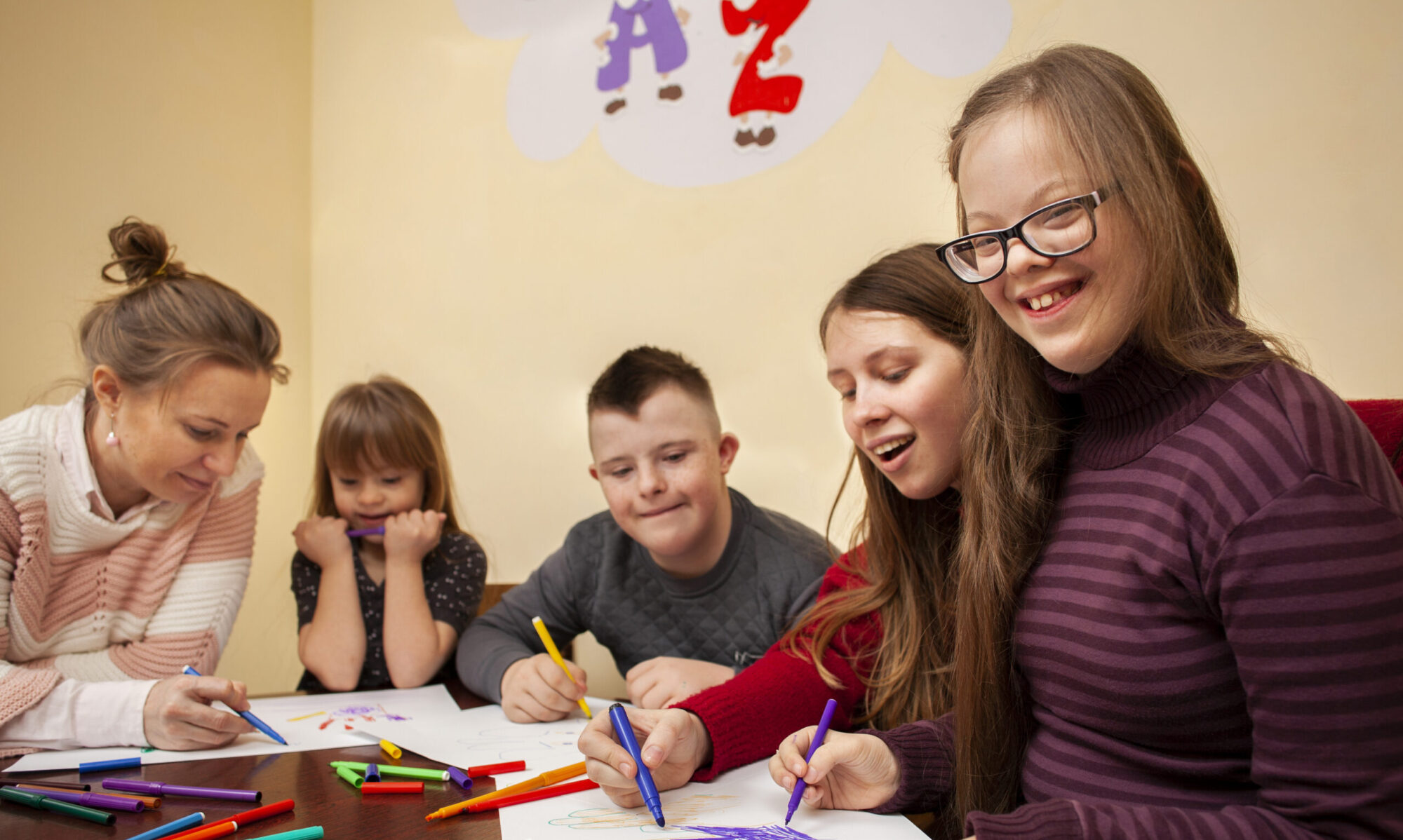
Inclusion for Individuals with Down Syndrome is Just a Click Away

Down syndrome comes with a lot of assumed can’ts and won’ts. But the world often misses the incredible way individuals with Down syndrome adapt. With the right supports, most things are possible.

Us with my 85-year-old Grandmother

Today, more than any time in history, a life of independence and self-determination is just a click away.

My 85-year-old grandmother laughs that her 4-year-old twin great-grandsons, one with Down syndrome, knows more about modern life than she does. And in a way, she’s right! Troy gets very limited screen time, but has still managed to master his Great-Grandma’s iPad. Technology is intuitive to all young people today; children with Down syndrome are no different.

I can envision Troy living on his own one day, driving to work on time, shopping, exercising, and loving life all with the help of modern assistive technology.

The future is here, and it’s revolutionizing how people with disabilities live

Many of you may have paused when I said “driving to work,” and rightly so. In reality, the likelihood of someone with Down syndrome earning their driver’s license is extremely low. I’ve read a handful of success stories, but by the time Troy’s old enough to learn to drive that number could be higher because of driverless car technology.

This is no longer the stuff of sci-fi movies and dreamers. Tesla recently released their mid-level, $35,000 driverless car, and Nissan promises a car with “autonomous drive technology” by 2020. Google’s second generation car doesn’t even have a steering wheel or brake pedal. Google says in order for people with disabilities to benefit from this type of technology, the car needs to be completely autonomous. Regulators and society in general will have to consider the ethics of this new technology, but that debate is already beginning and there’s no stopping progress.

Inclusion Through Innovation

If driverless cars seems too far-fetched for you, there’s a multitude of assistive technologies that you probably use every day that can help foster inclusion for individuals with Down syndrome. Everyone’s got a smartphone, and that alone has endless possibilities for supporting independence and inclusion.

Got a problem or an accommodation, there’s an app for that:

Alarm Clock

Voice to Text, Text to Voice

Sign Language, iSigns

Navigation

GPS technology

screen magnifiers

Word prediction

Social networking

Tracking Behavior

Organize Personal Tasks, iPrompt

Steve (left) lives independently with his roommate (right)

Disability advocate and Mom-extraordinaire, Ricky Sabia, says her son, Steve’s smartphone was a life line in high school and is now crucial to his independence. “I don’t know if I would have survived him taking public transportation in high school if I couldn’t track him on “Find My iPhone.” Believe it or not, the biggest tool Steve uses now is the alarm. He sets it to remind him of when he needs to leave, when he starts a break, comes back from a break, leaves for the metro—the alarm is for so much more than getting up in the morning,” Sabia explains.

A college student with Down syndrome wants to attend a general class, but can’t take notes. No problem, Google Glasses can record the teacher’s lecture. Grade school students with disabilities could wear the glasses to the zoo and get real time facts about the animals they see.

An iWatch could track a self-advocate’s calorie intake and heart rate, all while listening to music and calling a friend.

I love how all these technologies blur the line between assistive and general consumer technology. This is Universal Design for Learning at its finest. Read my post about UDL here. UDL means providing flexible technologies so that everyone can learn. Typical people use the technologies above every day, and may not even consider how they could help someone with an intellectual disability be better included. The possibilities are endless!

What technologies does your loved one with Down syndrome use to lead a more inclusive, independent life? Share below.

Why Your Child’s Teacher Should Be Trained in Non-Violent Crisis Intervention

So, wow! My recent post about an 7-year-old old boy being dragged by his teacher really hit a nerve. Many of you were shocked to see the video, and thankful for tips on how to help prevent this type of abuse.

Others responded that a No-Consent Letter alone is ineffective if school personnel are not trained properly in handling crisis situations. I wholeheartedly agree! We may disagree as to whether restraint and seclusion techniques work, but I think everyone can agree that crisis prevention training can help decrease these type of incidences.

As a teacher, I was never offered any crisis intervention training. And after digging around, I found that I am not alone.

Just as there are no federal laws restricting the use of restraints and seclusion, there is also no mandate for crisis prevention training across the country. School districts lack the money it takes to properly train their personnel in non-violent crisis interventions. This will only get worse if Title II, A is cut. Title II, A is federal funding for professional development, but the Trump administration wants to scrap it completely.

Another problem is the least qualified staff are often paired with students who have disabilities and the most challenging behaviors. And now Every Student Succeeds Act no longer requires teacher to be “highly qualified,” which will likely make matters worse. The result is hundreds of cases of abuse or even death related to using restraint and seclusion techniques, according to federal figures.

Advocating for Better Crisis Prevention Training

What can you do as a parent or teacher to prevent an incident like the one in above?

First, advocate for a Non-Violent Crisis Prevention Intervention program in your school district: Find out what, if any, behavior intervention training your school staff receives. At the very least, your child’s school should have access to a behavior specialist who’s trained in non-violent crisis prevention intervention. Your child should have a Functional Behavior Assessment as soon as a problem arises. Don’t let the situation get to crisis mode.

The Crisis Prevention Institute is an international organization that has provided training to teachers for more than 35 years. Their Non-Violent Crisis Prevention Intervention includes one-day seminars that help teachers identify how behavior escalates and how to respond in appropriately during times of chaos.

The lead instructor, Maria Navone, is part of a fabulous podcast about advocating and carrying out non-violent crisis prevention intervention. She stresses that all behavior is communication. “Being able to step aside and not take this acting-out personally helps you think more clearly about what your intervention is going to be,” Navone explains.

The institute also has a 4-day Instructor Certification program. They offer on-site and online training, but it all comes with a hefty price tag. That’s why it’s important to also advocate for funding for teacher training.

Call, email, and tweet your Congressmen: Tell them not to cut Title II, A. It seems “professional development” has become a dirty word. School districts have a hard time proving the effectiveness of teacher training, and politicians can’t stomach the cost. But it’s important that Congressmen know that Title II, A could be used for non-violent crisis prevention training for teachers. If we have one less abused student, then the tax money spent is worth it.

Contact your Congressperson here. 

Here’s the sample tweet I sent my Congressmen: @RepMikeTurner #TitleIIA is critical for school leaders and principals to do their jobs effectively; cuts threaten this ability. Get a sample email or call script here.

Also, advocate at the local level: You may have heard the saying “all politics is local,” and when it comes to education this is very true. Most school funding comes from local property tax. Only 5-10% of school funding comes from the federal government. That’s why it’s important to get involved with your child’s school board and advocate for better training in crisis prevention methods.


Evie’s Sleep Story

The Following is Evie’s Sleep Treatment Story as Told By Her Mom, Jen Alge: 

Read about new research that links sleep issues with cognitive, memory, language, and behavior issues HERE.

I could write a book about this. Evie’s had 7 sleep studies. Her first was at 11 months, because they were trying to rule out pulmonary pressure issues before doing heart surgery. She had mild apnea then.

We did another sleep study before her first set of tubes and they found she had severe sleep apnea. They put tubes in and took the adenoids out. She still had severe apnea. They then did the tonsils along with a tear duct probe and another set of tubes. Then her apnea was moderate so the tonsils helped a bit.

Then we did a simi MRI to get a better read on her airway. That helped the docs a ton. I highly recommend that procedure. But that showed us just how obstructed her airway is so that’s when we started the CPAP (Central Positive Air Pressure). Due to her tiny facial structure and age (she started this when she was 4) it took a while to find the right mask and pressure that she would tolerate.

Doing a sleep study to titrate the machine was the most challenging sleep study- keeping a canula in with a CPAP is rough. So they gave her ambien to get that result. Then after several months of her only wearing the CPAP for 2 hours we did another sleep study and this time with a time-released melatonin. That did the trick.

So Evie takes a pill like a champ every night along with her nasal steroid and allergy meds to open her airway. After we got her pressure where it works best and a full face mask, she wears her CPAP an average of 7 hours a night. Now, she’s on a pressure of 11, and the full face mask isn’t the best option because when she moves the seal breaks pretty easy. So we’re not at the finish line yet. But the docs are happy with her use and they want to kick us out of the upper airway clinic.

I’m holding on because, yes, she does wear it on average 7 hours a night, but that’s only because I’m in her room 5-8 times a night at least putting the mask back on. She lets me put it back on, but man is this lack of sleep going to get old someday soon. And I’ve definitely considered other options like orthodontic pieces and the surgeries they really wanted to do when she wasn’t wearing her CPAP more than 2 hours.

Those surgeries are 3 in total: 1. Cutting the back of her tongue and pulling out some tissue. 2. Cutting away her lingual tonsils at the back of her throat (this is a risky procedure with a long recovery due to the risk of her throat swelling and closing up- lots of steroids) 3. The insertion of a screw under her chin with a string tied to her tongue to keep it forward. Evie’s problem is not the tongue, the throat or the width or length of her mouth- it is all three. So only all three procedures would solve it. Oh and all three procedures only have a 60% success rate so she’ll likely still need a CPAP. 🙂

I’ve notice no behavior changes since the treatment. Evie’s always been a smarty pants and she talks all day long so I can’t credit the CPAP for any changes there. I will say she is getting more air and isn’t gasping for breath or snoring with the cpap on so that’s a relief. The behavior changes might be more long term given her age.

Worth More Than a Test Score

Want to really make a parent of a student with Down syndrome cringe? Bring up assessments, especially IQ testing. Sitting around a table, outnumbered by school professionals, describing in detail how your child doesn’t measure up. I’ve been through it (albeit, not IQ scores) and Troy is only in preschool!

Why is this being done and what can be done about it?

It’s understandable that schools must use some sort of assessment to decide eligibility for special education services. The key word here is “services.” Special education is not a place, but a service!

I repeat, federal law does not define disability services as a special education classroom, but instead a “free and appropriate education” in the “least restrictive environment.”

But many school district use IQ testing and other assessments to systematically segregate students.

The school district I taught in called it “tracking.” Supporters of tracking or ability-grouping say it allows students to learn at their own level, and prevents teachers from having to teach many different abilities in one classroom. I argue that the costs to students in the low-level, or special education classroom, negates the benefits to the students in the advanced classes.

Instead, why not follow federal law and court precedent that calls for inclusion with needed supports in the general education classroom? Why not execute a true “Individualized” Education Plan (IEP), instead of systematically creating “places” for groups of students to be served. If a student is best served in a separate room so be it, BUT it should not be an assumed, systematic practice solely based on the student’s test score or disability.

New Approaches to Assessing the Strengths and Weaknesses of Students with Down Syndrome:

“It’s misleading to take that one score and portray the entirety of that child. May be that child functions well when you do non-verbal skills. Parents should make it clear during the testing that the teacher should sit down and understand both your child’s strengths and weaknesses,” says Dr. Jamie Edgin of the University of Arizona.

For the past decade, Professor Edgin has been researching better ways to assess students with Down syndrome. Her team is currently working on two types of cognitive test batteries. The Arizona Cognitive Test Battery is for students 7-years-old and older, and a newer iPad assessments for preschoolers (some of whom are completely non-verbal) called the Arizona Memory Assessment for Preschoolers. Unlike IQ tests, that are a global assessment with a cut off score, Edgin’s set of tests assesses multiple domains of strengths and weaknesses.

UC David MIND Institute is testing adults with Down syndrome

Another method being developed at the UC Davis MIND Institute breaks down scores below the IQ cutoff (the most common IQ tests are not able to measure cognitive ability below a certain level).  “A child placed in a new special education classroom may be given the Stanford-Binet IQ test and obtain a floored score showing no variation in performance, which would give the impression that he is simply low functioning and has no real cognitive strengths or weaknesses,” says David Hessl, UC Davis professor of psychiatry and behavioral sciences and the study’s senior author. “But if our scoring method is used, you are likely to find that particular verbal skills are relatively better, or there are unique visual spatial strengths, and that might help you to better serve his needs.”

The problem is neither of these new methods to test students with Down syndrome are widely available in school districts across the country. “You have to function within the way the school system works. These batteries haven’t been around long enough, and tested enough students to be widely accepted,” Dr. Edgin argues.

So, what do we as parents do when our child’s school wants to use a traditional IQ test?

3 Alternatives to Traditional IQ Testing of Students with Down Syndrome:

  1. Refuse: IQ Testing is NOT required for Special Education services, so many parents refuse the test.  Even when a school district argues that a designation of “intellectual disability” cannot be used without an IQ score, parents have gotten around the pesky assessment. Usually by using the “Other Health Impairment” designation instead. Both ID and OHI should be measured by a wide range of assessments and observations, not necessarily IQ scores. Before your child turns 18-years-old, find out what your state requires for eligibility to adult services. Some states require an IQ score to receive these services.
  2. Request a Better Test: Professor Edgin says it’s worth asking for a Differential Abilities Scale, which gives a wide range of scores with strengths and weakness. If your school refuses, and you have the financial ability, an outside assessment may be worth your child’s time.
  3. Advocate: Ask what test is being given and how the scores will be used. It’s your right to know which assessment your child will be given, and what impact it will have on their education. Never sign an IEP or assessment form without understanding the implications of test results. Another good tip: ask for the test results before the IEP meeting. That way you can leave your emotional response to the test results at home, and better advocate for your child at the meeting. Also, ensure that strengths and areas for improvement are a focus of any conversation.

Know that your child is worth more than one test score. Know your child’s rights, and don’t be afraid to advocate!


College Scholarships for Students with Down Syndrome Is The Pot at the End of the Rainbow

College acceptance for students with Down syndrome is a real possibility, as you learned in my very first blog post. But once you’re accepted, how do you pay for college tuition? 

Ruby’s Rainbow, that’s how!

Ruby’s Rainbow is an amazing non-profit that grants post-secondary scholarships to students with Down syndrome. The scholarship recipients can use the money for a university, community college, or vocational program.

Ruby’s Rainbow creator and Executive Director, Liz Plachta says the non-profit gives over 40 scholarships every summer, each worth from $3,000 to $5,000 dollars.

This year, the organization raised a record $137,500 for 47 Rockin’ Recipients. Check out the winners here.

Ruby’s Rainbow is such an important organization, because college tuition for students with Down syndrome can sometimes costs more than typical college tuition.

At Syracuse University’s InclusiveU program, tuition can increase by $10,000 dollars to $24,000 a year if a student needs addition supports. That’s enough to make college out of reach for this group of students.

“Parents weren’t expecting to pay for college for their child who was born with Down syndrome a generation or two ago,” Plachta says. If a student with Down syndrome decides to go to a community college, Ruby’s Rainbow scholarships could cover the whole cost.

Also, the Higher Education Opportunity Act allows college students with cognitive disabilities to apply for pell grants or work study funds, but they still can’t get a student loan.

Ruby, center, with her dad and mom

The inspiration for Ruby’s Rainbow is Plachta’s daughter, Ruby, who is now 7-years-old and rocks an extra chromosome.

“I knew I wanted Ruby to have the same opportunities as her older sister. I didn’t even know if people with Down syndrome went to college when Ruby was born. But I started researching and found college programs for student with cognitive disabilities…

…At that point, I was full force ahead. I wanted to raise expectations!” says Liz Plachta, Ruby’s Rainbow creator.

And raise expectations is just what she did!

“The non-profit’s growth has blown me away!” Plachta says. This year Ruby’s Rainbow almost doubled their applicants and recipients. Since 2012, the organization has provided more than $400,000 in scholarship money to over 150 students with Down syndrome.

“When we first started, my goal was to raise $2,000 dollars and give one scholarship. That first year we raised $20,000 and gave 10 scholarships!” explains Plachta. 

One of the first scholarship recipients, Alex Bender, just graduated from University of Cincinnati’s 4-year Transition and Access Program (TAP).

Alex Bender, Ruby’s Rainbow Scholarship Recipient

“I love my college, University of Cincinnati, a ton! Now that I graduated my plans are to get a Job at University of Cincinnati Bearcats Athletics Department,” Bender explains.

Bender plans to live in a house or apartment near the University of Cincinnati with friends. She says Ruby’s Rainbow helped make all this possible.

Plachta says her next goal is to raise scholarship amounts. “Right now our scholarships make a small dent in college tuition. I want to make our impact even bigger,” Plachta says.

Of course, all of these scholarships are made possible through generous donations.

“I see a piece of my daughter, Ruby, in every single applicant we review. I hate to turn anyone away, but right now we don’t have the funds to give every applicant a scholarship,” Plachta explains.

Ruby’s Rainbow’s biggest fundraiser is on March 21st or World Down Syndrome Day. They ask donors for 3 ways to help:

  1. Donate $21 (representing the 21st chromosome–people with Down syndrome have 3 copies of this chromosome)
  2. Make a pledge to be kind to people of all abilities
  3. And ask 3 friends to do the same

Plachta expects to announce this year’s winners in August sometime.

To find out how you can donate, apply, or find out about this year’s recipients visit Ruby’s Rainbow at www.rubysrainbow.org