College Students with Down Syndrome REACH for True Inclusion

College may not be for everyone, but for students with intellectual disabilities (ID) post-secondary programs have historically been completely out of reach. Since 2008 the federal government has given incentives to higher education programs who open their doors to students with Down syndrome and other intellectual disabilities.

Since the reauthorization of the Higher Education Act a decade ago, more than 260 college programs have been created for students with ID. But only the minority of these programs include a 4-year, all inclusive program for students with ID. The College of Charleston’s REACH program is one of them.

Read Related Post: InclusiveU: What College Should Look Like for Students with Intellectual Disabilities

“I love it here. I am treated like a person, not like a disability. My classes are hard but I get all the help I need. I have lots of friends who don’t care about my disability, we don’t really talk about it,” explains a students with Down syndrome attending the REACH program.

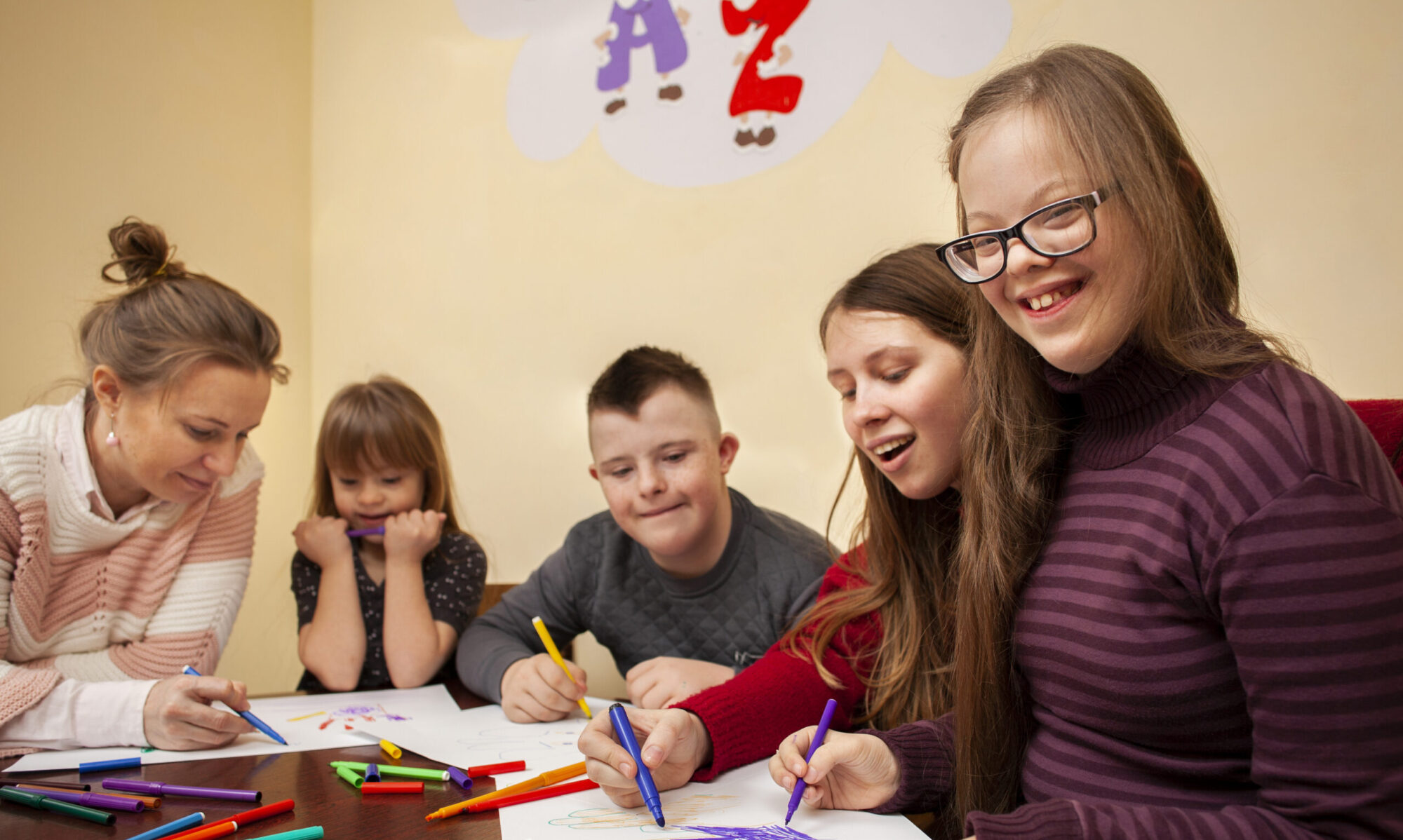
The REACH program models a typical college experience. Students take regular classes and live on campus. The 4-year program started in 2009 with a grant from the College Transition Connection program, and has four areas of focus: academics, social, independent living, and career development.

Program Executive Director, Edie Cusack, says student success in the program often requires training parents and professors to change their mindset. “There’s an acceptance process for parents too. We’re really looking for them to let go. We often get parents at orientation who say ‘maybe that student can do it, but my child cannot.’ By the end of the program they’re proven wrong.”

“We also conduct specific inclusion training with professors, who often have no background in teaching techniques for students with intellectual disabilities. We promote UDL, scaffolding instruction, and stress high expectations that academic learning will take place,” explains Cusack.

Read Related Post: College Scholarships for Students with Down Syndrome

REACH boasts a 93% post-program employment rate, and a 75% independent living rate. Cusack says students spend the last six months of the program finding employment and independent living supports. Students must also complete an internship in a career field of their choice.

“I believe in the dignity of risk. Stopping people with disabilities from taking risks and making mistakes is stopping them from living a full life. A cool side effect of the program is the idea of disability is shifting. No one turns and looks and stares when our students with Down syndrome goes into cafeteria. In fact we have a student with Down syndrome currently who has been entered into the lottery to dorm with typical students because she’s on-par for living skills,” Cusack says.

There are no national standards or accreditation process that post-secondary programs must follow to serve students with ID. Think College works as a clearing house for more than 260 college programs, and is working with the federal government to develop standards. You can learn about other college programs here.

A bill was just released to the House of Representatives to reauthorize the 2008 Higher Education Act last week. Some worry that gains that have been made under the 2008 version, could be lost in the current bill that calls for deregulation. You can read the bill here.

You can find out about the College of Charleston’s REACH program here. Is your loved one with Down syndrome going to college? What other post-secondary programs have you learned about that serve students with ID? Share what you know below.


321 Let’s Count!

I just need to be up front: I’M NOT A HUGE FAN OF MATH! Add to this the fact that students with Down syndrome often struggle with the abstract idea of numbers, and we’ve got a tough problem to solve. 

But one of my recent posts “Teaching Your Child with Down Syndrome to Read,” was so popular that I thought I should share a similar approach to teaching early math concepts. All of this information is from two programs that I learned about at the National Down Syndrome Congress Convention and other conferences I’ve attended. Most of the material is free, so in the end it’s just about finding the time to incorporate this into your child’s day.

Related: Teaching Your Child with Down Syndrome to Read

Here’s what we know about math and students with Down syndrome. There’s less research regarding this topic compared to literacy and students with T21. We do know that you can teach these students math in the same way you teach it to typical students, but it needs to include “smaller steps, more repetition, more guided practice and lots of visuals.” That’s according to Orange County Learning Program Director, Dana L. Halle.

Math sense equals INDEPENDENCE!

Just like literacy, math can open doors for individuals with Down syndrome. But unlike my typical children, who seem to just figure out how to do simple counting and patterns on their own, Troy has needed a lot more guided practice. You will likely have to consciously teach concepts like “more than” and “less than.”

There’s a benefit to starting early and often. “This doesn’t mean 3 times a day everyday. It just means often enough that it becomes part of what they expect. So they don’t forget what you’re teaching and you have to start over again,” says Halle.

So, where do you we start?

With Troy I use Sue Buckley‘s one-to-one correspondence method, which includes keeping the objects the same. This means you want to throw out those counting visuals that has 1 elephant, 2 balls, 3 flowers, etc. Buckley argues the changing objects are too confusing for beginning counters.

Related: 4 Tips to Help Teachers Include Students with Down Syndrome in the General Education Classroom

We literally started one-to-one correspondence with Troy using black dots–simple, unmistakeable. Now Troy is using Buckley’s method with his favorite food. YES, food is imperative in teaching counting in our house (LOL)!

Like Halle encourages, we try to incorporate simple math sense into our every day routine. Troy counts the stair steps, the buttons on his shirt, the number of plates at the table, while we clap to music, etc. Troy is starting to understand that counting isn’t just memorizing the words 1 through ten, but instead that each number represents a specific amount of objects. It took us 2 years of counting and lots of one-to-one correspondence practice to get to this point.

What comes next? 

Patterns worksheet from LP Online

Other early math skills include shapes and patterning. Troy has mastered shapes names and sorting through continuous repetition, but patterns are much more difficult. Understanding what comes next is a very abstract thought. We’re starting simple. You can download free pattern worksheets like these from LP Online with a guest login.

I always forget to print new pattern sheets out, so again FOOD works better for us. Check out Troy below doing a simple ABAB pattern with his favorites: blueberries and Cheerios a.k.a O’s (disclaimer: let me apologize in advance for my 2-year-old crying in the background…REAL LIFE here people! LOL!)

With all this conscious practice, Troy will be prepared for math lessons in kindergarten. He’s still behind his typical twin brother, but he has a basic understanding of the earliest math skills. Luckily, we have one more year to continue to practice.

If your child is ready to move on to the next stage of math sense, I would start with Down Syndrome Education USA’s “Number Skills for Children with Down Syndrome (5-11 years)“. Also, I bought a Numicon system for Troy, but have yet to start this skill. It’s a great visual way to make numbers real. Check it out below and here.

How do you teach math sense to your child with Down syndrome? Tell me about your triumphs and challenges below!


Dear IEP Team

The following letter is a pre-planned posthumous letter to my son, Troy’s IEP team. The context of the letter can be explained by reading The Immortal Mom: Why I Can Never Die.

Dear IEP Team,

Thank you for your tireless efforts to ensure Troy receives the best educational career. One that prepares him for college or a career and independent living. I wish that I could be there to advocate for my son. To watch as he meets his ambitious IEP goals, fret over stalled progress, marvel at him making new friends and learning grade-level content, and nervously laugh as he gets into a bit of mischief.

Unfortunately, God had other plans. So, I am writing to you in hopes that my educational goals for Troy are carried out in his Individualized Education Plan. When I wrote this I had no idea when or how I might pass, but I knew then that I am my son’s best advocate. If I was there my plans would be much more detailed, but as it stands I hope these broad goals are used as guidance to create an ambitious, supportive, and fluid plan for Troy.

  1. Troy should be present at every IEP meeting, and should start advocating for himself in Middle School.
  2. Always Presume Troy is Competent! It’s the least dangerous assumption.
  3. A COPAA trained advocate should be present at every IEP meeting, and should have full access to Troy’s records.
  4. Troy’s teachers should receive the support they need through set planning time and professional inclusion training courses.
  5. Troy should have a one-on-one aide or his classes should be co-taught. The one-one-one aid or co-teacher should get the same training as his general education teacher.
  6. Troy should learn to read  and understand what he reads using proven methods like Orton-Gillingham.
  7. Troy should learn functional math using proven methods.
  8. Troy should get Speech and OT pushed into his general education classroom throughout his elementary school years; if not, beyond.
  9. Evaluations and assessments should never be used for placement. General education is the least restrictive environment.
  10. Troy should access grade-level content at his own level using appropriate modifications.
  11. Troy should get the behavior supports he needs if behavior problems are preventing him from learning.
  12. Troy should stay in a general education setting at his neighborhood school 70 to 80% of each day.
  13. Troy should stay with his typical twin throughout his educational career.
  14. Troy should not do any cleaning or functional life skills type tasks, unless his typical peers are also doing the tasks.
  15. Troy should work towards a general diploma.
  16. When in doubt, ask yourselves the following question: “How is this specific IEP goal helping Troy be ready for college, career, and independence?”

Thank you for taking my posthumous wishes into consideration. Troy’s future depends on you carrying it out with fidelity. I appreciate all of you!

Sincerely,

Courtney

Troy’s Mom

Down Syndrome Blogs Sure to Inspire

In the beginning there was Google. It’s what every new mom turns to these days when they receive their child’s Down syndrome diagnosis. Like it or not, moms want information and Google provides it fast.

That’s why it’s so important that advocates like myself and the ones you’ll meet below win the Google Wars. Out-dated, misinformation about Down syndrome is rampant on Google. But slowly more and more blogs, as well as national Down syndrome organizations are putting an end to this misinformation. Some argue that the blogosphere is flooded with too many new moms sharing their journey with a child with Down syndrome. I say bring it on!

Read Related Story Here: Why I blog

It’s important that we advocate and share our personal stories, so that new moms and strangers of Down syndrome develop a new, better perspective of people living with Down syndrome. I started Inclusion Evolution to provide one more glimpse into the diverse world of Down syndrome. If I inspire one person, change one mind, then my goal is met. Other bloggers are doing the same, and below I share my top 10 favorite.

10 Most Inspiring Down Syndrome Blogs: 

Cedar’s Story:

This has got to be the best diagnosis-centered blog on the web. One-year-old Cedar’s mom, Dawn, does a fabulous job sharing hundreds of diagnosis stories. The first place I turned when I learned about Troy’s diagnosis was the web, and I wish then that I would have had Cedar’s Story. Click here to read a diagnosis story from the Ivory Coast in Africa.

Dawn and Cedar from “Cedar’s Story”

News Anchor to Homemaker:

Jillian Benfield’s raw emotion and eloquent words will have you coming back for more. I feel she and I could be best friends, and I don’t even know her. As I began reading her blog, I realized we had SO much in common. First, we both grew up in the same county in Florida. Second, we were both television journalist (albeit–she was much more successful), turn stay-at-home moms. But mostly it’s her first son, Anderson, who has Down syndrome that hooked me. Her “Mid-Week Moral” will cut you down deep, and bring you closer to her beautifully broken journey and your own.

Jillian, Anderson and Family from “News Anchor to Homemaker”

The Sassy Southern Gal:

Almost every blog about Down syndrome has a baby or toddler in its starring role. But I’m hungry for sneak peeks into Troy’s future, so I’m always looking for reads on teens and adults with Down syndrome. 17-year-old Rachel fills me with such hope for Troy’s future. She’s the star of “The Sassy Southern Gal,” written by her mother and my advocacy mentor, Jawanda Mast. Jawanda’s blog shows Rachel’s journey of inclusion from her elementary school years to her present senior year. Rachel is an amazing self-advocate, and the blog show’s this transformation. Check it out here.

Rachel from “Sassy Southern Gal”


Grown Ups and Downs:

Another fabulous blog from a mother of an adult with Down syndrome. Brought to you by the co-author of “The Parents’ Guide to Down Syndrome,” Mardra Sikora inspires young moms to always dream big. Her son, Marcus, is also an author and amazing self-advocate. Check out his children’s book, “Black Day: A Monster Rock Band,” and all his adventures here.

Marcus with his book “Black Day” from the blog “Grown Ups and Downs”

A Day in the Life with Down Syndrome:

This is a new blog (like mine) with an extra special mission. To share families’ journey with Down syndrome. You can submit your own story and also learn about Down syndrome resources on and off social media. The author is Meriah, who first inspired me with a cross-disability blog now called Two Thirds of the Planet. Using her own disability as a compass, Meriah provides a unique glimpse into life with a disability.

Meriah and Moxy from “A Day in the Life with Down Syndrome”

This Life I Live:

The blogosphere is dominated by strong women sharing stories about their beautiful children with Down syndrome. It’s rare to find a father’s perspective, so Rory Feek’s blog is a rare gem. He writes it like an open diary about his wife who recently passed from cancer, his country music career, homestead farming, and his youngest daughter, Indy, who happens to rock an extra chromosome. Feek plan to homeschool Indy. Check out the one-room schoolhouse he recently built for her here.

Rory Feel with his late wife and daughter, Indy

Lexi Loo, Lily, Liam & Dylan Too:

If you want more from a blog than just Down syndrome talk, then Stephanie’s parenting and lifestyle blog is your jam. It has the perfect mix of decorating tips, stylish clothes and toys, as well as updates on her son Liam who has Down syndrome. Click here learn about her son’s journey.

Stephanie and Liam from “Lexi Loo, Lily, Liam, and Dylan Too”


No BS About DS:

It’s common to find a Down syndrome blog that’s heavy on emotion, but as Troy gets older I can’t help but want more. Enter “No BS About DS.” Co-Author, Sruthi Muralidharan does a good job of including human interest pieces, but also scientific posts. Check out their Ask the Expert post with Dr. Brian Skotko here or their post about Miralax for Constipation here.

Sruthi Muralidharan with her husband and son, Tejas

I Am River

River is a little boy with Down syndrome that lives between the United Kingdom and Tanzania. His mom and author of “I am River” blog, Hayley has an amazing way of sharing their unique story through words and pictures. I love this blog for it’s international flair and amazing prose. Check it out here.

Hayley and River from “I Am River”

Down Syndrome Diagnosis Network 

My last pick for most inspiring Down syndrome blog comes from a volunteer-run organization and non-profit, Down Syndrome Diagnosis Network (DSDN). They have a great website with resources for moms with children from birth to age 5-years-old. But they also share personal stories on their blog from hundreds of parents across the United States. Check it out here.

What are your favorite blogs? Share in the comments section below!


Down Syndrome Policy Expert Chosen as Parent Advisor for New National Center to Include Students with Intellectual Disabilities

Research shows that full inclusion for students with the most significant intellectual disabilities is the best path forward. Federal law requires it. But reality is much different! Talk to any parent of a student with Down syndrome, and they will tell you: “the struggle is real!” In fact, statistics show only 16% of students with intellectual disability spend the majority of their time in a general education classroom with their typical peers.

Now, the University of Minnesota’s National Center on Educational Outcomes (NCEO) plans to put more of these students in general education classes with the support they need. NCEO was recently awarded $10 million dollars from the U.S. Department of Education to create the TIES Center: Increasing Time, Instructional Effectiveness, Engagement, and State Support for Inclusive Practices for Students with Significant Cognitive Disabilities.

Read Related Post Here: $10 Million To be Awarded To Agency that Delivers Inclusive Results for Students with Down Syndrome

“We’re so excited to get this center up and running. The grant begins October 1st, and we’re thrilled to have this opportunity,” says principal investigator for NCEO, Sheryl Lazarus. The center is charged with a monumental task: to support systematic changes in the way most school districts are teaching our loved ones with intellectual disabilities (ID).

“We believe in full inclusion for these students, and now we want to make that happen for them,” explains Lazarus. The goal of the TIES Center is to get students with ID fully engaged in in the same instructional activities and curriculum as their typical peers, while meeting their individual learning needs.

Students with Down syndrome would be a target group for this program. In fact, National Down Syndrome Congress Education Policy Advisor, Ricki Sabia, was chosen to be the parent advisor and liaison for the TIES Center.

“In spite of the strong least restrictive environment language in IDEA, the vast majority of these students are still segregated from their peers. Studies show that students in separate classes have less access to the grade level curriculum and content trained teachers. NDSC is looking forward to the impact that the TIES Center will make to improve the quality of instruction for students with significant cognitive disabilities in inclusive environments,” Ricki Sabia says.

Read Related Post Here: Promoting Inclusion Through Universal Design for Learning

Lazarus says the TIES Center hopes to accomplish the following goals:

  1. Develop professional learning communities in partner state and local education agencies
  2. Develop coaching models for implementation of resources, inclusive practices and communicative competence.
  3. Improve the efficiency and effectiveness of existing resources.
  4. Support parents to become partners in the practice of inclusion for students with significant cognitive disabilities.
  5. Support systems change within the leadership of state and local education agencies for implementation of inclusive practices.

Research on better inclusion won’t be limited to the University of Minnesota. Lazarus says they will have subcontractors at the University of North Carolina Charlotte, University of North Carolina Greensboro, University of Cincinnati, CAST, University of Kentucky and the Arizona Department of Education. There will also be parent liaison’s working with the TIES Center to help parents better advocate for their child.

Read Related Post Here: How Homeschooling is One Path to Inclusion for Students with Down Syndrome

Lazarus says they plan to work backwards to find solutions to the barriers keeping students with ID out of general education classrooms. “We plan to work with schools to find out what’s working and what’s not to create better outcomes for these students. Hopefully that will translate into materials for teachers and parents. We don’t pretend to have all the answers, but we’re going to work hard to find the best path forward,” says Lazarus.

To learn more visit https://nceo.info. I’ll be posting more information on this grant project as new policies or practices are introduced.

What barriers do you see to full inclusion for students with Down syndrome? Comment below and share your experiences and thoughts.