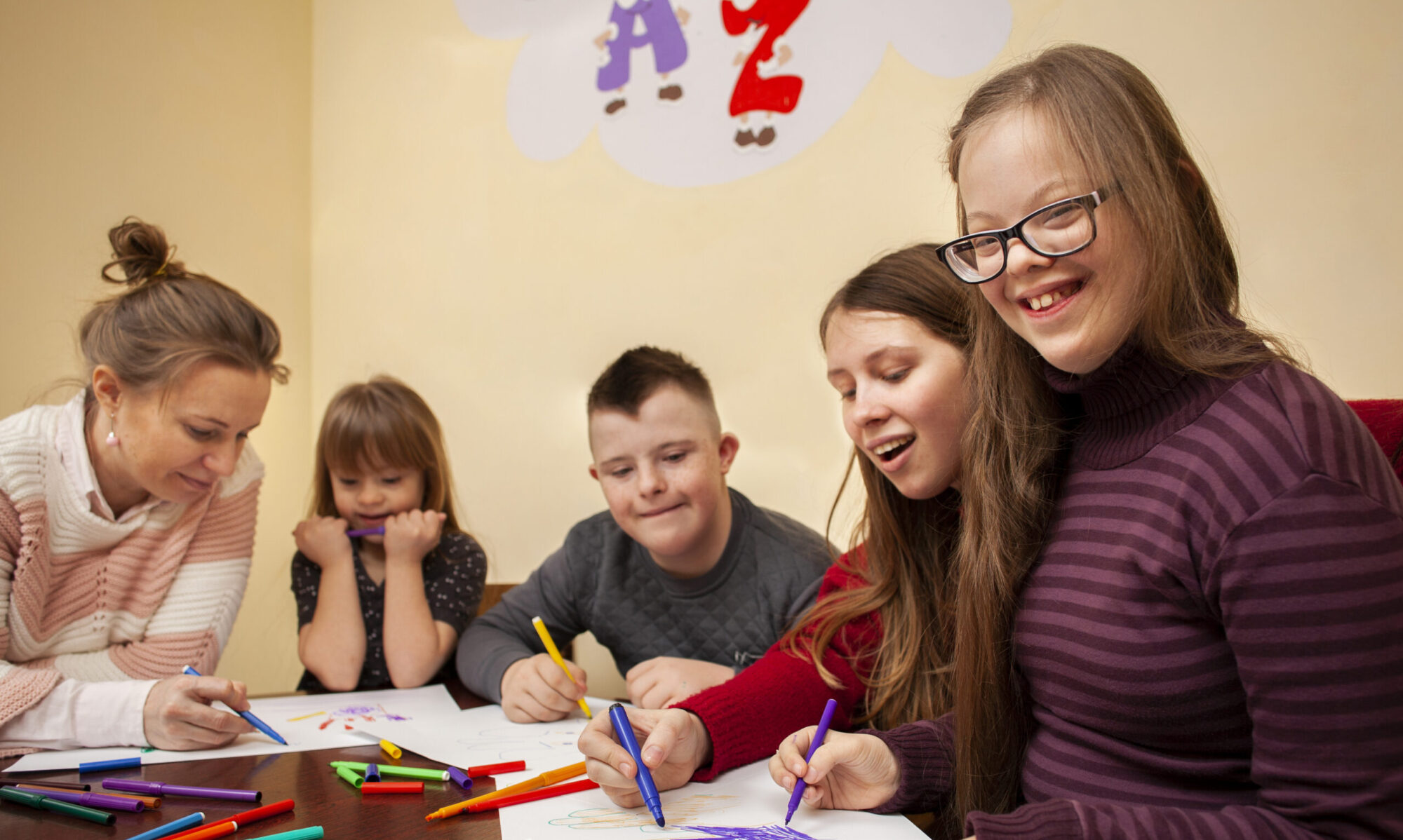
Stop Giving Only Kids with Disabilities Janitorial Jobs at School

Imagine your black child is asked to clean up trash throughout his school with all the other black students in an effort to learn life skills. White students are busy learning math, reading, writing, and socializing in the halls. They watch the black students clean up after them.

This smacks of demeaning and stigmatizing discrimination. It’s unbelievable in 2017! Except for the fact that if you replace black student with disabled student it’s a very real scenario in many schools throughout America today.

Troy loves a good dance party when we clean up at home

So, I’m about to go on a rant. Like a knock out, throw down tirade. Because this is something I feel VERY, VERY passionately about. My son with Down syndrome will NOT; I repeat, WILL NOT be cleaning his school while his typical twin brother is learning to read, write, and do math.

Having children with disabilities cleaning while their typical peers are learning is the anti-thesis of inclusion. It’s the very definition of discrimination.

This problem is very real at my 4-year-old son’s own school and too many of my friends’ children’s schools too. A dear friend of mine’s daughter with Down syndrome attends the same school as Troy. Her daughter and other students with disabilities learn to vacuum and wipe the cafeteria tables in kindergarten. KINDERGARTEN, people!!! The students that need more help and time in academics are being singled out to instead learn how to vacuum at age six.

I flinched when my friend told me this. Troy is only two years behind her daughter. Our experience in preschool at the school has been good, but I cannot envision Hunter watching his brother cleaning his table at school. Asking me after school: “Why isn’t Troy in class with me anymore? Why is he cleaning tables at lunch, instead of eating with me?” It literally rips my heart out to think about it. What will I do?

Read Related Post Here: Class of 2031, Yes My Son with Down Syndrome Can Go to College

Here’s the thing: I’m all for life skills. I think EVERY student can learn a thing or two about life by cleaning their school. I am in full support of bringing home-economics and shop class back. In Japan there are no janitors, because the students clean their school EVERY DAY. This is admirable! In fact, I would be proud if any one of my children chooses a profession in the janitorial, waste management, fast food industry, etc. My mother and step-father had jobs in both. NO job is beneath ANY of my children, disability or not. Getting a job and keeping it is what makes me proud.

The fact of the matter is my son and students like him are being singled out, and pigeon-holed into a stereotypical path for employment and life. Were they even asked what interests them; what they want to be when they grow up? Their typical peers are watching this cleaning scene unfold on a daily basis and here’s where their minds begin to be molded: disability is different, disability is separate, disability is dirty, disability is shameful.

Read Related Post Here: Why You Should Hire Someone with Down Syndrome

This mindset follows them throughout their educational career and into adulthood. Educators who support these programs argue they’re teaching these special students activities that “instill soft skills such as how to follow rules, adhere to a schedule, complete tasks and accept criticism.”

As students with disabilities enter high school it gets worse. Many are shuffled into a life skills path that supposedly prepares them for employment in the real world. Wanna know how that’s going? Only 24% of individuals with intellectual disabilities are competitively employed. News flash: the life skills path isn’t working!

Parents and Teachers Need to Demand Equitable Treatment of Students with Disabilities. 

Christopher on his way to school

One Oklahoma mom is doing just that after her son with Down syndrome reacted with anger at being given a job of cleaning up after teachers and students at his school. Jordan Shuffield says her son, Christopher, “isn’t as verbal as some of the kids in his class but he does have feelings about it.”

Christopher lashed out in frustration on at least one occasion: “He had cleaned a table and a group of teachers sat at the table he cleaned. In his frustration he threw his bucket on the ground, and then had to mop up his mess,” Shuffield describes.

Now Shuffield has a meeting scheduled with the school this Friday to advocate for change. “We feel that having his class do this work at school isn’t inclusive,” Shuffield explains. “My son has lost skills, such as money denomination and simple addition and subtraction skills that he used to know.” The family believes if more time was spent on academics than cleaning, Christopher would be making better progress.

Read a Related Post Here: Realizing the Promise of the Endrew Supreme Court Case

Federal law and a recent U.S. Supreme Court ruling demands that Christopher and other students with disabilities make “meaningful progress.” Shuffield has every right to demand a change in how her son is being educated. We’ll check back in on their story as it unfolds.

Has your child or loved one experienced this type of discrimination in school? Comment with your stories below. 


Realizing the Promise of the Endrew Supreme Court Case

It’s been six months since the U.S. Supreme Court ruled schools must be held to a “markedly more demanding” standard when educating students with disabilities. The case of Endrew F. (Drew) vs. Douglas County is the disability community’s Brown vs. Board of Education. It should have a far reaching impact on America’s 6.5 million students with disabilities.

With the school year just starting again, the question is: are parents using this case to advocate for higher expectations for their child with a disability?  

The Judge David L. Bazelon Center for Mental Health Law is requesting parents contact them if they have. The center is providing support to parents who want to understand the court precedent, and wants to collect data on how the ruling is being carried out throughout the country.

“The Endrew decision is a major advance. To realize its promise, parents, students, educators, and advocates must work together to ensure school districts comply with the new standard it sets,” says Ira Burnim of the Bazelon Center.

Watch this short clip for background on the Endrew case: 

In March, the U.S. Supreme Court sided unanimously with Endrew’s parents and the U.S. government at the time that argued the country should reject the “bigotry of low expectations” set by the last Supreme Court case on this topic, Rowley vs. Board of Education. That 1982 court case required schools to provide “some educational benefit” to students with disabilities, but did not establish a test to determine that benefit. The result was states and school districts with wildly varying degrees of “educational benefit.”

In his opinion, Chief Justice Roberts wrote, “a student offered an educational program providing ‘merely more than de minimis’ progress from year to year can hardly be said to have been offered an education at all.” The court creates a new standard that requires special education students to meet academic standards and advance grade to grade.

There is some concern regarding the court case and students who cannot meet general academic standards. 

Endrew requires schools to provide special education that enable even the most significant cognitive disabilities  to meet “challenging” and “appropriately ambitious” goals. For these students, progress may be measured against “alternate academic achievement standards” designed to promote further education, work, and independence.

Students with Down syndrome may fall into this category, and I worry that school districts will use this part of the court ruling to exclude these students. Parent advocate, Taina Karru-Olsen, says her daughter’s district staff already tried to use the case against her. “They were trying to use Endrew F. to justify extensive pullouts, more than 20% because of my daughter’s ‘need for intensive instruction,'” Olsen explains. Olsen believes all students could be fully included with the proper supports, and the Supreme Court should have stated this clearly in their ruling.

“I do think that is a danger. We tried to address it in our paper saying that it did not mean that students should be included only if they can meet grade level standards,” explains Burnim from the Bazelon Center. “Endrew was more about high expectations than about inclusion. But research and experience demonstrates that the two are very related.”

So how can parents of children with Down syndrome use Endrew to advocate for their child’s education? 

“I think one way to use Endrew is to make the case that inclusion is required to enable the child to meet challenging and ambitious goals” says Burmin. We must remember that special education is not a place, but a service.

Under the Individuals with Disabilities Education Act, students with the most significant cognitive disabilities are required to be instructed and assessed on the same challenging academic CONTENT standards as all other students. The difference is that these students performance on those content standards is measured using different ACHIEVEMENT standards (using an alternate assessment). The Supreme Court did not make this distinction clear, and parents would be advised to make this clear if challenged on this point. Look here for more on this.

Also, pick up one of these nifty “IEP is not a form” t-shirts and wear it to your child’s IEP meeting. The shirt takes a quote from Chief Justice Roberts, who explained that the IEP should be used like a living document.

If you’re interested in learning more about how you can advocate for your child’s education using Endrew or to share how you already have, email Bazelon Center representatives at lewisb@bazelon.org or irab@bazelon.org.

Comment below on how this case may change your child’s education expectations. I’d love to hear your stories of advocacy.


Self-Advocate Uses Fame To Spread Message of Inclusion

You’ve probably seen this incredible World Down Syndrome Day PSA. I’ve yet to watch it without smiling and crying simultaneously.

Gorgeous actress and model, Olivia Wilde, spending time with family, working, dating, living an ordinary life. But the voice is not Olivia Wilde’s. And the life it describes is anything but ordinary.

20-year-old AnnaRose is the voice behind the 2016 World Down Syndrome Day PSA “How Do You See Me?”

She says the video perfectly reflects her life of inclusion: “I want people with Down syndrome to be heard and to be treated with respect like everybody else. I think that speaking up is the right way to advocate for people who have Down Syndrome like me.”

The ad quickly became a sensation in and out of the Down syndrome community, but AnnaRose says a more recent accomplishment is what really makes her proud.

“I just graduated from Rowan College in New Jersey, and I’m so excited and proud of myself. I did a lot of exciting things to achieve my goal of graduating.” 

AnnaRose says the best part of college life was being included on campus. “I’m a DJ at the Pemberton Campus at RCBC and I have also worked at the bookstore at the RCBC Mount Laurel Campus,” she explains.

This incredible self-advocate didn’t stumble upon fame and inclusion at college by accident. AnnaRose says she and her family have worked hard from day one to make her a fully included member of her school and community. 

“I have always been in inclusive classes, ever since I started school.  My classmates have helped me with school projects, sharing notes, following along, and learning acceptable behavior.  I also have had to work sometimes to get my teachers on board with MY educational goals.  I had to show them that I want to learn. In 2014, I graduated from high school and got my diploma.  I was a member of the National Honor Society and an active member of many clubs in my high school,” AnnaRose describes.

She’s also been included in sports teams throughout her childhood, and in 2015 she was invited as a VIP guest of the ticker tape parade after the USA Women’s National Soccer Team won the Women’s FIFA World Cup.

AnnaRose takes her role as self-advocate seriously.

I had the privilege of meeting her this past April, as we both advocated for the rights of individuals with Down syndrome on Capitol Hill. There, she spoke with Congressmen about issues that impact her.

“For all my life, in my experience, inclusion works. Studies prove that inclusion works for everyone. But, there is still a lot of work to be done,” she argues.

AnnaRose says she is not the exception to the rule. “Inclusion is for everyone,” she argues.

For those who want to follow her path of inclusion, AnnaRose has this advice: 

“In high school, you have to take serious, inclusive classes. Academics comes first. You have to be prepared to work hard in college, and that starts in middle and high school, even elementary school…

You should also take classes that you are passionate about so that in college, you will know what you want to learn more about. I took TV Technology in high school, and then interned in that classroom in college for my major, Entertainment Technology: Video and Digital Media Production. You should also make friends who support your goals, and who you can support, too. I have friends on both sides: with and without Down syndrome. That is important.”

The recent college grad now plans to look for a summer job in filmmaking, radio, or television. She’ll further her education this fall. ” I’m going to Rider University to continue my degree in Filmmaking, TV and Radio,” AnnaRose explains.

And while her ultimate dream is to work on or behind the silver screen, that dream also includes something most of us take for granted.

“I dream of having a strong group of supportive friends, and of being treated with respect by everyone I meet and work with.” 

Congratulations to the amazing AnnaRose! Inclusion Evolution and the entire Down Syndrome community applauds you! You’re an inspiration and we can’t wait to follow your journey of inclusion!

Inclusion for Individuals with Down Syndrome is Just a Click Away

Down syndrome comes with a lot of assumed can’ts and won’ts. But the world often misses the incredible way individuals with Down syndrome adapt. With the right supports, most things are possible.

Us with my 85-year-old Grandmother

Today, more than any time in history, a life of independence and self-determination is just a click away.

My 85-year-old grandmother laughs that her 4-year-old twin great-grandsons, one with Down syndrome, knows more about modern life than she does. And in a way, she’s right! Troy gets very limited screen time, but has still managed to master his Great-Grandma’s iPad. Technology is intuitive to all young people today; children with Down syndrome are no different.

I can envision Troy living on his own one day, driving to work on time, shopping, exercising, and loving life all with the help of modern assistive technology.

The future is here, and it’s revolutionizing how people with disabilities live

Many of you may have paused when I said “driving to work,” and rightly so. In reality, the likelihood of someone with Down syndrome earning their driver’s license is extremely low. I’ve read a handful of success stories, but by the time Troy’s old enough to learn to drive that number could be higher because of driverless car technology.

This is no longer the stuff of sci-fi movies and dreamers. Tesla recently released their mid-level, $35,000 driverless car, and Nissan promises a car with “autonomous drive technology” by 2020. Google’s second generation car doesn’t even have a steering wheel or brake pedal. Google says in order for people with disabilities to benefit from this type of technology, the car needs to be completely autonomous. Regulators and society in general will have to consider the ethics of this new technology, but that debate is already beginning and there’s no stopping progress.

Inclusion Through Innovation

If driverless cars seems too far-fetched for you, there’s a multitude of assistive technologies that you probably use every day that can help foster inclusion for individuals with Down syndrome. Everyone’s got a smartphone, and that alone has endless possibilities for supporting independence and inclusion.

Got a problem or an accommodation, there’s an app for that:

Alarm Clock

Voice to Text, Text to Voice

Sign Language, iSigns

Navigation

GPS technology

screen magnifiers

Word prediction

Social networking

Tracking Behavior

Organize Personal Tasks, iPrompt

Steve (left) lives independently with his roommate (right)

Disability advocate and Mom-extraordinaire, Ricky Sabia, says her son, Steve’s smartphone was a life line in high school and is now crucial to his independence. “I don’t know if I would have survived him taking public transportation in high school if I couldn’t track him on “Find My iPhone.” Believe it or not, the biggest tool Steve uses now is the alarm. He sets it to remind him of when he needs to leave, when he starts a break, comes back from a break, leaves for the metro—the alarm is for so much more than getting up in the morning,” Sabia explains.

A college student with Down syndrome wants to attend a general class, but can’t take notes. No problem, Google Glasses can record the teacher’s lecture. Grade school students with disabilities could wear the glasses to the zoo and get real time facts about the animals they see.

An iWatch could track a self-advocate’s calorie intake and heart rate, all while listening to music and calling a friend.

I love how all these technologies blur the line between assistive and general consumer technology. This is Universal Design for Learning at its finest. Read my post about UDL here. UDL means providing flexible technologies so that everyone can learn. Typical people use the technologies above every day, and may not even consider how they could help someone with an intellectual disability be better included. The possibilities are endless!

What technologies does your loved one with Down syndrome use to lead a more inclusive, independent life? Share below.

How Having a Son with Down Syndrome Pushes Me to be “That Mom”

I’m becoming “that mom.” You know the one: 

The one who honestly thinks her child would be an asset, rather than a liability to your typical kid’s classroom.

Who thinks her son doesn’t have to “keep up” to be included.

The one who cares when you say “retarded,” even when you argue that you “didn’t mean Troy.”

Who writes all those annoying political posts about how Medicaid cuts would impact Troy, and take disability rights back a generation.
The one who thinks inclusion for her son is the civil rights debate of our time.

Who shouts that separate is NEVER equal to anyone that will listen.

How dare she! The audacity of it all! 

The evolution to becoming “that mom,” isn’t an easy one for me. I’ve had to adapt to my new environment. I used to be so easily swayed.

First, I was a journalist who always tried hard to be unbiased. Then, I was a teacher who ran my classroom like a well-oiled machine, not thinking much about the absence of any kids with disabilities in my school.

But what I now realize is if I don’t stand for Troy, who will?

Our culture has yet to embrace full inclusion of my son. Sure, there’s been good progress, but you know how I can tell we’re not there yet? I can tell when I take my twin son’s to school, and one can enter a regular kindergarten class no questions asked; while the other must fight to earn a spot in the same class.

Federal law protects my son from this culture of exclusion. IDEA says he deserves an individualized, free, and appropriate education in the least restrictive environment. Still, these laws are not enforced the same across our nation.

Federal courts have ruled “Inclusion is a right, not a special privilege for a select few” in Oberti v. Board of Education.

Still, my friends tell me how their kid is doing laundry and vacuuming in primary school, instead of learning to read next to their typical peers.

At the Buddy Walk on Washington with self-advocate, Kyle McKay

So, instead of just hoping my son learns next to his brother, I’m applying to the Special Education Advocate Training through the Council of Parent Attorneys and Advocates. I will be an expert in the laws that protect my son in school.

Not only do I post on Facebook about legislation that impacts my son, I attend the Buddy Walk on Washington to actually meet with my legislator and tell them my son’s story.

Instead of waiting until Troy turns 21-years-old to think about what job he might get, I’ve started a local communications workshop for adult self-advocates to learn about their successes and challenges in employment.

Obviously, you don’t have to go this far to be “that mom.” I’ve seen moms feared, misunderstood, and even pitied for a lot less.

I surprise even myself by my moxie.

But I’ve also gained a new clarity of my life’s ambition. Because if I don’t stand as an advocate for my son now, how will he ever know how to advocate for himself in the future.

If I don’t stand for something, I’ll fall for anything.