Self-Advocates Learn Body Language Speaks Louder than Words

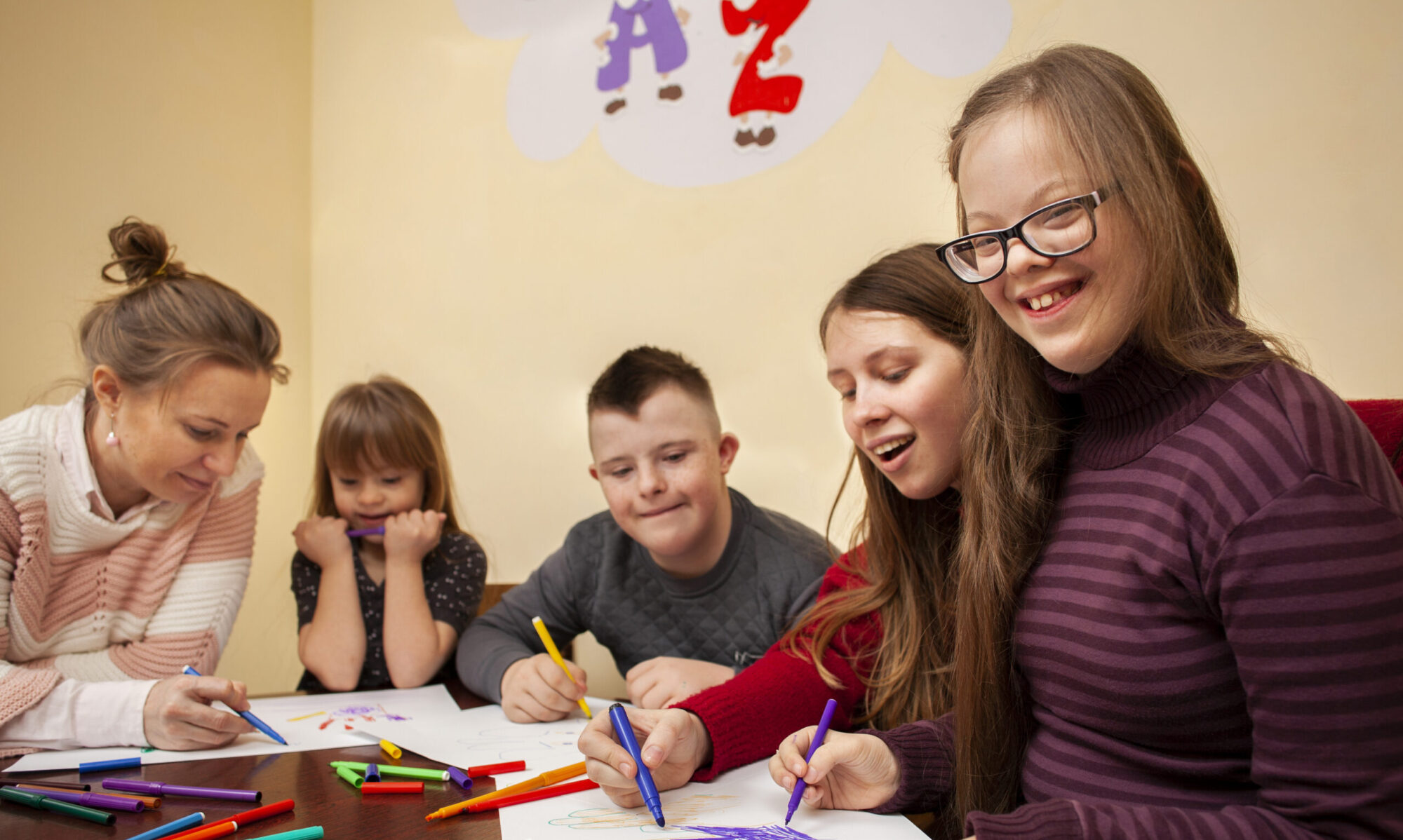
The adult self-advocates in our monthly communications workshop are learning how body language shapes people’s perceptions. 

Every month a group of up to 9 self-advocates get together to hone their communication skills. Our short-term goal is to prepare these adults with Down syndrome to lead our advocacy table at the Buddy Walk in September. In the long-term, our hope is these new communication skills will lead to more involvement in the community and employment opportunities.

Self-advocate, Anna, watching herself talk in the mirror

This month’s topic is non-verbal communication, which experts say makes up for 70% of any given conversation. All of us used body language long before we learned to talk. For individuals with Down syndrome, non-verbal communication may be their primary mode of communicating their needs and wants.

What is your body telling your audience?

That’s the question we posed to our self-advocates. Although they all used many non-verbal cues in conversation, almost all were unaware of the impact of those cues. A long look in the mirror brought some of our negative body language to light.

Lack of eye contact and looking “closed off” were two of the most common mistakes we learned by taking a look in the mirror.

Anna is a particularly confident communicator. She always made great eye contact and uses hand gestures to explain her point. But after seeing herself in the mirror she remarked “I need to remember to keep smiling.”

Theater Educator, Stephanie Radford (emphasize on the “RAD”), gave our self-advocates pointers on “matching”. This technique requires the listener to copy the expression and emotion of the talker. “It’s important to show you are listening and empathize with the talker, without saying a word,” Radford explains.

Theater Educator, Stephanie Radford

Radford stresses the action of body language is more memorable than what you say.

This is especially important for our self-advocates who are often unsure of what to say or concerned that they might not be intelligible or understood. At the Buddy Walk we stressed that their body language should exude an air of confidence and openness.

They’ll be introducing Congressmen and our mayor at the Buddy Walk, as well as teaching attendees about Down syndrome and programs our local group provides self-advocates. It’s important that they use their expression, eye contact, and gestures to show they’re the experts on all things Buddy Walk related.

In three short sessions I have have seen improvement in our self-advocates communications skills. I can’t wait to see them in action during our 15th Annual Buddy Walk!

To learn more about our self-advocate communication workshop click here.


Continue reading “Self-Advocates Learn Body Language Speaks Louder than Words”

We Meet with Senator Portman’s Office In Last Effort to Save Medicaid

Disability advocates share our Medicaid story with Senator Portman’s staff member, Robert Braggs (far left)

My son, Troy, and I met with Ohio Senator Rob Portman’s office to share our Medicaid story. We joined five other parents and their children who have a disability. 

Senator Rob Portman (R)

We met with a staff member, because Senator Portman (R) had just flown out of Cincinnati the day before to attend a Republican caucus luncheon to talk about the American Health Care Act. The bill will repeal Obamacare and cut more than $800 billion from Medicaid.

The Senate version of the bill has been shrouded in secrecy. My disability advocate friends who work on Capitol Hill told me that the public will likely not see the contents of the bill until right before it’s brought up for a vote, before July 4th.

It passed in the House along party lines, although my Representative Mike Turner (R-Dayton) voted against the House version. Congress wants to pass the healthcare repeal bill fast for two reasons: Republicans campaigned on repealing Obamacare and many want to move on to President Trump’s tax reform bill.

Unfortunately, this hastily drafted bill will be devastating for the disability community.

Troy and I on our way to Senator Rob Portman’s office

The $800 billion in Medicaid cuts goes further than rolling back Obamacare Medicaid expansion. The “per capita based caps” would completely restructure how Medicaid is funded, leaving cash-strapped states to pick up the tab.

Troy and other individuals with Down syndrome rely heavily on community and home based services under Medicaid for early intervention, school related therapies, transportation to work, job training, and independent living supports to name a few. Per capita based caps would force states to end these optional community and home based services, because they would have to use what money’s left for acute health care.

Our meeting with Senator Portman’s office is an important one, because the Republican from Ohio is on the committee drafting the Senate version of the AHCA bill. He’s also considered a potential flip vote.

In a statement regarding the bill Portman said “I’ve already made clear that I don’t support the House bill as currently constructed because I continue to have concerns that this bill does not do enough to protect Ohio’s Medicaid expansion population.” 

But he also submitted a proposal supporting cuts to Medicaid expansion that are slowly phase out over seven years, instead of three years under the AHCA House version of the bill.

Troy the Tiny Self-Advocate

Ohio’s Governor, John Kasich (R), is also concerned about the AHCA bill and it’s impact on Medicaid. Here’s part of a letter to Congress that he penned along with 5 other Governors: “Unfortunately, H.R. 1628 calls into question coverage for the vulnerable and fails to provide the necessary resources to ensure that no one is left out, while shifting significant costs to the states.”

Troy deserves a self-determined life of choice, but he’ll need support to get there. Troy doesn’t need a hand out, but a hand up.

Senator Portman’s staff member, Robert Braggs, was very kind to listen to our stories. He told us he would pass along our concerns to the Senator, but there was no clear indication as to how he might vote. Braggs did not indulge any of the Senator’s thoughts on the bill. To those in the room and across America, the bill is still an unknown.

It’s so frustrating to have your child’s future in the hands of those who don’t understand the struggles special needs parents face. We rely on a village of support, and we don’t take for granted the power government has over our children’s fate.

Ronald Reagan began the Medicaid waiver system for children with disabilities when I was born a generation ago. In that time life expectancy has more than doubled for individuals with Down syndrome, from 25-years-old to 60. That’s not coincidental. Government can and has improved the lives of our nation’s more vulnerable. We can’t go back! 


Grassroots Advocacy Empowers Parents to Fight for Inclusion

One group of parents in California’s Bay area say inclusion won’t happen unless they ban together. About four years ago they started an informal advocacy group to empower parents to fight for inclusion.

Ellen with her husband and son, Jeremy

Ellen Hovey is one of the founders of the Educational Advocacy Group. Her 17-year-old son, Jeremy, has Down syndrome and is in a transitional program now.

“I had to fight for inclusion and I want other parents to understand the positive impact it has had on my son. I started this group because too many parents don’t understand their child’s rights.”

The group is truly a grassroots effort. They get word out through a private Yahoo group, social media, and their local Down syndrome association. The last Friday of every month, parents meet at Hovey’s house to discuss IDEA, IEPs, FAPE, LRE, due process. Basically, how to ensure their child receives an individualized education in the least restrictive environment.

“We don’t aggressively push inclusion on new parents, because it’s a lot of work and everyone has to decide what’s right for their child. We do council parents that schools are a business. Their job is to get as many kids that need an IEP into places as cheaply as possible; with as little effort as they have to expend. You have to understand that going in.”

May’s Educational Advocacy Meeting

The educational advocacy group has anywhere from 5 or more parents a session. Hovey says they’ve gone so far as to help parents through due process, by helping with lawyer and advocate recommendations. And it seems to be working:

“The school officials started noticing a common effort for inclusion. We go into educational conference and teachers say ‘you’re one of those Down syndrome families and you’re all trying to get included,” Hovey describes. 

Hovey’s best advice is to not look for the “perfect school,” but instead learn your child’s rights and change the school you’re in.

“I shy away from recommending a particular district. For example, my school district was open to inclusion, but then we got a new superintendent and special education director and things took a turn for the worse. You have to learn how to advocate, and change the district you’re already in,” Hovey argues.

Jeremy with his inclusive theater group

Hovey reminds parents that attend that she and other leaders of the group are not certified advocates. “We’re just parents that want to help out those that come after us. We’ve been through the system, and feel like we have something to share.”

Hovey is now focusing on transitional services and employment for her son, Jeremy. She says she wishes there was a parent group for this stage of life too. “It’s always important to stick together and fight for what’s right. Our children deserve it!” 


“Faith” in Inclusion Leads Student with Down Syndrome to Make History

A standard high school diploma can seem out of reach for students with Down syndrome. But with inclusion and a lot of hard work, 19-year-old Faith did just that! 

Faith (bottom left) performing with her typical peers

Faith became the first person with Down syndrome to graduate with a regular high school diploma in Martin County, Florida School District. Also unprecedented, she was included in general education throughout her educational career. 

“I’m really happy to graduate with a standard diploma. I learned chorus, I learned drama. I like drama, I like to act. I was in Romeo and Juliet, Wizard of OZ, Beauty and the Beast. I was in Jubilate chorus too. I like all my friends,” Faith says.

Faith was on track to earn a special certificate of completion until 2014, when Florida special education law changed to allow students with disabilities to try for a standard diploma. Students with disabilities can use alternate assessments and something called “access points,” which allows them to access the general curriculum in a modified way with supports. They still must pass alternative assessments and earn enough credits to receive a standard diploma.

The school district told her mom, Paulette, that on top of being the first student with a significant disability to receive a standard diploma, Faith was the first to use the “access points” in a general education setting. “That has always seemed odd to me, that a special curriculum offering access to the general education curriculum would cause the student to be excluded from the gen ed class,” Paulette describes. 

Paulette said inclusion wasn’t easy. She received a lot of push back when Faith entered kindergarten and again as she entered middle and high school. But she always set high expectations and was able to find at least one educator who supported their efforts or had an open-mind.

“At Faith’s first IEP meeting, her preschool teacher remarked that Faith had done well in the preschool, developed friendships, learned the alphabet and how to write her name. Then this wise and wonderful woman said: ‘I am not trained in special education, no one is in our private school. Faith has been successful. Certainly with all the resources of the public school system she can continue to be included with typical children,'” Paulette describes.

Faith (bottom, third from the left) performing with the Senior Jubilates

“At the beginning of 8th grade our supportive inclusion specialist called the high school to tell them to get ready, they would be including their first student with Ds. The ESE director at the high school laughed and told her they didn’t do that. The first year of high school was rocky, but then the woman retired and the new director was fully on board with making history!” Paulette remembers.

Faith’s inclusive experience allows her to be comfortable in many situations. She’s danced and acted alongside her typical peers. With appropriate supports and modifications she dissected a frog in a general education Biology class, which she described as a “yucky experience.”

“I have friends in drama club and Jubilate. I have friends from economics, history, math. I learned all things and got A’s. My mom helped me to learn in other classes,” Faith describes.

“Faith has made a difference in the lives of many typical students over the years. She has changed the attitude of people she has shared the classroom with. They know that although it is challenging, people with Ds can learn and be a valued member of a group,” Paulette says.

Faith is set to begin vocational training at a local hospital with Project Search. Her goal is to be a musical theater actress, but says she wouldn’t mind working in a movie theater for now to earn money. 

Faith’s mom hopes that their story will lead other parents to fight for inclusion. “I really want parents of younger kids to follow the path we have blazed. Faith is a pioneer and I have led the wagon train. I am willing to help parents who want help with IEP meetings or just for a listening ear. I don’t want our experiences to be an anomaly. I want us to be an example of success,” Paulette explains.

As for Faith, she has her own advice for students with Down syndrome that want to follow in her footsteps: “My advice to other kids with Ds is get a standard diploma. Take drama, chorus, English, economics, history. My teachers are impressed with me and my activities. I learned about Beowulf, Hamlet, Romeo and Juliet and I did projects. Read a lot of books. That’s it.”

Faith and her family at graduation. Faith’s mom, Paulette, to the right of Faith.


Small Talk Leads to Big Rewards

Our group of adult self-advocates are learning that small talk is where real opportunities begin.

These adult self-advocates meet once a month to hone their communication skills. It was an idea I got from a program out of Maryland. Our mantra is “I can,” and you can read about our first session here.

Our end goal is for these nine self-advocates to act as our 15th Annual Buddy Walk Ambassadors. They’ll educate attendees about Down syndrome and the programs our local Down syndrome group provides. They will also escort VIP guests like Ohio Representative Niraj Antani. Since we know where we’re going and what we’re doing (advocating at the Buddy Walk), now we’re learning how small talk will get us there.

Small talk is like a free, unknown gift. There’s no initial cost or risk, but the outcomes are endless.

Joe making small talk with Megan

Small talk can lead to just a pleasant exchange with a stranger or an amazing job offer. You’ll never know what you’ll get unless you try.

But conversational skills require you to think on your toes. This can be hard for anyone, and it was an obvious challenge for some of our self-advocates.

35-year-old Joe had a 14-year start on the rest of us!

He’s a loyal employee of Kroger grocery store for the last 14 years, and is now a natural at making small talk. I watch him do this every time I visit Kroger, and he is a great coach for our other self-advocates.

Our amazing Theater Educator, Stephanie Radford (heavy on the “RAD”), added another tool to our communication toolbox with a conversational acronym: FORD.

“If you get to the Buddy Walk and can’t think of anything to say to Congressman Antani, remember FORD,” Stephanie urges.

Small talk usually revolves around FORD, which stands for (Family, Occupation, Recreation, and Dreams). These are always safe topics to bring up to a complete stranger.

By the end of our session we created a web of small talk with questions like:

“What do you like to do with your family?”

“Do you work?”

“What’s your favorite hobby?”

“If you won the lottery what would you do with the money?”


It seems so simple, and studies show that small talk actually makes us smarter. It forces you to take someone else’s perspective and boosts our ability to problem solve.

Another great point Stephanie makes, is people love to talk about themselves.

How better to engage Buddy Walk attendees and get them to listen to our advocacy message than to ask them about themselves first.

I love how each of these self-advocates are so open to learning new techniques that will help them become better communicators. It takes a lot of courage to step out of your comfort zone. That’s why we love the informal workshop approach, because they have a safe space to practice skills like small talk.

15th Annual Buddy Walk: HERE WE COME!