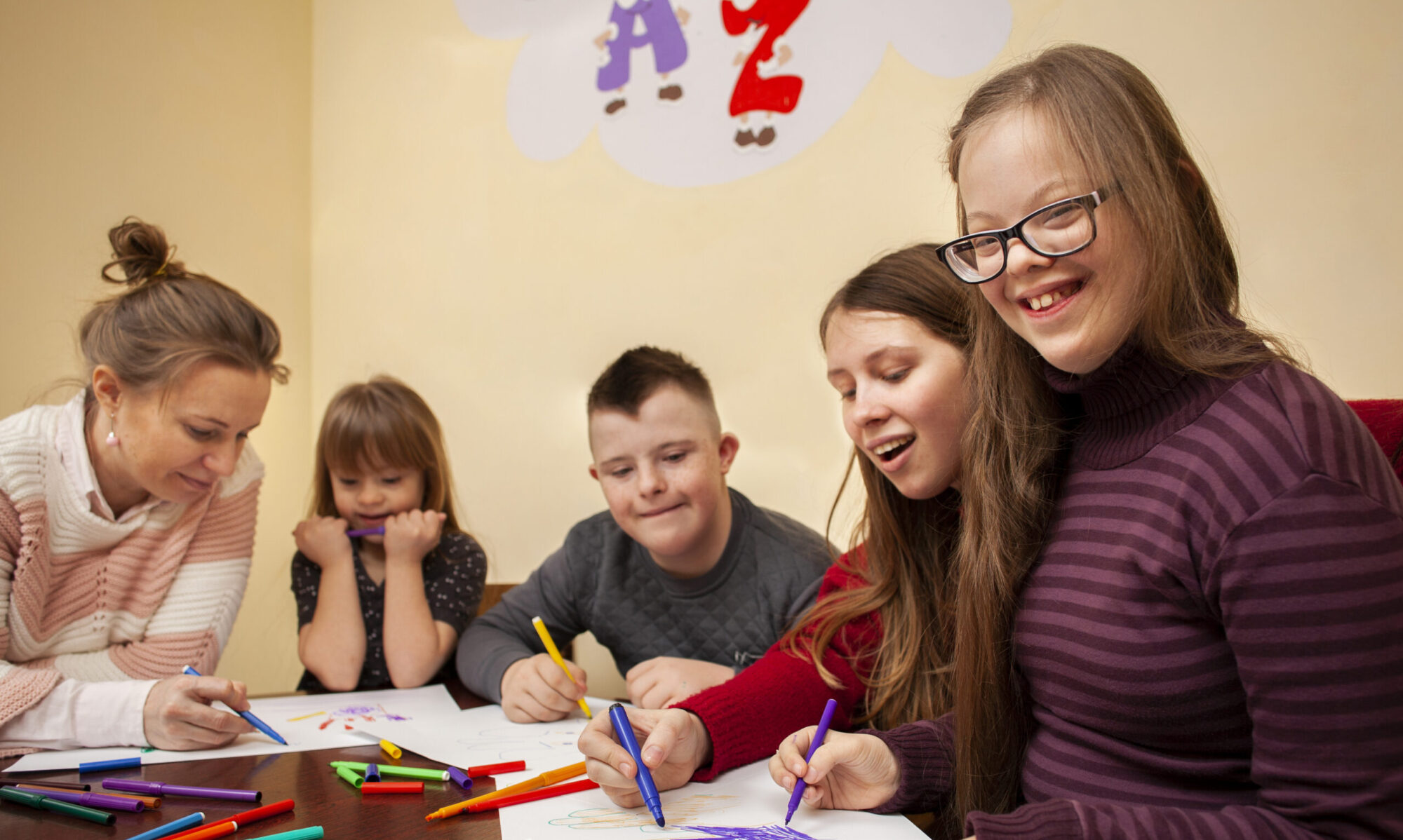
Self-Advocate Uses Fame To Spread Message of Inclusion

You’ve probably seen this incredible World Down Syndrome Day PSA. I’ve yet to watch it without smiling and crying simultaneously.

Gorgeous actress and model, Olivia Wilde, spending time with family, working, dating, living an ordinary life. But the voice is not Olivia Wilde’s. And the life it describes is anything but ordinary.

20-year-old AnnaRose is the voice behind the 2016 World Down Syndrome Day PSA “How Do You See Me?”

She says the video perfectly reflects her life of inclusion: “I want people with Down syndrome to be heard and to be treated with respect like everybody else. I think that speaking up is the right way to advocate for people who have Down Syndrome like me.”

The ad quickly became a sensation in and out of the Down syndrome community, but AnnaRose says a more recent accomplishment is what really makes her proud.

“I just graduated from Rowan College in New Jersey, and I’m so excited and proud of myself. I did a lot of exciting things to achieve my goal of graduating.” 

AnnaRose says the best part of college life was being included on campus. “I’m a DJ at the Pemberton Campus at RCBC and I have also worked at the bookstore at the RCBC Mount Laurel Campus,” she explains.

This incredible self-advocate didn’t stumble upon fame and inclusion at college by accident. AnnaRose says she and her family have worked hard from day one to make her a fully included member of her school and community. 

“I have always been in inclusive classes, ever since I started school.  My classmates have helped me with school projects, sharing notes, following along, and learning acceptable behavior.  I also have had to work sometimes to get my teachers on board with MY educational goals.  I had to show them that I want to learn. In 2014, I graduated from high school and got my diploma.  I was a member of the National Honor Society and an active member of many clubs in my high school,” AnnaRose describes.

She’s also been included in sports teams throughout her childhood, and in 2015 she was invited as a VIP guest of the ticker tape parade after the USA Women’s National Soccer Team won the Women’s FIFA World Cup.

AnnaRose takes her role as self-advocate seriously.

I had the privilege of meeting her this past April, as we both advocated for the rights of individuals with Down syndrome on Capitol Hill. There, she spoke with Congressmen about issues that impact her.

“For all my life, in my experience, inclusion works. Studies prove that inclusion works for everyone. But, there is still a lot of work to be done,” she argues.

AnnaRose says she is not the exception to the rule. “Inclusion is for everyone,” she argues.

For those who want to follow her path of inclusion, AnnaRose has this advice: 

“In high school, you have to take serious, inclusive classes. Academics comes first. You have to be prepared to work hard in college, and that starts in middle and high school, even elementary school…

You should also take classes that you are passionate about so that in college, you will know what you want to learn more about. I took TV Technology in high school, and then interned in that classroom in college for my major, Entertainment Technology: Video and Digital Media Production. You should also make friends who support your goals, and who you can support, too. I have friends on both sides: with and without Down syndrome. That is important.”

The recent college grad now plans to look for a summer job in filmmaking, radio, or television. She’ll further her education this fall. ” I’m going to Rider University to continue my degree in Filmmaking, TV and Radio,” AnnaRose explains.

And while her ultimate dream is to work on or behind the silver screen, that dream also includes something most of us take for granted.

“I dream of having a strong group of supportive friends, and of being treated with respect by everyone I meet and work with.” 

Congratulations to the amazing AnnaRose! Inclusion Evolution and the entire Down Syndrome community applauds you! You’re an inspiration and we can’t wait to follow your journey of inclusion!

How Having a Son with Down Syndrome Pushes Me to be “That Mom”

I’m becoming “that mom.” You know the one: 

The one who honestly thinks her child would be an asset, rather than a liability to your typical kid’s classroom.

Who thinks her son doesn’t have to “keep up” to be included.

The one who cares when you say “retarded,” even when you argue that you “didn’t mean Troy.”

Who writes all those annoying political posts about how Medicaid cuts would impact Troy, and take disability rights back a generation.
The one who thinks inclusion for her son is the civil rights debate of our time.

Who shouts that separate is NEVER equal to anyone that will listen.

How dare she! The audacity of it all! 

The evolution to becoming “that mom,” isn’t an easy one for me. I’ve had to adapt to my new environment. I used to be so easily swayed.

First, I was a journalist who always tried hard to be unbiased. Then, I was a teacher who ran my classroom like a well-oiled machine, not thinking much about the absence of any kids with disabilities in my school.

But what I now realize is if I don’t stand for Troy, who will?

Our culture has yet to embrace full inclusion of my son. Sure, there’s been good progress, but you know how I can tell we’re not there yet? I can tell when I take my twin son’s to school, and one can enter a regular kindergarten class no questions asked; while the other must fight to earn a spot in the same class.

Federal law protects my son from this culture of exclusion. IDEA says he deserves an individualized, free, and appropriate education in the least restrictive environment. Still, these laws are not enforced the same across our nation.

Federal courts have ruled “Inclusion is a right, not a special privilege for a select few” in Oberti v. Board of Education.

Still, my friends tell me how their kid is doing laundry and vacuuming in primary school, instead of learning to read next to their typical peers.

At the Buddy Walk on Washington with self-advocate, Kyle McKay

So, instead of just hoping my son learns next to his brother, I’m applying to the Special Education Advocate Training through the Council of Parent Attorneys and Advocates. I will be an expert in the laws that protect my son in school.

Not only do I post on Facebook about legislation that impacts my son, I attend the Buddy Walk on Washington to actually meet with my legislator and tell them my son’s story.

Instead of waiting until Troy turns 21-years-old to think about what job he might get, I’ve started a local communications workshop for adult self-advocates to learn about their successes and challenges in employment.

Obviously, you don’t have to go this far to be “that mom.” I’ve seen moms feared, misunderstood, and even pitied for a lot less.

I surprise even myself by my moxie.

But I’ve also gained a new clarity of my life’s ambition. Because if I don’t stand as an advocate for my son now, how will he ever know how to advocate for himself in the future.

If I don’t stand for something, I’ll fall for anything.

Why Your Child’s Teacher Should Be Trained in Non-Violent Crisis Intervention

So, wow! My recent post about an 7-year-old old boy being dragged by his teacher really hit a nerve. Many of you were shocked to see the video, and thankful for tips on how to help prevent this type of abuse.

Others responded that a No-Consent Letter alone is ineffective if school personnel are not trained properly in handling crisis situations. I wholeheartedly agree! We may disagree as to whether restraint and seclusion techniques work, but I think everyone can agree that crisis prevention training can help decrease these type of incidences.

As a teacher, I was never offered any crisis intervention training. And after digging around, I found that I am not alone.

Just as there are no federal laws restricting the use of restraints and seclusion, there is also no mandate for crisis prevention training across the country. School districts lack the money it takes to properly train their personnel in non-violent crisis interventions. This will only get worse if Title II, A is cut. Title II, A is federal funding for professional development, but the Trump administration wants to scrap it completely.

Another problem is the least qualified staff are often paired with students who have disabilities and the most challenging behaviors. And now Every Student Succeeds Act no longer requires teacher to be “highly qualified,” which will likely make matters worse. The result is hundreds of cases of abuse or even death related to using restraint and seclusion techniques, according to federal figures.

Advocating for Better Crisis Prevention Training

What can you do as a parent or teacher to prevent an incident like the one in above?

First, advocate for a Non-Violent Crisis Prevention Intervention program in your school district: Find out what, if any, behavior intervention training your school staff receives. At the very least, your child’s school should have access to a behavior specialist who’s trained in non-violent crisis prevention intervention. Your child should have a Functional Behavior Assessment as soon as a problem arises. Don’t let the situation get to crisis mode.

The Crisis Prevention Institute is an international organization that has provided training to teachers for more than 35 years. Their Non-Violent Crisis Prevention Intervention includes one-day seminars that help teachers identify how behavior escalates and how to respond in appropriately during times of chaos.

The lead instructor, Maria Navone, is part of a fabulous podcast about advocating and carrying out non-violent crisis prevention intervention. She stresses that all behavior is communication. “Being able to step aside and not take this acting-out personally helps you think more clearly about what your intervention is going to be,” Navone explains.

The institute also has a 4-day Instructor Certification program. They offer on-site and online training, but it all comes with a hefty price tag. That’s why it’s important to also advocate for funding for teacher training.

Call, email, and tweet your Congressmen: Tell them not to cut Title II, A. It seems “professional development” has become a dirty word. School districts have a hard time proving the effectiveness of teacher training, and politicians can’t stomach the cost. But it’s important that Congressmen know that Title II, A could be used for non-violent crisis prevention training for teachers. If we have one less abused student, then the tax money spent is worth it.

Contact your Congressperson here. 

Here’s the sample tweet I sent my Congressmen: @RepMikeTurner #TitleIIA is critical for school leaders and principals to do their jobs effectively; cuts threaten this ability. Get a sample email or call script here.

Also, advocate at the local level: You may have heard the saying “all politics is local,” and when it comes to education this is very true. Most school funding comes from local property tax. Only 5-10% of school funding comes from the federal government. That’s why it’s important to get involved with your child’s school board and advocate for better training in crisis prevention methods.


Communication is Key to Self-Advocates’ Pursuit of Goals

This summer I started a “Self-Advocate Communications Workshop” in my local area, and I’ve been blown away by the progress of the teens and adults with Down syndrome.

Honestly, I didn’t have many expectations for the workshop. I just wanted our local self-advocates to better represent themselves and the organization that supports them (MVDSA).

But watching our group of self-advocates rehearse for their role at our 15th Annual Buddy Walk literally brought happy tears to my eyes. I know it sounds cheesy, but they are really starting to act like self-advocates by communicating their wants and needs to people outside their family. 

Our mantra for the workshop is “I Can!”

Many of our self-advocates started the workshop apprehensive to speak in front of strangers, to look someone in the eye, and tell others who they are and what they stand for. The “I Can!” mantra helped them put into words their goals for the Buddy Walk and life in general.

In our last workshop before the Buddy Walk our Theater Educator, Stephanie Radford (heavy on the “RAD”), brought in strangers to test the self-advocates’ new communications skills.

They’ve been working on:

  • conversational skills
  • non-verbal communication skills like eye contact and body language
  • improv skills
  • speech skills

The self-advocates have warmed up to us over the last three months, but we wondered how they would perform in front of complete strangers. We set up a practice advocacy table with games and brochures, like they’ll have at the real Buddy Walk.

Practice with strangers to prep for the Buddy Walk

The first interaction was a bit forced, but as the strangers started asking the self-advocates questions about their life everyone started smiling and having a good time. The self-advocates used what they’ve learned about eye contact and reciprocal conversations to engage these strangers they’ve never met. I was impressed! They know that people may have a harder time understanding them, but still they advocated for themselves and got the job done.

I can’t wait to see how they do September 16th at our Buddy Walk!

They’ll be the ambassadors of the Miami Valley Down Syndrome Association; running our advocacy table and introducing national, state, and local politicians to Buddy Walk attendees.

Self-Advocates with our volunteer actors

Brother Urges Parents to Prepare Typical Siblings For the Future

“My sister helped shape the trajectory of my life!”

Phillip Clark adores his sister, Sarah.

“I was 4-years-old when she was born, and I knew she was different then. From a young age, I knew I would always protect her.”

Clark kept his promise. He even created a career path centered around Sarah and other individuals with disabilities.

Clark owns ENABLE Special Needs Planning, LLC, and works with families daily to get their financial, life, resource, and legal plans in order for their child with a disability.

Phillip with his parents, wife, and sister’s Sarah and Grace

“We often talked about future planning in our family. When I was going away to college, my parents sat me down and explained how they prepared for Sarah’s future. They said she would live with one of my cousins if my parents both passed on. I told them ‘absolutely not! Sarah and Grace (the youngest, typical sister) would live with me’.”

When Sarah was born 28-years-ago, doctors told her parents she would
never learn to read, among many other limitations. However, today, Sarah works as a second grade teacher’s aide, tutoring students in reading.


Clark credits Sarah’s success to his parent’s diligent planning early on. “They always focused on her abilities, and they always included my typical sister, Grace, and I in the decision-making process.”

Phillip Clark with his sisters, Sarah and Grace

In his professional experience, Clark has found that parents who didn’t plan are struggling as their child ages.

“Some of these parents are in their 60s, and their adult child is in their 40s. Many didn’t plan, and now there’s not much help for them. Most end up in government run day programs, because the parents can no longer care for them at home.”

His advice, start early and think abundantly about your child’s future. Include your typical children as early as possible in the future decision-making plans.

Clark is optimistic about the opportunities that individuals with special needs and their families currently have. He believes these opportunities will continue to grow as awareness continues to get stronger.

“The generation before Sarah was often institutionalized because people didn’t realize the profound impact that individuals with special needs could have on their families, communities, and businesses. Sarah’s generation was the first to widely stay at home with their parents; but the awareness and opportunities weren’t yet there for them to be fully included in all aspects of life. The next generation will have countless opportunities for inclusion, and parents need to be prepared for this new reality.”

Clarks says it’s not enough to plan financially. 

His personal journey allows him to understand the difference in planning  special needs families face, compared to typical families. He explains that every aspect of your family’s life and child’s life must be carefully considered.

It is important to plan financially, but equally important to create a Life Plan and a Resource Plan. He says you must make a Life Plan for your child that gives him or her every opportunity to live a purposeful, impactful life.

As for Sarah, Clark says she is busy leading a fulfilling and purpose-filled life, but he’s prepared to help her when she needs him.

Clark is a Special Needs Planning consultant licensed to serve families in every state. He provides Life, Resource, and Financial consulting services and referrals for Legal Planning. He also created a database of resources for special needs planning. See what services Clark can provide your family here.

Inclusion Evolution and it’s author did not received any services from Clark or Enable Special Needs Planning.